VMware 2V0-72-22 Exam Questions
Questions for the 2V0-72-22 were updated on : Mar 21 ,2026
Page 1 out of 6. Viewing questions 1-15 out of 79
Question 1
Refer to the exhibit.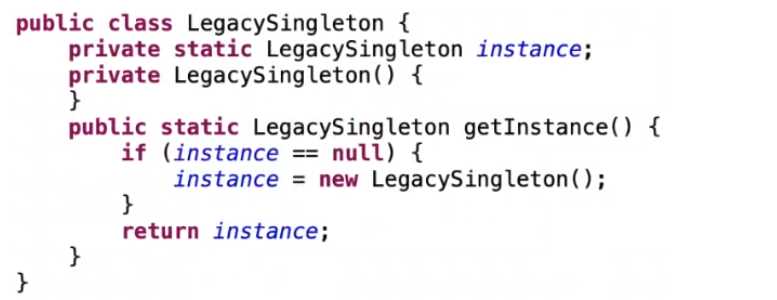
How can a Spring Bean be created from this LegacySingleton class?
- A. Call LegacySingleton.getInstance() from within a @Bean method and return the instance.
- B. Return an instance of LegacySingleton using the new keyword from a @Bean method.
- C. It is not possible without modifying the LegacySingleton class, the constructor must be public.
- D. Modify the LegacySingleton class by adding the @Autowired annotation to the instance variable.
Answer:
A
Question 2
Which two statements are true regarding @WebMvcTest? (Choose two.)
- A. It auto-configures a MockMvc.
- B. It will only scan for @Controller beans in the source code.
- C. It is used for testing Spring MVC components such as @Controller with a running server.
- D. Typically it is used in combination with @MockBean when there is a dependency bean to be mocked.
- E. It is typically used with @ExtendWith(MockitoExtension.class) in JUnit 5.
Answer:
AD
Question 3
Which two annotations are meta-annotations on the @SpringBootApplication composed
annotation? (Choose two.)
- A. @Configuration
- B. @ComponentScan
- C. @SpringBootConfiguration
- D. @SpringApplication
- E. @AutoConfiguration
Answer:
AB
Explanation:
A . @Configuration This annotation indicates that the class has @Bean definition methods and may
be processed by the Spring container to generate bean definitions and service requests for those
beans at runtime. B. @ComponentScan This annotation configures component scanning directives
for use with @Configuration classes. Provides support parallel with Spring XML's
context:component-scan element.
Question 4
Which two mechanisms of autowiring a dependency when multiple beans match the dependency's
type are correct? (Choose two.)
- A. Use of @Qualifier annotation on the class and @Autowired annotation either on a field or setter methods.
- B. Use of @Qualifier and @Autowired annotations together with setter methods.
- C. Use of @Qualifier annotation only with setter methods (@Autowired is optional for setters).
- D. Use of @Qualifier and @Autowired annotations together on a field.
- E. Use of @Qualifier annotation only on a field (@Autowired is optional for fields).
Answer:
AD
Question 5
Which is the correct approach to register for a bean destruction callback?
- A. Annotate the callback method with @PostDestroy.
- B. Annotate the callback method with @PreDestroy.
- C. Add the @Lazy annotation to the bean configuration.
- D. Configure the bean instance to use prototype scope.
Answer:
B
Question 6
Refer to the exhibit.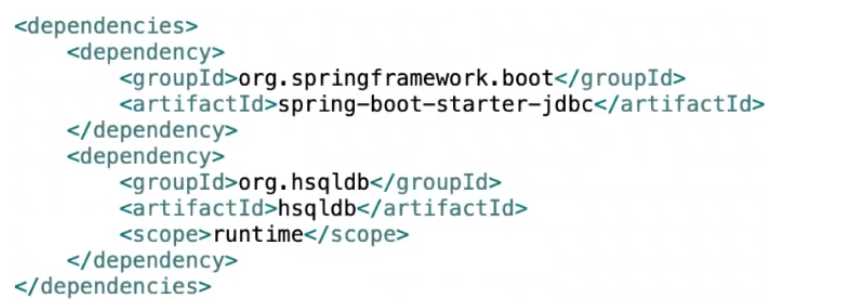
Which two statements are correct regarding auto-configuration of DataSource and JdbcTemplate
beans given a Spring Boot application with only these two dependencies? (Choose two.)
- A. A DataSource bean will not be auto-configured.
- B. A JdbcTemplate bean will not be auto-configured.
- C. A JdbcTemplate bean will be auto-configured.
- D. A DataSource bean will be auto-configured only if a JdbcTemplate bean is explicitly defined.
- E. A DataSource bean will be auto-configured.
Answer:
CE
Question 7
Refer to the exhibit.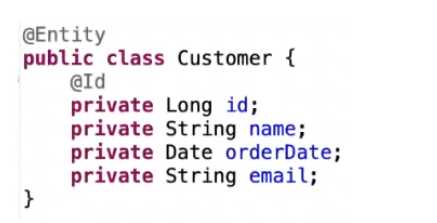
Which two methods will be implemented at runtime if declared in a Spring Data JPA Repository?
(Choose two.)
- A. public Customer getsingle(Long id);
- B. public Customer findFirstOrderDateMax();
- C. public Customer findByEmail(String email);
- D. public Customer findFirstByOrderDateBetween(Date d1, Date d2);
- E. public Customer findCustomerByName(String name);
Answer:
CD
Question 8
Which statements is true?
- A. Methods annotated with @AfterEach will run only once before any tests in a class are executed.
- B. @BeforeAll annotation can only be used on non-static methods.
- C. Methods annotated with @BeforeAll will run only once before any tests in a class are executed.
- D. @AfterEach annotation must be used on a cleanup method when @BeforeEach is used.
Answer:
C
Question 9
What's the password storage format when using the DelegatingPasswordEncoder?
- A. encodedPassword{id}, where {id} is an identifier used to look up which PasswordEncoder should be used.
- B. {id}encodedPassword, where {id} is an identifier used to look up which PasswordEncoder should be used.
- C. {timestamp}encodedPassword, where {timestamp} is the time when the password was encoded.
- D. {id}{salt}encodedPassword, where {id} is an identifier used to look up which PasswordEncoder should be used and {salt} a randomly generated salt.
Answer:
B
Explanation:
https://docs.spring.io/spring-security/site/docs/current/api/org/springframework/security/crypto/password/DelegatingPasswordEncoder.html
Question 10
Refer to the exhibit.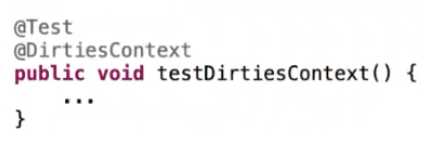
What statement is true about @DirtiesContext?
- A. It will close the existing cached ApplicationContext and recreate a new one before the test method.
- B. It will close the existing cached ApplicationContext and recreate a new one after the test method.
- C. It will keep the existing cached ApplicationContext, all changes to Spring managed beans will be reverted after the test.
- D. It will recreate only the Spring managed beans that are modified inside the test method.
Answer:
B
Explanation:
@DirtiesContext @Test void testProcessWhichDirtiesAppCtx() { // some logic that results in the
Spring container being dirtied } Dirty the context after the current test method.
https://docs.spring.io/spring-framework/reference/testing/annotations/integration-spring/annotation-dirtiescontext.html
Question 11
Which two statements are true about Spring AOP? (Choose two.)
- A. The @After advice type is invoked regardless of whether a method successfully returned or an exception was thrown.
- B. In Spring AOP, a join point represents a method execution or property access.
- C. Spring AOP does not use AspectJ's pointcut expression language.
- D. Examples of cross-cutting concerns include security, caching, transaction.
- E. There are in total 4 types of advice, @Before, @After, @AfterReturning and @AfterThrowing.
Answer:
AD
Question 12
Refer to the exhibit.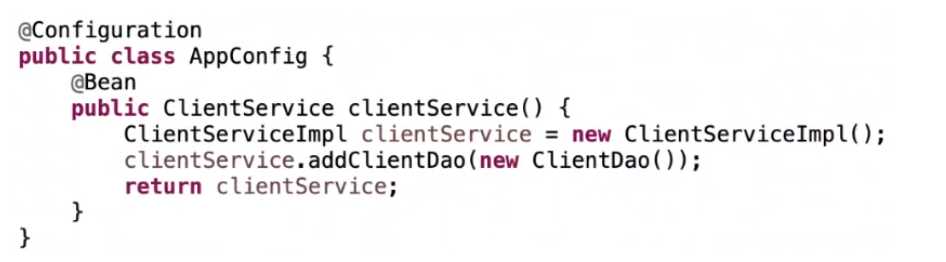
AppConfig is a Java configuration class. Which two statements are true? (Choose two.)
- A. The clientService bean declared will have prototype scope by default.
- B. The name of the clientService() method is invalid and will throw an error.
- C. The clientService bean will be lazy initialized the first time accessed.
- D. The bean is of type clientService and by default will be a Singleton.
- E. The Java configuration can be profile specific by adding a @Profile annotation.
Answer:
DE
Question 13
According to REST principles, which is the recommended way to update the order resource identified
by 1234?
- A. Send a PUT request to /orders/edit?id=1234.
- B. Send a PUT request to /orders/1234.
- C. Send a POST request to /orders/1234.
- D. Send a POST request to /orders/edit?id=1234.
Answer:
B
Question 14
Which two statements are true regarding a Spring Boot "fat" JAR? (Choose two.)
- A. The "fat" JAR contains both the class files and the source files for your project.
- B. The "fat" JAR requires an external Servlet container.
- C. The "fat" JAR contains compiled classes and dependencies that your code needs to run.
- D. The "fat" JAR can contain multiple embedded application servers.
- E. The "fat" JAR is created by the Spring Boot Maven plugin or Gradle plugin.
Answer:
CE
Question 15
Which two statements about BeanFactoryPostProcessors are true? (Choose two.)
- A. Allows for the transformation of Spring bean definitions after the beans have been instantiated.
- B. Allows for the transformation of Spring bean definitions before the beans are instantiated.
- C. Creates proxies for the Spring beans that require an extra behavior like transaction management.
- D. PropertySourcesPlaceholderConfigurer implements BeanFactoryPostProcessor and is used to read property values from the Spring Environment.
- E. Detects annotations such as @PostConstruct and @PreDestroy and then invokes appropriate behavior.
Answer:
BD
Explanation:
(1) BeanFactoryPostProcessor (Spring Framework 6.1.3 API). https://docs.spring.io/spring-framework/docs/current/javadoc-api/org/springframework/beans/factory/config/BeanFactoryPostProcessor.html.(2)Spring
BeanPostProcessor | Baeldung. https://www.baeldung.com/spring-beanpostprocessor. (3)
BeanFactoryPostProcessor - Spring | Home. https://docs.spring.io/spring-
framework/docs/3.0.x/javadoc-
api/org/springframework/beans/factory/config/BeanFactoryPostProcessor.html. (4)
BeanFactoryPostProcessor (Spring Framework API 2.5). https://docs.spring.io/spring-
framework/docs/2.5.x/javadoc-
api/org/springframework/beans/factory/config/BeanFactoryPostProcessor.html. (5) Spring
BeanPostProcessor Example - HowToDoInJava.
https://howtodoinjava.com/spring-core/spring-bean-
post-processors/