VMware 2V0-21-23 Exam Questions
Questions for the 2V0-21-23 were updated on : Mar 08 ,2026
Page 1 out of 8. Viewing questions 1-15 out of 107
Question 1
A combination of which two components of the software-defined data center (SDDC) are responsible
for the initial abstraction of CPU, memory, disk, and network resources and their subsequent
management? (Choose two.)
- A. VMwere ESXi
- B. VMware vCenter Cloud Gateway
- C. VMware Ana Suite Lifecycle
- D. VMware vCenter
- E. VMware Ana Operations
Answer:
AD
Explanation:
VMware ESXi and VMware vCenter are the two components of the software-defined data center
(SDDC) that are responsible for the initial abstraction of CPU, memory, disk, and network resources
and their subsequent management1
.
VMware ESXi is the virtualization platform where you create
and run virtual machines and virtual appliances2
.
VMware vCenter is the service through which you
manage multiple hosts connected in a network and pool host resources2
.
These two components are
part of the SDDC architecture that enables a fully automated, zero-downtime infrastructure for any
application, and any hardware, now and in the future3
.
Question 2
Refer to the exhibit.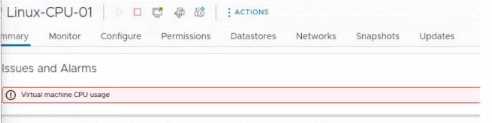
After removing an ESXi host from a cluster for maintenance, a number of virtual machines have
encountered the warning seen in the exhibit. After re-adding the ESXi, the issue is resolved. Which
step should the administrator take to move the triggered alarm to its normal state?
- A. Ignore
- B. Reset to Green
- C. Acknowledge
- D. Disable
Answer:
B
Explanation:
https://communities.vmware.com/t5/ESXi-Discussions/Alert-on-virtual-machine-that-i-cant-quot-
clear-quot-or-remove/td-p/1685418
Question 3
An administrator manages VM templates and ISO images for a remote office. Their main
requirements are to store these templates in a single repository and manage different versions of the
templates.
What solution should the administrator deploy to meet these requirements?
- A. A subscribed content library
- B. A local content library
- C. A vSAN datastore
- D. A shared VMFS datastore
Answer:
B
Explanation:
https://4sysops.com/archives/how-to-create-a-vmware-content-
library/#:~:text=A%20VMware%20content%20library%20provides,maintain%20consistency%20acros
s%20VM%20deployments.
Question 4
An administrator receives reports from the application team of poor performance of a virtual ma-
chine (VM). The administrator reviews the virtual machine and discovers that it has 20 snapshots
that are over 12 months old.
What could the administrator do to improve the VM’s performance?
- A. Inflate the base disk to make space for future snapshots.
- B. Revert to the latest snapshot.
- C. Consolidate all of the snapshots into the base VM.
- D. Identify and delete the largest delta .vmdk file.
Answer:
C
Explanation:
https://4sysops.com/archives/performance-impact-of-snapshots-in-vmware-vsphere-
7/#:~:text=As%20you%20know%2C%20snapshots%20affect,time%20you%20took%20the%20snapsh
ot
.
Question 5
An administrator plans to bring VMware vCenter offline in order to perform hardware mainte-nance
on the host where the vCenter Server Appliance is running.
Which vSphere feature must be configured to ensure that vCenter users experience minimal
downtime?
- A. vSphere Distributed Resource Scheduler
- B. Hybrid Linked Mode
- C. vCenter Server High Availability
- D. Enhanced Linked Mode
Answer:
C
Explanation:
https://docs.vmware.com/en/VMware-vSphere/7.0/com.vmware.vsphere.avail.doc/GUID-4A626993-A829-495C-9659-F64BA8B560BD.html
Question 6
An administrator runs a two-node vSphere cluster, which contains two domain controller virtual
machines (VMs). The administrator wants to ensure that VMs run on separate hosts without
interfering with normal maintenance operations.
How should the administrator configure Distributed Resource Scheduler (DRS)?
- A. Create a 'Must run Virtual Machines to Hosts' anti-affinity rule.
- B. Create a 'Virtual Machines to Virtual Machines' anti-affinity rule.
- C. Create a 'Virtual Machines to Virtual Machines' dependency rule.
- D. Create a 'Should run Virtual Machines to Hosts' anti-affinity rule.
Answer:
D
Explanation:
https://docs.vmware.com/en/VMware-vSphere/7.0/com.vmware.vsphere.resmgmt.doc/GUID-793013E2-0976-43B7-9A00-340FA76859D0.html
Question 7
An administrator wants to use tag-based placement rules on their virtual machine disks using
VMware vCenter.
Which option would allow the administrator to achieve this?
- A. Storage Policy Based Management
- B. Storage I/O Control
- C. vSphere Storage APIs for Storage Awareness (VASA)
- D. vSphere Distributed Resource Scheduler (DRS)
Answer:
A
Explanation:
https://vnote42.net/2020/01/15/vcenter-tag-based-vm-placement/
Question 8
What are two uses cases for VMware Tools? (Choose two.)
- A. Time synchronization with an NTP server
- B. Direct deployment of the Aria Automation Config minion
- C. Share folders between ESXi hosts and guest OS file systems
- D. Ability to shut down a virtual machine remotely
- E. Support for unsupported network device drivers
Answer:
CD
Explanation:
https://www.stevenbright.com/2022/03/deploy-salt-minions-automatically-using-vmware-tools/
Two use cases for VMware Tools are direct deployment of the Aria Automation Config minion and
ability to shut down a virtual machine remotely. Direct deployment of the Aria Automation Config
minion is a feature that allows the administrator to deploy a configuration management agent to a
virtual machine using VMware Tools. This feature enables automation and orchestration of virtual
machine configuration tasks. Ability to shut down a virtual machine remotely is a feature that allows
the administrator to gracefully power off a virtual machine from the vSphere Client or other VMware
products. This feature requires VMware Tools to be installed and running on the guest operating
system. Reference:
https://docs.vmware.com/en/VMware-vSphere/7.0/com.vmware.vsphere.vmwaretools.doc/GUID-28C39A00-743B-4E23-9681-66254A15C2A0.html
Question 9
Refer to the exhibit.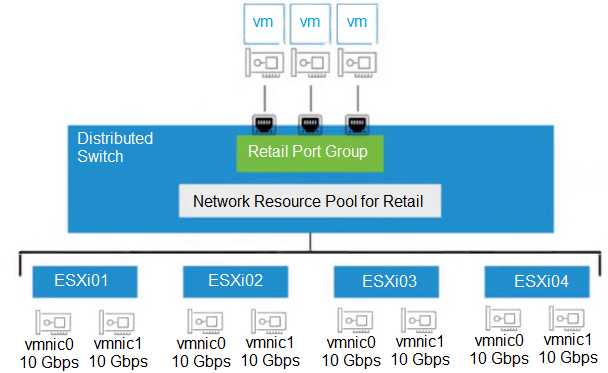
An administrator set up the following configuration:
• The distributed switch has four ESXi hosts, and each host has two 10 Gbps NICs.
• In the Network I/O Control configuration, the amount of bandwidth reserved for virtual machine
(VM) traffic if 4 Gbps.
The administrator wants to guarantee that VMs in the Retail distributed port group can access 50
percent of the available reserved bandwidth for VM traffic.
Given this scenario, what should the size (in Gbps) of the Retail network resource pool be?
- A. 40
- B. 32
- C. 8
- D. 16
Answer:
D
Explanation:
4Gbps*8Nic=32Gbps*50%=16Gbps
Question 10
An administrator is completing the configuration of a new vSphere cluster and has enabled vSphere
High Availability (HA) and vSphere Distributed Resource Scheduler (DRS).
After adding the ESXi hosts to the cluster, which networking information will the administrator be
prompted to provide when using the Cluster Quickstart workflow?
- A. vMotion networking
- B. Management networking
- C. vSAN networking
- D. Virtual machine networking
Answer:
A
Explanation:
https://core.vmware.com/resource/cluster-quickstart#section1
Question 11
An administrator is tasked with implementing a backup solution capable of backing up the Su-
pervisor cluster, vSphere Pods, and persistent volumes.
Which two solutions must be used to meet this requirement? (Choose two.)
- A. VMware vCenter
- B. Standalone Velero and Restic
- C. NSX-T Manager
- D. vSphere Host Client
- E. Velero Plugin for vSphere
Answer:
BE
Explanation:
https://docs.vmware.com/en/VMware-vSphere/7.0/vmware-vsphere-with-tanzu/GUID-9816E07A-466C-451D-A43B-D415B2FAB7D6.html
Question 12
A vSphere cluster hosts a three-tier application. The cluster has 50% resources available. If a host in
the cluster fails, the database server must be online before the application server, and the
application server must be online before the Web server.
Which feature can be used to meet these requirements?
- A. Predictive DRS
- B. vSphere HA Orchestrated Restart
- C. vSphere HA Restart Priority
- D. Proactive HA
Answer:
B
Explanation:
https://www.vladan.fr/what-is-vmware-orchestrated-restart/
Question 13
Exhibit switch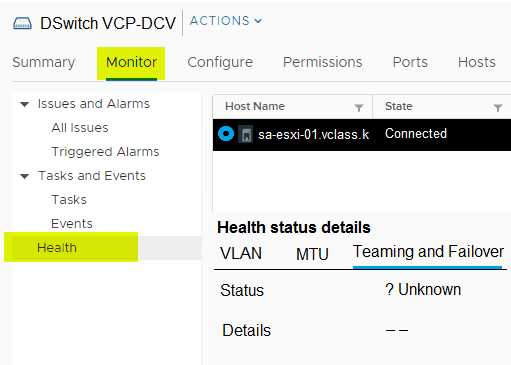
An administrator configures a distributed switch and adds the first VMware ESXi server to it.
The administrator also performs the following activities:
•
The administrator assigns two uplinks to the distributed switch.
•
The administrator enables uplink teaming.
When attempting to perform a health check of the teaming policy, the health status of the Teaming
and Failover reports as ' Unknown?, as seen in the exhibit.
What can the administrator changes in the distributed switch for the health status to report
correctly?
- A. Add a minimum of three hosts with two uplinks each
- B. Add a minimum of two hosts with two uplinks each
- C. Add a minimum of three hosts with four uplinks each
- D. Add a minimum of two hosts with one uplink each
Answer:
B
Question 14
Refer to Exhibit: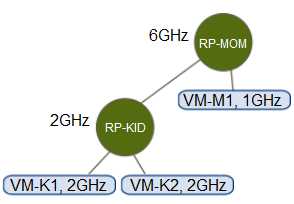
An environment has the following configuration:
•
Resource Pool “RP-MOM? has a reservation of 6GHz and one running virtual machine (VM)
"VM-M1? with 1 GHz reserved
•
Resource Pool ^RP-KID? has a reservation of 2GHz, and expandable reservations is activated
The administrator creates two VMs, “VM-K1? and 'VM-K2?, in the ''RP-KID? resource pool with 2GHz
reserved for each, and turns on “VM-M1 ?
Given this scenario, which statement is true?
- A. The administrator must deactivate expandable reservations to turn on VM-K2
- B. The administrator can create a third VM ( VM-K3?) at RP-KID and reserve 6GHz
- C. VM-K2 can be powered on because it can get the resources needed from RP-MOM.
- D. VM-K2 cannot be powered on because there are not enough resources in RP-KID.
Answer:
C
Explanation:
https://docs.vmware.com/en/VMware-vSphere/8.0/vsphere-resource-management/GUID-60077B40-66FF-4625-934A-641703ED7601.html
Question 15
An administrator is tasked with implementing a backup solution capable of backing up the Supervisor
cluster, vSphere Pods, and persistent volumes.
Which two solutions must be used to meet this requirement? (Choose two.)
- A. VMware vCenter
- B. Standalone Velero and Restic
- C. NSX-T Manager
- D. vSphere Host Client
- E. Velero Plugin for vSphere
Answer:
B, E