the open group OGBA-101 Exam Questions
Questions for the OGBA-101 were updated on : Feb 18 ,2026
Page 1 out of 8. Viewing questions 1-15 out of 110
Question 1
Consider the following output from Phase A: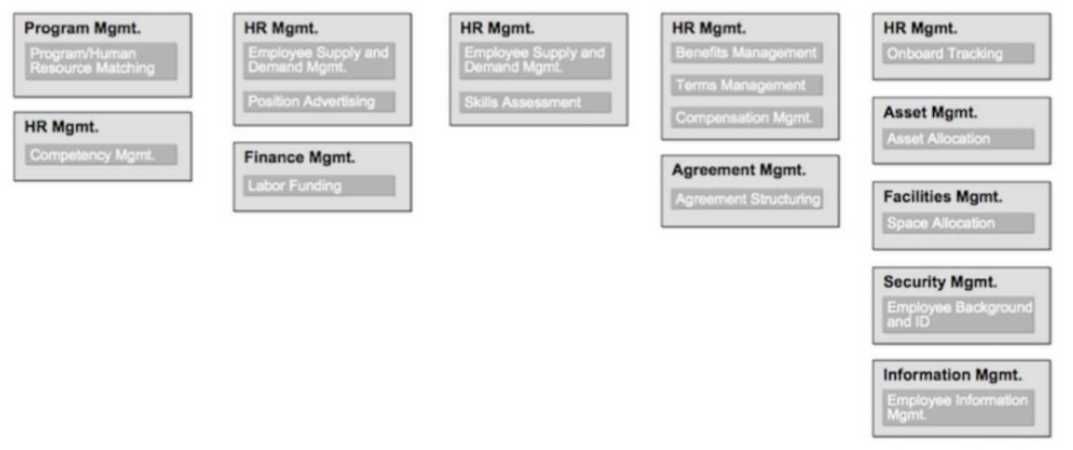
What is this an example of?
- A. Capability Map
- B. Organization Map
- C. Process Map
- D. Value Stream Map
Answer:
A
Explanation:
The diagram provided illustrates a Capability Map. Here's why:
Focus on "what" the organization does: The diagram depicts various functions and activities that the
organization performs, such as "Program/Human Resource Matching," "Employee Supply and
Demand Mgmt," "Benefits Management," etc. These represent the capabilities of the organization,
or what it is able to do.
Hierarchical structure: The capabilities are organized hierarchically, with broader functions like "HR
Mgmt." encompassing more specific capabilities like "Position Advertising" and "Skills Assessment."
This shows how different capabilities relate to each other and contribute to higher-level functions.
No specific process flow: Unlike a process map or value stream map, this diagram doesn't show a
sequence of steps or flow of activities. It focuses on the capabilities themselves, not how they are
executed
Question 2
In what TOGAF ADM phase is the organization map linked built out with the detail and relationships
to overviews in order to understand the needs of the organization?
- A. Phase B
- B. Phase E
- C. Preliminary Phase
- D. Phase A
Answer:
D
Explanation:
Phase A (Architecture Vision) of the TOGAF ADM builds out initial organizational maps to understand
high-level organizational needs and link them to architecture goals. This step provides foundational
insight that informs subsequent phases, particularly for stakeholder alignment.
Reference: TOGAF ADM Phase A.
In TOGAF, Phase A (Architecture Vision) is where the organization map is developed in detail and
linked to overviews to understand the organizational needs. This phase focuses on:
Defining the scope of the architecture: This includes identifying the parts of the organization that will
be affected by the architecture and the timeframe for the architecture development.
Identifying stakeholders and their concerns: Understanding the needs and expectations of different
stakeholders is crucial for developing an architecture that meets their requirements.
Creating a high-level architecture vision: This vision outlines the desired future state of the
architecture and how it will support the organization's strategic goals.
Question 3
Which of the following are used for structuring a business capability map?
- A. Categorizing, Grouping
- B. Aligning, Layering
- C. Mapping, Sorting
- D. Stratification, Leveling
Answer:
A
Explanation:
A Business Capability Map is structured by categorizing and grouping capabilities into high-level
clusters that align with business objectives. This approach aligns with TOGAF principles for clarity and
simplification in business capability representation, enabling a coherent view of business abilities.
Reference: TOGAF Standard, Capability Mapping Techniques.
Business capability maps provide a structured view of what an organization does to achieve its
objectives. To create a clear and understandable map, capabilities need to be organized effectively.
Categorizing and grouping are the primary methods used for this purpose:
Categorizing: This involves classifying capabilities into different types or categories based on their
characteristics or purpose. Common categories include:
Core capabilities: Essential for the organization's core business.
Supporting capabilities: Enable or enhance core capabilities.
Customer-facing capabilities: Directly interact with customers.
Operational capabilities: Focus on internal operations.
Grouping: This involves grouping related capabilities together to create a hierarchical structure. This
helps to visualize relationships between capabilities and understand how they contribute to broader
business functions
Question 4
Which of the following best describes why business model innovation should be approached in a
structured manner?
- A. To adapt to changes in the organization structure to meet a new market need.
- B. To ensure that changes to business models can interact with the existing architecture.
- C. To provide a consistent and measurable level of quality information to decision-makers.
- D. To enable the business to thrive in a state of constant motion.
Answer:
B
Explanation:
Business model innovation involves making significant changes to how an organization creates,
delivers, and captures value. These changes can be disruptive and have far-reaching implications for
the entire enterprise. A structured approach to business model innovation is essential to:
Maintain alignment with enterprise architecture: A structured approach ensures that new business
models are compatible with the existing technology, data, and application architecture. This prevents
costly rework, integration issues, and disruptions to existing operations.
Minimize risk and disruption: By carefully considering the impact of changes on different parts of the
organization, a structured approach helps to mitigate risks and avoid unintended consequences.
Facilitate effective decision-making: A structured approach provides a framework for evaluating
different business model options and making informed decisions based on clear criteria and analysis.
Enable smooth transition: A structured approach helps to manage the transition to the new business
model, ensuring a smooth implementation and minimizing disruptions to customers and employees.
Question 5
Complete the following sentence:
Presenting different ____ and ____ to stakeholders helps architects to extract hidden agendas,
principles, and requirements that could impact the final Target Architecture.
- A. Architecture Views, Architecture Viewpoints
- B. Business Scenarios, Business Models
- C. Solutions, Applications
- D. Alternatives, Trade-offs
Answer:
A
Explanation:
Presenting different alternatives and trade-offs to stakeholders is a crucial technique in TOGAF for
eliciting valuable feedback and refining the Target Architecture. This approach encourages
stakeholders to actively participate in the architecture development process and express their
preferences and concerns.
Here's why this approach is effective:
Reveals hidden agendas: By presenting different options with varying implications, stakeholders may
reveal priorities or concerns that were not explicitly stated before. This helps architects uncover
hidden agendas that could influence the architecture's success.
Uncovers underlying principles: Stakeholder reactions to different alternatives can reveal their
underlying principles and values, providing insights into what they consider important in the
architecture.
Identifies unspoken requirements: Through discussions and comparisons of alternatives,
stakeholders may express needs or requirements that were not captured during initial requirements
gathering.
Question 6
Consider the following statements:
Groups of countries, governments, or governmental organizations (such as militaries) working
together to create common or shareable deliverables or infrastructures
Partnerships and alliances of businesses working together, such as a consortium or supply chain
What are those examples of according to the TOGAF Standard?
- A. Business Units
- B. Organizations
- C. Enterprises
- D. Architectures Scopes
Answer:
C
Explanation:
TOGAF defines an “Enterprise” as any collection of organizations or alliances working toward shared
goals, such as in consortiums or partnerships. This scope allows the architecture to address cross-
organization processes and infrastructures for collaborative endeavors.
Reference: TOGAF Standard, Definition of an Enterprise.
TOGAF defines an Enterprise as any collection of organizations that has a common set of goals. This
definition is intentionally broad and can encompass various types of entities, including:
Single organizations: A traditional company or corporation with a unified structure and goals.
Groups of organizations: This could include:
Public sector: Government agencies, military branches, or international collaborations like the
United Nations.
Private sector: Consortiums, industry alliances, supply chains, or joint ventures where multiple
businesses work together towards shared objectives.
The key characteristic of an enterprise is the shared set of goals that drives its activities and
architecture.
Question 7
Consider the following extract of a model showing relationships between Business Architecture
concepts: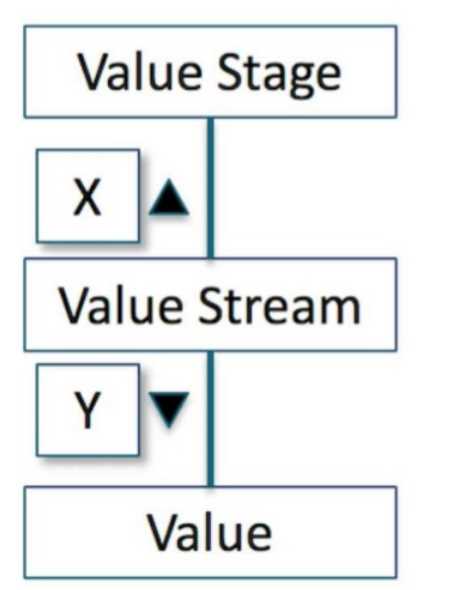
What is the relationship labeled X?
- A. Enables
- B. Consists of
- C. Receives
- D. Creates
Answer:
B
Explanation:
In the context of TOGAF and Business Architecture, the diagram depicts the relationship between a
Value Stream, Value Stage, and Value.
Value Stream: Represents the end-to-end set of activities that create and deliver value to a
stakeholder.
Value Stage: A distinct step or phase within the Value Stream.
Value: The benefit delivered to the stakeholder.
The relationship "X" indicates that a Value Stream is composed of multiple Value Stages.
Think of it like a journey (Value Stream) with multiple stops along the way (Value Stages). Each stage
contributes to the overall value delivered at the end of the journey.
Question 8
Complete the sentence. The purpose of the Preliminary Phase is to:
- A. Describe the target architecture.
- B. Architect an Enterprise Architecture Capability.
- C. Define the enterprise strategy.
- D. Identify the stakeholders and their requirements.
Answer:
B
Explanation:
In the TOGAF ADM, the Preliminary Phase sets up the architecture capability within the organization,
establishing architecture governance, defining architecture principles, and setting up necessary
processes and tools. This phase is crucial for laying the foundation before formal architecture
development begins.
Reference: TOGAF ADM Preliminary Phase.
The Preliminary Phase is the first phase in the TOGAF Architecture Development Method (ADM). It
sets the foundation for successful architecture development within an organization. The primary
purpose of this phase is to:
Establish an Enterprise Architecture practice: This involves defining the organizational structure,
processes, and resources needed to support architecture activities.
Tailor TOGAF to the organization's needs: TOGAF is a flexible framework. The Preliminary Phase
allows for adapting the ADM and other TOGAF components to fit the specific context and
requirements of the organization.
Secure senior management commitment: Gaining support from leadership is crucial for the success
of any enterprise architecture initiative. This phase helps to ensure that key stakeholders understand
and endorse the architecture development process.
Define the scope and approach: This includes determining the initial scope of the architecture work,
identifying relevant architecture domains, and selecting appropriate methods and tools
Question 9
Which of the following best describes "value” in the context of Business Architecture?
- A. The benefit of something.
- B. A numerical quantity assigned to something.
- C. The monetary worth of something.
- D. The market price of something.
Answer:
A
Explanation:
In Business Architecture, “value” refers to the benefit provided to stakeholders, aligning with
TOGAF's goal to capture and deliver value in business processes and capabilities. Business value is
viewed as outcomes or improvements that meet stakeholder needs, rather than purely financial or
numerical metrics.
Reference: TOGAF Business Architecture Value Definition.
In the context of Business Architecture, "value" is broadly defined as the benefit that something
provides to stakeholders. This benefit can take many forms, including:
Financial value: Increased revenue, reduced costs, improved profitability.
Customer value: Enhanced customer satisfaction, improved customer experience, increased
customer loyalty.
Operational value: Increased efficiency, improved productivity, reduced risk.
Social value: Positive impact on society, environmental sustainability, ethical practices.
The key point is that value is subjective and depends on the perspective of the stakeholder. What is
valuable to one stakeholder may not be as valuable to another. Therefore, understanding stakeholder
values is crucial for effective business architecture.
Question 10
Complete the sentence. The four dimensions used to scope an architecture are:
- A. Breadth, Depth, Time Period, Architecture Domains
- B. Business, Data, Application, Technology
- C. Strategy, Portfolio, Project, Solution Delivery
- D. Strategy, Segment, Capability, Budget
Answer:
A
Explanation:
In TOGAF, the dimensions for scoping an architecture are Breadth (coverage across the organization),
Depth (level of detail), Time Period (horizon of the architecture), and Architecture Domains (the four
architecture domains of Business, Data, Application, and Technology). These dimensions ensure
comprehensive scoping and contextual alignment.
Reference: TOGAF Standard, Chapter on Scoping the Architecture.
According to TOGAF, defining the scope of an architecture involves considering these four key
dimensions:
Breadth: This refers to how much of the enterprise is covered by the architecture. It defines the
boundaries of the architecture, which could range from a single department to the entire
organization, or even extending to external partners.
Depth: This dimension determines the level of detail included in the architecture. It can range from
high-level conceptual models to detailed specifications of individual components.
Time Period: This specifies the timeframe for the architecture, including the intended lifespan of the
architecture and any planned phases or iterations. It addresses questions like "What is the
architecture for now?" and "What should the architecture look like in the future?"
Architecture Domains: This dimension defines which of the four architecture domains (Business,
Data, Application, Technology) are included in the scope. The selection of domains depends on the
specific needs and objectives of the architecture development effort.
Question 11
What are the four architecture domains that the TOGAF standard deals with?
- A. Baseline, Candidate, Transition, Target
- B. Capability, Segment, Enterprise, Federated
- C. Business, Data, Application, Technology
- D. Application, Data, Information, Knowledge
Answer:
C
Explanation:
TOGAF defines four core architecture domains: Business, Data, Application, and Technology. These
domains collectively represent the key areas covered in enterprise architecture, where the Business
Architecture defines business strategy and organizational goals; Data Architecture addresses data
management and structure; Application Architecture focuses on system and software applications;
and Technology Architecture outlines the IT infrastructure.
Reference: TOGAF Standard, Architecture Domains (Chapter 3).
TOGAF, as a comprehensive Enterprise Architecture framework, divides the architecture landscape
into four interrelated domains:
Business Architecture: This domain focuses on the organization's strategic goals, business processes,
and organizational structure. It defines how the business operates and creates value.
Data Architecture: This domain deals with the structure, organization, and management of data
assets within the enterprise. It includes logical and physical data models, data storage, and data
security.
Application Architecture: This domain describes the applications used to support the business, their
interactions, and their alignment with business processes. It provides a blueprint for the application
portfolio.
Technology Architecture: This domain covers the technology infrastructure that supports the
applications and data. It includes hardware, software, networks, and IT services.
These four domains provide a holistic view of the enterprise and how its different components work
together.
Question 12
Which of the following is guidance for creating value streams?
- A. Create an initial set of value streams that provide a one-to-one mapping to existing capabilities.
- B. Identify the top-level value streams from components of capabilities.
- C. Clearly define the triggering stakeholder.
- D. Include operational levels of detail.
Answer:
C
Explanation:
Value streams represent the series of steps an organization takes to deliver value to a customer or
stakeholder. A key principle in defining value streams is clarity about who initiates the value stream
and what triggers it. This is essential for several reasons:
Understanding customer needs: Identifying the triggering stakeholder helps to understand their
specific needs and expectations, which drives the design and optimization of the value stream.
Defining scope and boundaries: Knowing the trigger helps to define the starting and ending points of
the value stream, ensuring that it encompasses all the necessary activities to deliver the desired
value.
Measuring effectiveness: With a clear trigger, it becomes possible to measure the effectiveness of
the value stream by tracking how well it meets the needs of the triggering stakeholder.
Question 13
Which of the following is a benefit of value streams and value stream mapping?
- A. Value streams help to identify value, duplication, and redundancy across the enterprise.
- B. Value streams provide a framework for more effective business requirements analysis, case management, and solution design.
- C. Value streams highlight the value of individual work packages needed to develop the business architecture.
- D. Value streams help to ensure that investments and project initiatives are prioritized and funded at an appropriate level commensurate with their value.
Answer:
B
Explanation:
According to the TOGAF Business Architecture Guide, value streams play a key role in providing a
structured framework that supports more effective analysis of business requirements, case
management, and solution design. Value streams offer a high-level, customer-centric view of how
value flows through the organization, which helps in aligning business requirements and ensuring
solutions are well-targeted to meet those requirements.
Role of Value Streams in Business Requirements Analysis
Value streams help stakeholders understand the key stages and outcomes that deliver value to
customers or stakeholders. This framework facilitates a clear alignment between business
requirements and the value outcomes each requirement supports. By mapping requirements to
specific value stream stages, architects can ensure that requirements are directly tied to business
outcomes.
Supporting Case Management
Value streams also provide a structured approach for managing various business cases. By identifying
key stages in the value creation process, value streams help in evaluating and prioritizing cases based
on their impact on value delivery. This structured approach enhances case management by focusing
on value, efficiency, and alignment with organizational goals.
Enhancing Solution Design
Solution design is more effective when informed by a value stream view, as it allows architects to
focus on delivering value at each stage of the process. By understanding the flow of value, architects
and solution designers can ensure that technology, processes, and capabilities are aligned to support
the most critical aspects of the value stream. This alignment optimizes solution design to meet
specific business needs more effectively.
Why Option B is Correct
The TOGAF Business Architecture Guide explicitly states that value streams provide a framework for
business requirements analysis, case management, and solution design. This insight indicates that
value streams are instrumental in ensuring that these elements are aligned with how value is
delivered within the organization.
Why Other Options are Incorrect:
Option A (Identify value, duplication, and redundancy):
While value streams can provide insights into operational efficiency, they are not primarily focused
on identifying duplication and redundancy across the enterprise. Instead, this aspect is typically
covered by detailed process mapping or capability assessments.
Option C (Highlighting value of individual work packages):
Value streams do not emphasize individual work packages but rather focus on the overall flow of
value. Work packages are more granular and usually defined during implementation and migration
planning.
Option D (Ensuring investment prioritization):
Investment prioritization is more closely associated with portfolio management rather than value
stream mapping. Although value streams inform decision-making, they do not directly handle
funding prioritization.
Conclusion:
The correct answer is B because value streams provide a framework that directly supports business
requirements analysis, case management, and solution design, as outlined in the TOGAF Business
Architecture Guide.
Reference:
TOGAF Business Architecture Guide, Value Streams Section
Question 14
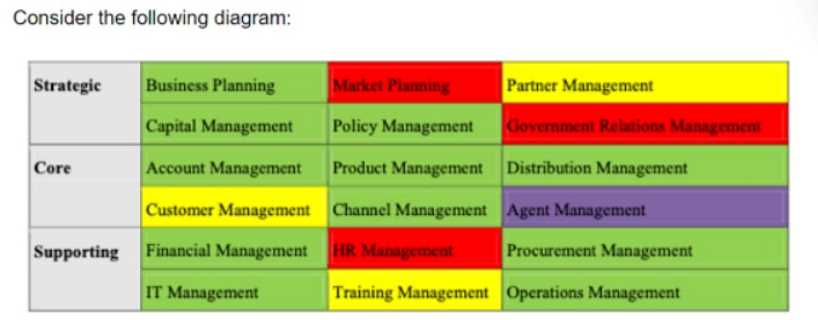
Which of the following best describes this diagram?
A.
Business Capability Map
B.
Business Capabilities Layer diagram
C.
Business Capability/Value Stream Mapping
D.
Business Relationships diagram
Answer:
A
Explanation:
The diagram presented is best described as a Business Capability Map. Here's a detailed explanation:
Business Capability Map:
Definition: A Business Capability Map represents the various capabilities an organization requires to
deliver its products and services and achieve its strategic objectives. It typically categorizes
capabilities into different levels or tiers, such as strategic, core, and supporting capabilities.
Diagram Analysis:
Layers and Groupings: The diagram shows capabilities grouped into three categories: Strategic, Core,
and Supporting. Each group lists specific business capabilities necessary for the organization’s
functioning.
Color Coding: The use of different colors (green, red, yellow, purple) may indicate various aspects
such as priority, status, or different business units. However, the primary purpose is to visually
represent and categorize capabilities.
TOGAF Reference:
Phase B: Business Architecture: In this phase, creating a Business Capability Map is a crucial activity.
It helps in understanding the business functions and aligning them with strategic goals.
Capability-Based Planning: TOGAF promotes capability-based planning, which involves identifying,
mapping, and analyzing business capabilities to ensure they support the overall strategy and
objectives.
Purpose and Benefits:
Strategic Alignment: The Business Capability Map helps in aligning business capabilities with the
strategic objectives of the organization. It provides a clear view of what the organization needs to do
to achieve its goals.
Gap Analysis: It is useful for conducting gap analysis by comparing current capabilities with the
desired state, helping to identify areas for improvement.
Resource Allocation: By understanding the different capabilities, organizations can allocate resources
more effectively to areas that need development or enhancement.
In summary, the diagram is best described as a Business Capability Map because it visually
represents and categorizes the various capabilities needed by the organization into strategic, core,
and supporting layers, aligning them with the business strategy and objectives.
Question 15
Which of the following is guidance for creating value streams?
- A. Identify the top-level value streams from components of capabilities.
- B. Include operational levels of detail.
- C. Start with customer-based value streams.
- D. Create an initial set of value streams that map one-to-one to existing capabilities.
Answer:
C
Explanation:
When creating value streams, it is recommended to start with customer-based value streams. Here’s
a detailed explanation:
Value Streams:
Definition: Value streams represent the end-to-end activities that create value for customers or
stakeholders. They provide a high-level view of how value is delivered within the organization.
Starting with Customer-Based Value Streams:
Customer Focus: Starting with customer-based value streams ensures that the architecture is aligned
with the needs and expectations of the customers. This approach helps in identifying the most critical
value-creating activities and aligning them with business goals.
Value Delivery: Customer-based value streams provide a clear understanding of how value is
delivered from the customer’s perspective. This helps in designing processes and capabilities that
enhance customer satisfaction and business performance.
TOGAF Reference:
Phase B: Business Architecture: In this phase, value streams are identified and modeled to ensure
that the architecture supports the delivery of value to customers. Starting with customer-based value
streams is a key activity in this phase.
Capability-Based Planning: TOGAF emphasizes the importance of aligning business capabilities with
value streams to ensure that the architecture supports value creation and delivery.
Benefits:
Customer-Centric Design: Starting with customer-based value streams ensures that the architecture
is designed with a focus on customer needs and value delivery.
Strategic Alignment: Aligning value streams with customer needs helps in ensuring that the
architecture supports the strategic goals of the organization and enhances customer satisfaction.
In summary, when creating value streams, starting with customer-based value streams ensures a
customer-centric design, aligning the architecture with the needs and expectations of the customers
and supporting strategic goals.