the open group OG0-023 Exam Questions
Questions for the OG0-023 were updated on : Feb 18 ,2026
Page 1 out of 7. Viewing questions 1-15 out of 103
Question 1
Scenario
Please read this scenario prior to answering the question
Independent insurance brokers that work with ArchiSurance have complained of difficulty in
communicating with salespeople and other personnel at ArchiSurance. They have said that email is
too clumsy and slow for working on urgent deals, people do not always answer their mobile phones,
and it is difficult to tell whether an individual is available. They have also complained that it is too
time-consuming for them to manage their commission payments using an older web application that
requires them to print out and mail forms for making some routine changes, and also does not work
on many mobile devices. Some brokers have said that it is easier to do business with ArchiSurance
competitors that provide easy-to-use mobile applications for both general communication and
commission management. In fact, the ArchiSurance Vice President of Sales and Chief Marketing
Officer have both expressed concern about reports from the ArchiSurance market research
department that the company is gradually losing market share withsome of the same brokers that
have been complaining. These executives are also concerned that ArchiSurance may not meet the
targets for revenue growth.
Upon hearing about these issues, the ArchiSurance Chief Information Officer (CIO) hired a consultant
to design a new mobile infrastructure for broker interaction. This infrastructure is required to enable
easier communication with ArchiSurance brokers in order to help the company increase its market
share with each of them and consequently attain its targets for revenue growth. In order to ensure
that the new infrastructure would meet these goals, the CIO told the consultant that the new
infrastructure must make it easy for ArchiSurance to develop and deploy applications and content for
its brokers. It must provide federated authentication and an encrypted communication channel as
well as instant messaging and presence services.
The new mobile broker interaction infrastructure architecture includes a number of system software
components. A secure reverse proxy authenticates users and provides an encrypted channel to
communicate with them. The proxy uses a service provided by directory server software to
authenticate users. The directory server communicates with the ArchiSurance federation server,
which in turn communicates with peer federation servers hosted by trusted brokerage organizations.
Once the user is authenticated, the ArchiSurance broker portal uses the ArchiSurance web content
management system to assemble authorized and relevant content for each broker. In order to
provide presence services, a unified communications (UC) server exchanges information with the
directory server and an instant messaging server.
All of these components are hosted on a single physical hardware platform hosting a virtualized
server infrastructure. The server infrastructure is connected to a converged local area network (LAN),
which is also connected to a commercial wide area network (WAN) over which ArchiSurance
communicates with its brokers.
Refer to the Scenario
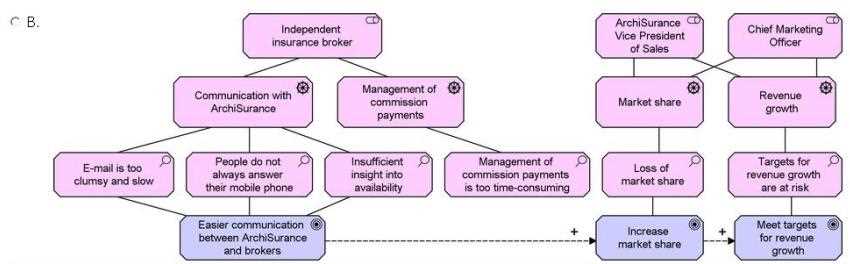
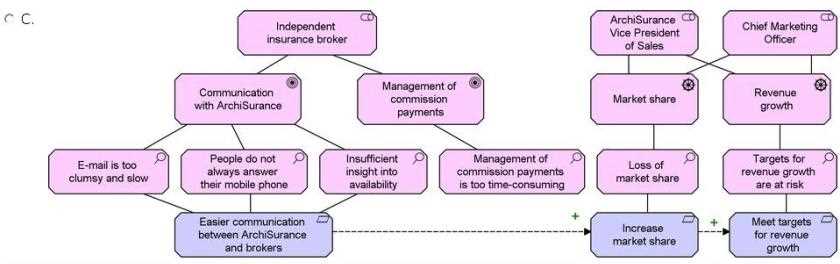
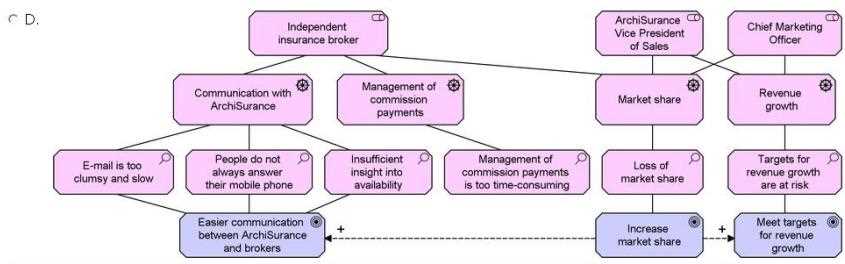
The solution delivery team for broker interaction would like to get a clearer idea of the motivations
behind this solution as they plan a second release. You must model the stakeholders, drivers,
assessments and goals that shape this strategic initiative. You must also show the relationships
between these motivational elements.
Which answer provides the most complete and accurate model?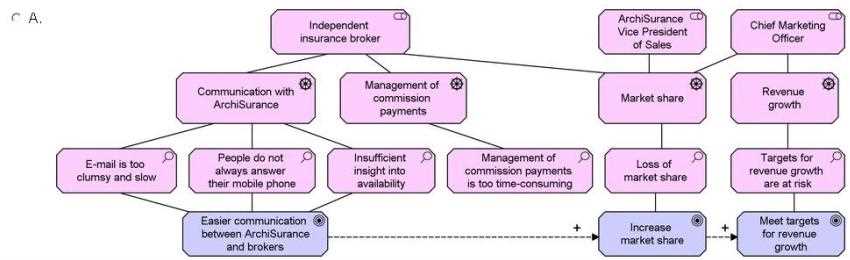
- A. Option A
- B. Option B
- C. Option C
- D. Option D
Answer:
B
Question 2
Scenario
Please read this scenario prior to answering the question
ArchiSurance has a partnership with ArchiBank in which the two companies market each other's
consumer offerings to their own customers. Each quarter, the chief marketing officers (CMOs) of the
two companies work together to plan the next quarter's promotions. First, they review each other's
business objectives related to the partnership. Then, they formulate the co-operative marketing
plan. The CMOs determine which offerings they will promote, the characteristics of the target
customers, and the timing of each promotion. They assemble their findings into a co-operative
marketing plan that Is reviewed separately by the chief financial officer (CFO) of each organization. If
either of the CFOs finds a problem, the CMOs must quickly work together to formulate another
version of the plan. The review and reformulation process continues until both CFOs have approved a
version of the plan. Then,the CMOs share the plans with their respective operations teams. Each
organization's operations team configures the bank's systems toexecute the joint promotions.
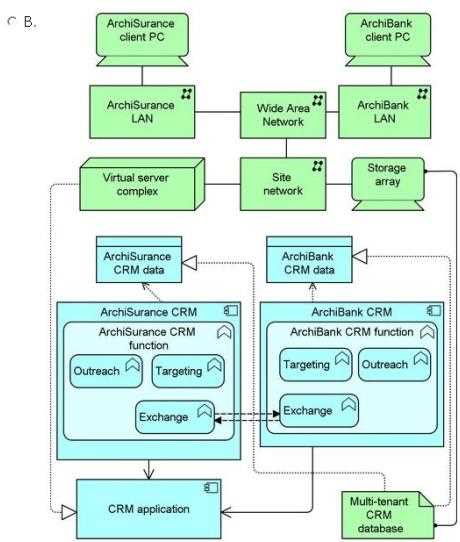
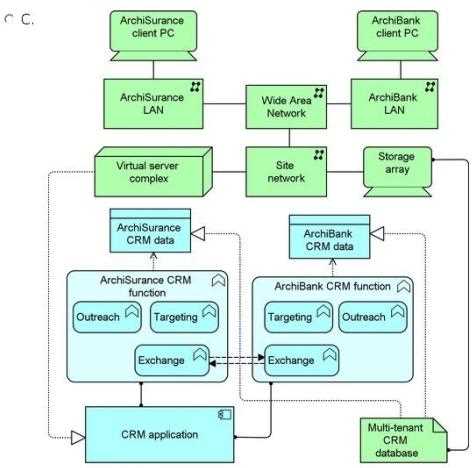
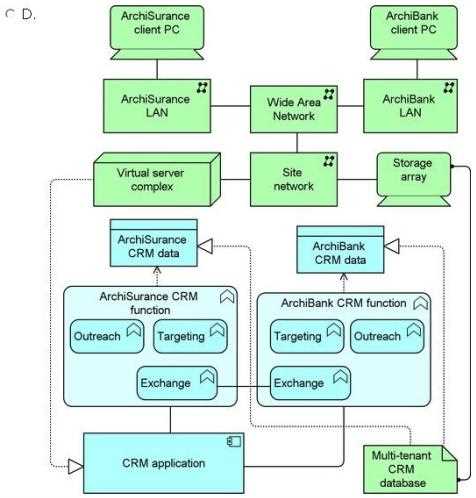
The cooperative marketing process is enabled by CRM software delivered as a service (SaaS). The
two organizations each use separate logical instances of a multi-tenant customer relationship
management (CRM) application hosted by a service provider. Each company's CRM instance is a
dedicated function of the same CRM application component. The dedicated functions also share the
same multi-tenant database. The component's data access layer is designed with safeguards to keep
each company's data separate unless it is intentionally shared.
Each CRM instance has targeting, exchange and outreach sub-functions. The targeting sub-functions
select customers based on criteria developed by the CMOs and configured by the operations teams.
The exchange sub-functions share the selected customer profiles with each other, and the outreach
sub-functions generate promotional email. In this way, each company's CRM system generates a list
of target customers that the other company's CRM system uses to send promotional email.
The multi-tenant CRM application component is hosted on a large virtual server complex that is
connected via a site network to a physical storage array and a commercial wide-area network (WAN)
used by both companies. Both companies access their CRM systems via PCs connected to Local Area
Networks (LANs) that are in turn connected to the shared commercial WAN.
Refer to the Scenario
The new head of IT has asked you to describe how the CRM application supports the partnership,
including the CRM application itself, the various application functions and the data flows between
them, and the hosting and networking that supports the CRM application.
Which answer provides the best description?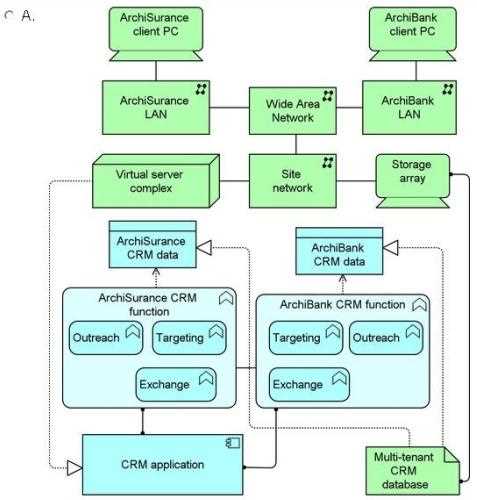
- A. Option A
- B. Option B
- C. Option C
- D. Option D
Answer:
C
Question 3
Scenario
Please read this scenario prior to answering the question
ArchiSurance has entered into a legal agreement to acquire ArchiSpecialty, a specialty insurer that
has several lines of business, including insuring organizations that conduct high-stakes contests. Prior
to entering into this agreement ArchiSurance staff carefully examined the ArchiSpecialty Enterprise
Architecture to develop an integration plan with four successive phases. Each phase of the plan
provides a stable foundation for ArchiSurance to conduct its newly expanded business while making
significant progress toward the targeted integration of ArchiSpecialty operations. The first phase of
the plan, Common Ownership, will begin on the acquisition date specified in the legal agreement.
The second through fourth phases will begin after their predecessors are complete.
During the Common Ownership phase, the two companies' websites will be linked to each other and
their Interactive voice response(IVR) system menus will be integrated. During the second phase,
known as Integrated Organizations, the corresponding ArchiSurance and ArchiSpecialty departments
will be combined and all financial processing will be migrated to the original ArchiSurance systems.
In the third Phase, known as Integrated Customer Operations, ArchiSpecialty customer relationship
management (CRM) data will be migrated to the corresponding ArchiSurance applications. In the
fourth and final phase, known as Integrated Operations, the ArchiSpecialty claims data will be
migrated to the corresponding ArchiSurance applications. However, the ArchiSpecialty underwriting
solution for high-stakes contests will be retained due to its unique capabilities.
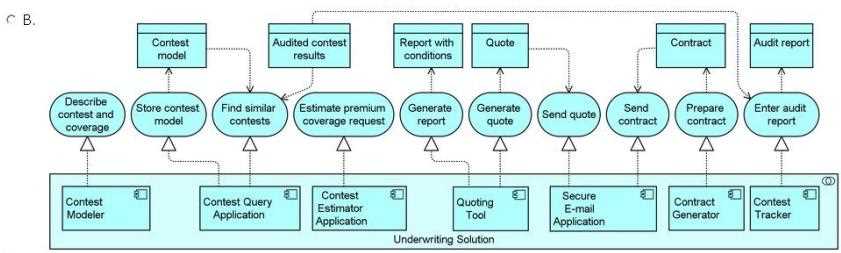
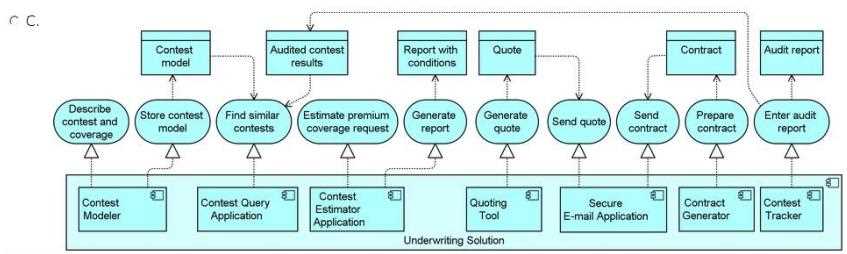
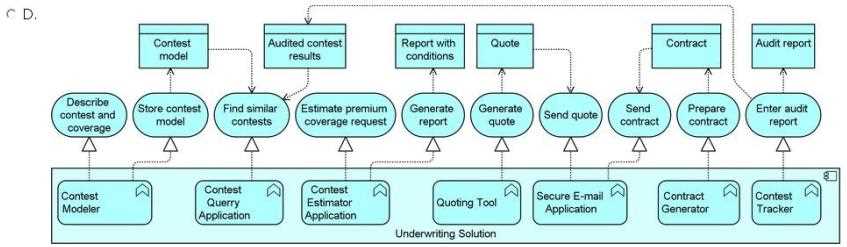
The underwriting solution for high-stakes contests assists underwriters in creating a policy to insure
against the possibility of a contestant winning an improbable but expensive award, such as $1 million
US for hitting a hole-in-one on a golf course, or a luxury world cruise for a winning spin of a roulette
wheel. In return for a single premium payment, the insurer agrees to pay the award if a contestant
earns it fairly. When an underwriter receives a request for an insurance quote, either from a
promotions company that isplanning the contest or from a company with its own promotions
department, he uses the Contest Modeler application to precisely describe the planned contest and
the coverage requested, and to store the contest model in a machine-readable format. Then, the
underwriter uses the Contest Query application, which reads the contest model and queries a
collection of audited contest results to find records of similar contests. Then, the underwriter uses
the Contest Estimator application to estimate the premium for the coverage request, and also to
produce a report with a recommended set of conditions to provide with the quote. After consulting
the report, the underwriter uses the Quoting Tool application to prepare a quote for the customer.
Then, the underwriter sends the quote to the customer via secure email. If the customer accepts the
quote, the underwriter uses the Contract Generator to prepare t contract for the customer, which he
also sends via secure email. In the contract, the customer agrees to employ a contest auditorwho will
report the audited results of the contest regardless of whether prizes are awarded. The underwriter
uses the Contest Tracker application to add these reports to the collection of audited contest results.
Note that all reports are delivered in a standard markup language that can be read by other software
programs and either processed in the background or rendered visually.
Refer to the Scenario
The ArchiSurance chief information officer has asked you to explain the unique suite of applications
that ArchiSpecialty uses to underwrite high-stakes contest insurance. You must model these
applications, the services they provide and the data they access.
Which answer provides the best explanation?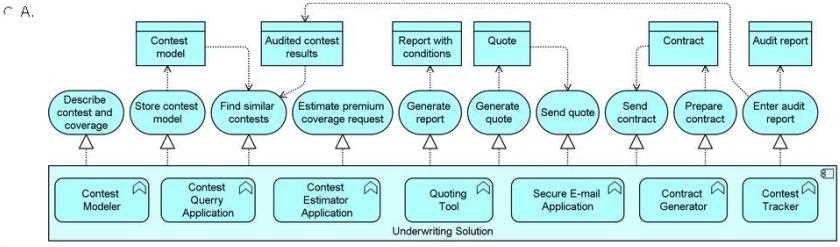
- A. Option A
- B. Option B
- C. Option C
- D. Option D
Answer:
C
Question 4
Scenario
Please read this scenario prior to answering the question
ArchiSurance senior management, board members, customers and major stockholders have long
been concerned about disaster resiliency in light of the company's heavy reliance on a single data
center. The data center is located in an area that is prone to flooding and earthquakes, according to
expert assessments done by consultants retained for this purpose. In addition, the data center is
located under a busy cafeteria, and water occasionally leaks through its ceiling.
To adoress these problems, ArchiSurance has developed a plan to move from its current data center
to a pair of ready-to-use data centers in separate cities. The data center move is designed to reduce
the risk of business interruption, reduce both planned and unplanned downtime for critical
applications, and reassure ArchiSurance stakeholders. However, a number of limitations make
theplanned transition to the new data centers particularly challenging. A number of critical
ArchiSurance applications cannot be offline for more than an hour, and any downtime for these
application must only occur in certain four-hour windows each weekend. Also, the move cannot
occur during quarterly or year-end closing periods in order to avoid interrupting critical processing.
Fulfillment of these specific type of requirements will reduce the risk of business interruption from
the data center move activities themselves.
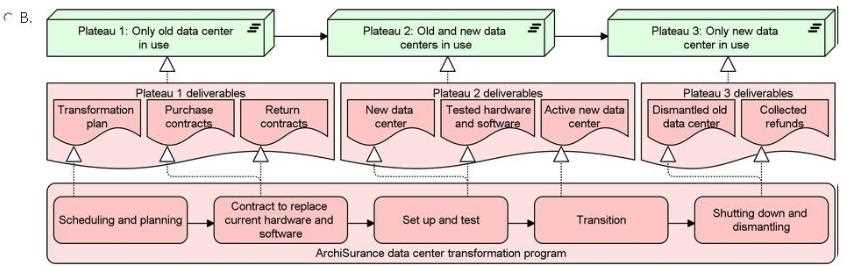
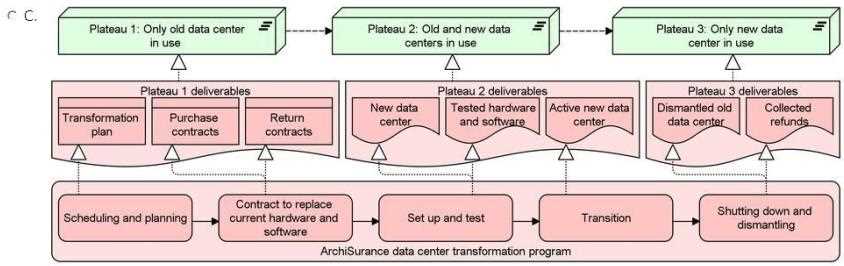
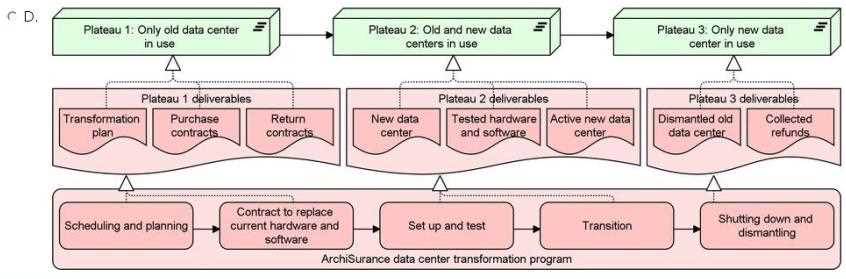
ArchiSurance management has therefore planned a multi-phase data center transformation
program. All of the activities in each phase are necessary to ensure a progression of stable and fully
functional data center configurations. The first phase consists of detailed scheduling and planning to
produce a comprehensive transformation plan that meets ArchiSurance timing and scheduling
requirements During the second phase, ArchiSurance is to contract for the hardware and software
required for the new datacenters,as well for refunds for the hardware and software to be returned
from the current data center once it is shut down. During the third phase, the new data centers are
to be set up, and the new hardware and software are to be tested in parallel with what is already in
production. The actual transition between the old and new data centers occurs in the fourth phase,
and the fifth phase involves shutting down and dismantling the old data center, and returning its
hardware and software for contracted refunds. Phases two through five are each to be initiated when
specific conditions are met in the previous phase.
Refer to the Scenario
The newly hired program manager for data center transformation has asked you to describe the
program implementation plan. You must express each of the plan phases as a separate work package
with specific deliverables. You must also show the relationships between phases along with how
each phase contributes to a particular stable data center state.
Which answer provides the best description?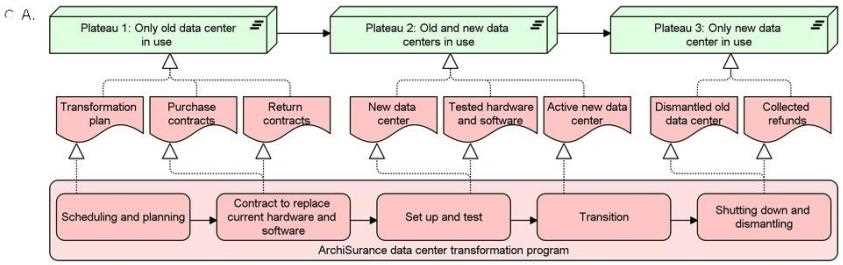
- A. Option A
- B. Option B
- C. Option C
- D. Option D
Answer:
B
Question 5
Scenario
Please read this scenario prior to answering the question
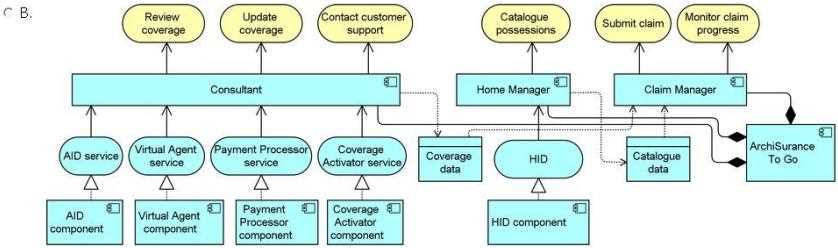
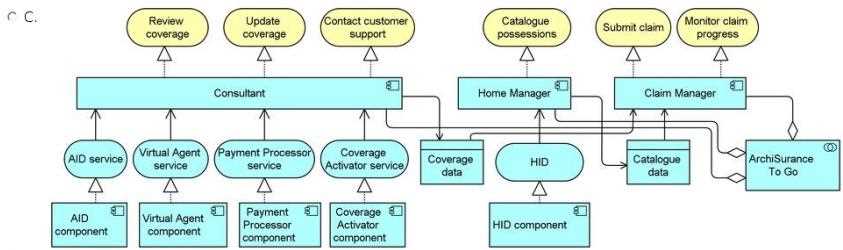
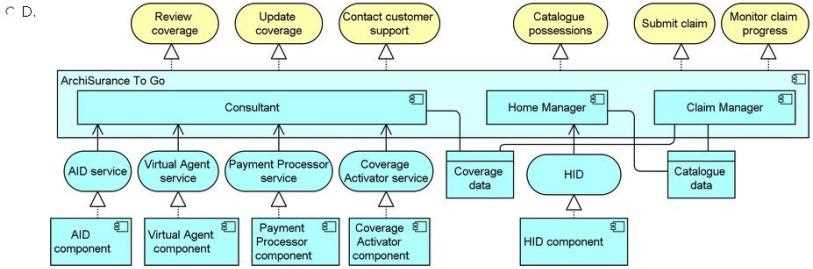
The ArchiSuranceTo Go mobile consumer solution is increasingly important to ArchiSurance, which
uses it to sell and renew insurance products, provide customer service, enable accurate and
convenient home recordkeeping, and capture and process claims. The solution consists of three
components. The Consultant lets customers review their existing coverage, and update it based on
common life events, such as getting a new car, moving into a new home, or having a family member
move in or out. If necessary, they can speak or chat with a customer service representative. The
Home Manager helps customers photograph and catalogue their valuable possessions in order to
support the filing of accurate claims in case of loss or damage. The Claim Manager enables
customers to quickly file a claim for loss or damage to an insured auto, home or possession. It
enables customers to describe the incident by referencing information captured with the Consultant
and the Home Manager applications. In addition, it allows thecustomer to add photocraphs, audio,
video and text to support a claim, submit the claim, and monitor its progress.
The ArchiSuranceTo Go components rely on a number of application services hosted by ArchiSurance.
The first is an Auto Identification and Description (AID) service that the Consultant uses to validate
and complete auto information entered by customers. The second service, Home Identification and
Description (HID) performs the same function for home information, and is used by the Home
Manager. The Consultant also uses the Virtual Agent service to guide customers as they select
coverage options, the Payment Processor service to arrange premium payments, and the Coverage
Activator service to generate policies and put them in force.
ArchiSurance to Go also relies on a number of infrastructure services. The Home Manager uses a
Multimedia Repository service to store and retrieve information about insured homes. The Claim
Manager also uses this service for claim information entered bycustomers. All three components of
ArchiSuranceTo Go use a Personal Security service to register and authenticate customers, and to
manage their profiles.
Each application service is realized by an application component with the same name. Also, each
infrastructure service is realized by a system software environment with the same name.
ArchiSurance hosts both the application components and system software environments in a
virtualized server pool within its data center. Each service has its own virtual server. Each server is
connected to a data center network (DCN) which in turn connects to a commercial wide area
network (WAN).
Refer to the Scenario
The marketing department would like a better understanding of the business services that
ArchiSuranceTo Go delivers, and the application services and components that are used to deliver
those business services. The marketing department would also like to understand the data accessed
directly by the interactive application components.
Which answer provides the best explanation?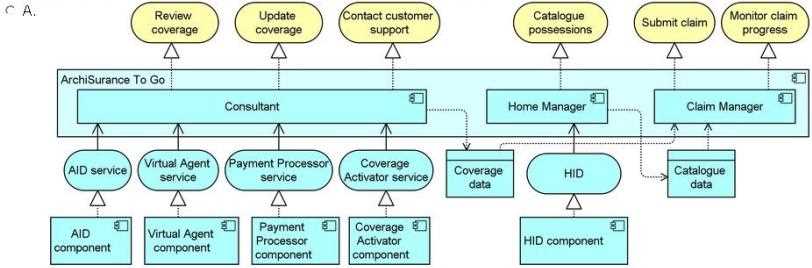
- A. Option A
- B. Option B
- C. Option C
- D. Option D
Answer:
A
Question 6
Scenario
Please read this scenario prior to answering the Question
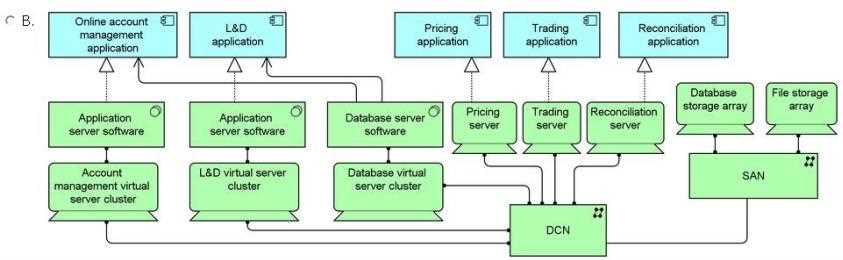
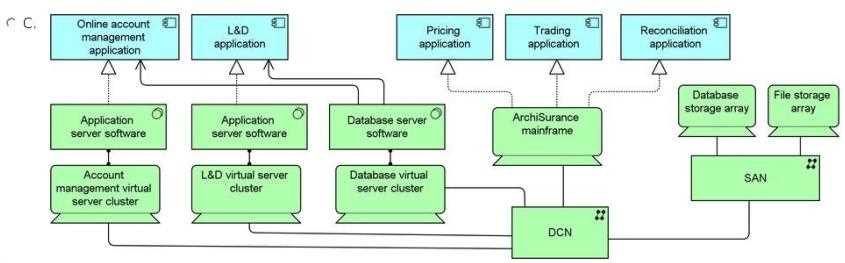
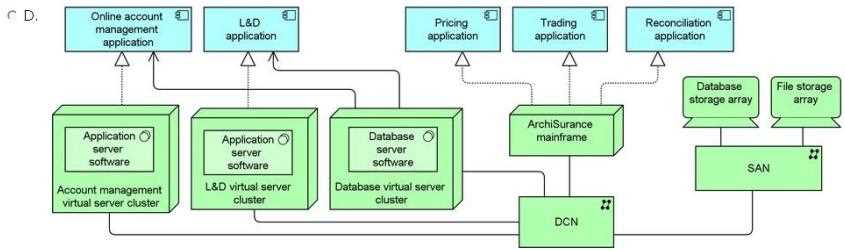
The daily mutual fund trading cycle consists of four key processes: Transaction capture, pricing,
trading and reconciliation. Transaction capture consists of two sub-processes: manual exchange and
loans and distributions (LSD). For transaction capture, retirement plan participants use an online
account management application to enter manual fund exchange transactions. For LSD, plan
participants use a separate application to enter requests. The L&D application determines whether
the request can be fulfilled based on the mutual fund balances held in each plan balances and a set
of business rules. Each day's captured manual exchange transactions accumulate in a transaction
database.
ArchiSurance contracts with a third-party information service to receive a file of mutual fund prices
at the close of each trading day.
The pricing application uses this file to convert captured transaction into trades, and then validates
each trade against the mutual fund balances held in each plan. The pricing generates a trade file with
the minimum number of trades necessary. The trading application sends this file to an external
trading service. When the trading application receives a confirmation file back from the trading
service, it passes it to the reconciliation application, which updates the plan recordkeeping database.
The account management and LSD applications are hosted on separate application server clusters.
Each cluster is a physically separate host that runs application server software on a set of virtualized
hosts. All of these applications use a database server infrastructure that is hosted on another
separate cluster of virtualized servers also on a dedicated physical host. The pricing, consolidation,
trading and reconciliation applications, however, are batch applications that run on the ArchiSurance
mainframe computer. All application hosts are connected via a converged data center network
(DCN), which also connects them to a storage area network (SAN) as well as a wide area network
(WAN) that is used to communicate with the external trading service. The SANincludes two physically
separate storage arrays, ere of which holds data for all databases, and another that holds data for all
files.
Refer to the Scenario
You have been asked by a team of IT auditors to show the applications used for daily trading and the
infrastructure that underlies them, including all ArchiSurance servers, storage arrays and networks. It
is not necessary to model the WAN or other external infrastructure.
Which answer best describes the applications and infrastructure?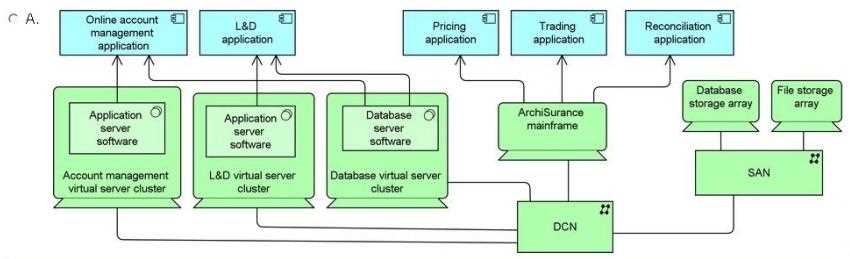
- A. Option A
- B. Option B
- C. Option C
- D. Option D
Answer:
C
Question 7
Scenario
Please read this scenario prior to answering the question
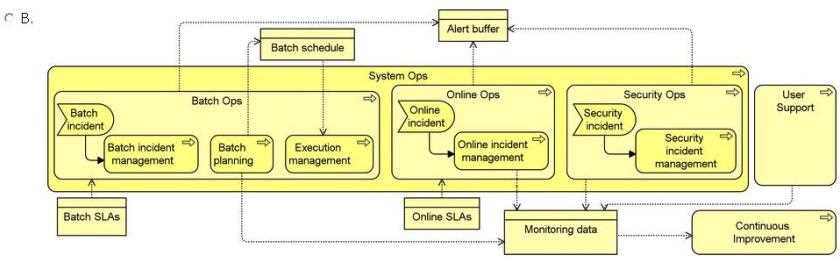
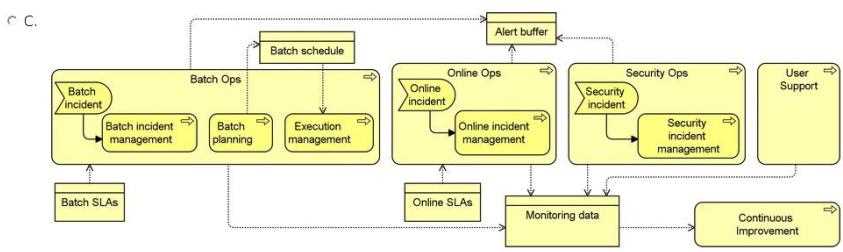
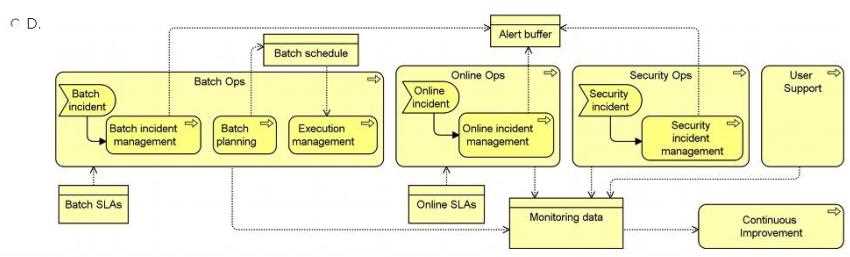
The ArchiSurance IT Operations (IT Ops) department has five core responsibilities, and continuously
executes a core business process for each responsibility. (1) The Batch Ops process makes sure that
batch jobs execute completely, successfully, and on time, consistent with their service level
agreements (SLAs). (2) The Online Ops process makes sure that all web applications and content
delivery services are available and performing according to their SLAs. (3) The Security Ops process
protects ArchiSurance IT operations from being damaged by malicious or careless incidents. (4)The
User Support process assists users of ArchiSurance systems with problems or requests. (5) The
Continuous Improvement process monitors and measures the performance of each of the other
processes and works to solve problems and optimize use of ArchiSurance resources. In order to
enable monitoring, each of the other processes generates monitoring data that is read by the
Continuous Improvement process.
The processes in the System Ops category, which are Batch Ops, Online Ops and Security Qds, each
have a separate sub-process for incident management. These sub-processes are triggered,
respectively, by Batch, Online and Security Incidents. One of the first steps in each incident
management sub-process, is to pass an Incident Alert to each of the other System Ops processes.
This is accomplished by posting the alert to the Alert Buffer.
The Batch Ops process uses a schedule that lists all batch jobs and their dependencies. The schedule
is used by two Batch Ops sub-processes. The Batch Planning sub-process updates this schedule for
use by the Execution Management sub-process.
The Batch Ops process uses a number of applications that interact with each other. The Batch
Scheduler application enables users to manage a database of jobs, job schedules and dependencies,
and launches batch jobs according to the database. The Batch Monitor application uses the job
schedules as a reference to monitor job execution, and reports all exceptional conditions to the both
the Batch Scheduler and the Incident Handler applications via the Alert Buffer described earlier in
the scenario. The Incident Handlerrefers to a set of business rules to determine the systems and
individuals that must be notified of each incident. Based on these determinations, the Incident
Handler produces appropriate notifications.
Due to their criticality, the Batch Scheduler, Batch Monitor and Incident Handler applications are
hosted redundantly in multiple geographically distributed data centers. In each data center, the three
applications are hosted on a fully redundant virtual server cluster. Each cluster is connected to two
site local area networks, each of which connects to a separate physical storage array.
Refer to the scenario
As part of an IT service management initiative, you have been asked to model the operations
management business processes and sub-processes, including their relationships, the events that
trigger them and the information they exchange.
Which answer provides the most complete and accurate model?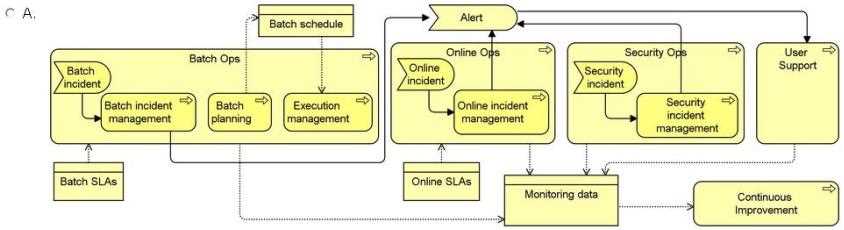
- A. Option A
- B. Option B
- C. Option C
- D. Option D
Answer:
D
Question 8
Scenario
Please read this scenario prior to answering the question
The ArchiSurance enterprise document management infrastructure provides critical support for
myriad types of documents and document-based transactions, many of which are executed in high
volume each day. At the core of the infrastructure is the document management systems software,
which has three major modules: a document engine that stores, retrieves and performs a variety of
operations on documents, a workflow engine that hosts document management applications, and an
application engine, which hosts the most sophisticated applications. The application engine invokes
the document and workflow engines as necessary when hosting application components that require
their services.
The claim management application component is critical to ArchiSurance business operations. It is
hosted by the application engine, and launches whenever an individual files a new claim. The claim
management component requires different documents to demonstrate proof of loss depending on
the type of claim filed, the type of insurance that is in force, and various other circumstances. When
the correct documents are filed and verified by an intake operator, proof of loss is complete, and the
claim management component assigns the claim to a claim analyst by reading and updating analyst
status data and applying business rules stored as data.
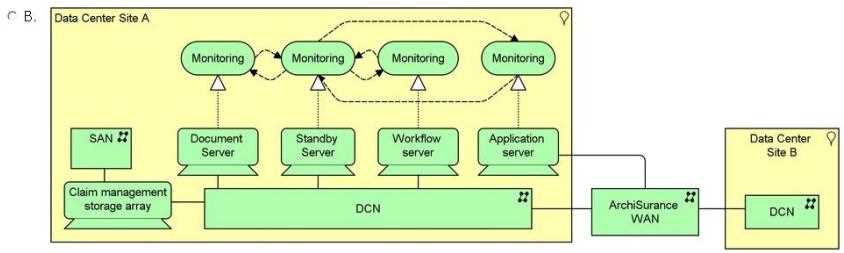
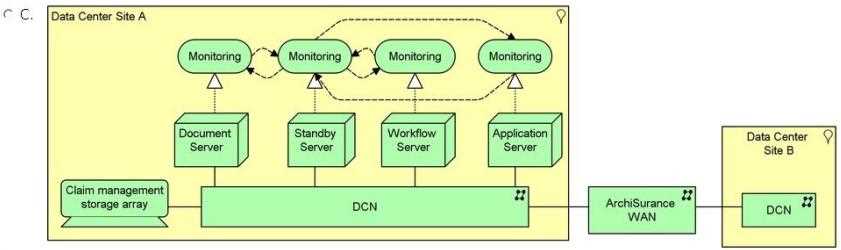
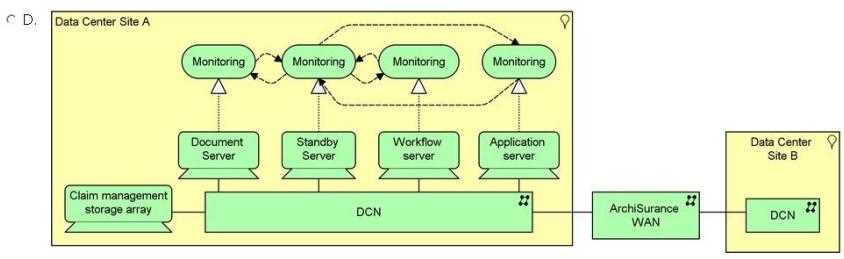
Due to its business-critical nature, the document management solution is hosted redundantly at two
geographically separate data center sites known as Site A and Site B. Both sites provide identical
infrastructure. Each site contains a highly available data center network (DCN) that is connected to
the highly available ArchiSurance wide area network (WAN). Each claim management server is
connected to its site DCN, and each DCN is a converged network that connects both servers and
storage arrays, including a physical storage array dedicated to the claim management application.
Each site contains four high-powered separate physical serversrules stored as data.
Due to its business-critical nature, the document management solution is hosted redundantly at two
geographically separate data center sites known as Site A and Site B. Both sites provide identical
infrastructure. Each site contains a highly available data center network (DCN) that is connected to
the highly available ArchiSurance wide area network (WAN). Each claim management server is
connected to its site DCN, and each DCN is a converged network that connects both servers and
storage arrays, including a physical storage array dedicated to the claim management application.
Each site contains four high-powered separate physical servers dedicated to the claim management
application. At any one time, one server is on standby while the other three servers are, respectively,
hosting the document, workflow and application engines. Each active server provides a monitoring
service that is In constant two-way communication with the monitoring service on the standby
server. If a server fails, the surviving monitoring services perform a failover sequence to assume
failed server's workload if it was active. The surviving monitoring services also alert the operations
team on duty.
Refer to the Scenario
A new IT manager has asked you to model the infrastructure hardware and networks that supports
document management, including the data center sites, servers, storage, and networks as well as
the services necessary for automated failover within a server cluster. Since the two data centers
provide identical document management infrastructure, for Site B it is only necessary to show the
associated networking.
Which is the best answer?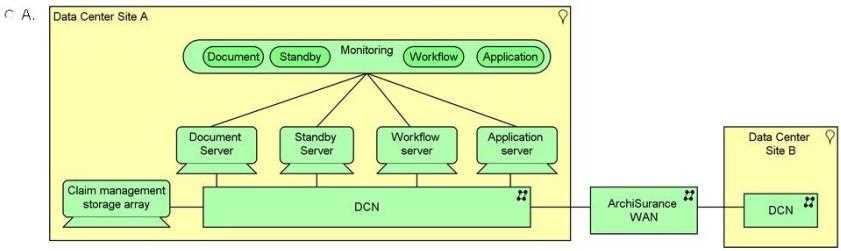
- A. Option A
- B. Option B
- C. Option C
- D. Option D
Answer:
D
Question 9
Scenario
Please read this scenario prior to answering the Question
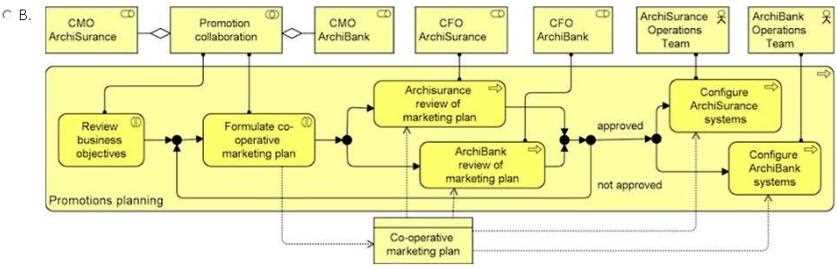
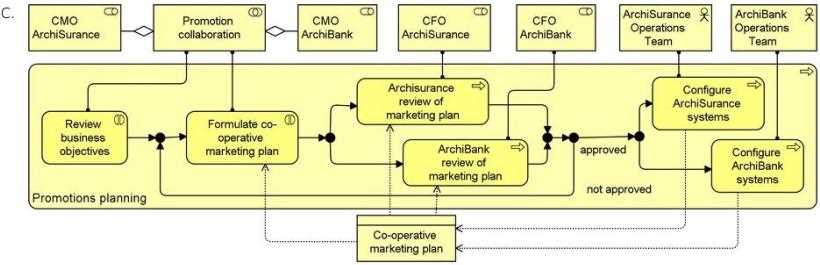
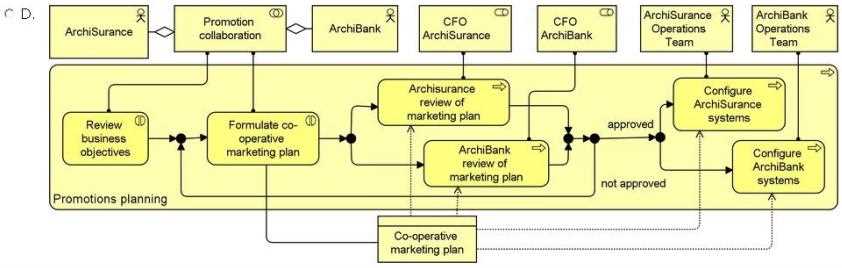
ArchiSurance has a partnership with ArchiBank in which the two companies market each other's
consumer offerings to their own customers. Each quarter, the chief marketing officers (CMOs) of the
two companies work together to plan the next quarter's promotions. First, they review each other's
business objectives related to the partnership. Then, they formulate the co-operative marketing
plan. The CMOs determine which offerings they will promote, the characteristics of the target
customers, and the timing of each promotion. They assemble their findings into a co-operative
marketing plan that is reviewed separately by the chief financial officer (CFO) of each organization. If
either of the CFOs finds a problem, the CMOs must quickly work together to formulate another
version of the plan. The review and reformulation process continues until both CFOs have approved a
version of the plan. Then, the CMOs share the plans with their respective operations teams. Each
organization's operations team configures the bank's systems to execute the joint promotions.
The cooperative marketing process is enabled by CRM software delivered as a service (SaaS). The
two organizations each use separate logical instances of a multi-tenant customer relationship
management (CRM) application hosted by a service provider. Each company's CRM instance is a
dedicated function of the same CRM application component. The dedicated functions also share the
same multi-tenant database. The component's data access layer is designed with safeguards to keep
each company's data separate unless it is intentionally shared.
Each CRM instance has targeting, exchange and outreach sub-functions. The targeting sub-functions
select customers based on criteria developed by the CMOs and configured by the operations teams.
The exchange sub-functions share the selected customer profiles with each other, and the outreach
sub-functions generate promotional email. In this way, each company's CRM system generates a list
of target customers that the other company's CRM system uses to send promotional email.
The multi-tenant CRM application component is hosted on a large virtual server complex that is
connected via a site network to a physical storage array and a commercial wide-area network (WAN)
used by both companies. Both companies access their CRM systems via PCs connected to Local Area
Networks (LANs) that are in turn connected to the shared commercial WAN.
Refer to the Scenario
In preparation for a presentation to investors, the ArchiSurance chief financial officer has asked you
to model the business architecture of the partnership, including the executives and teams involved,
the information they exchange, and the activities they perform.
Which answer best describes this business architecture?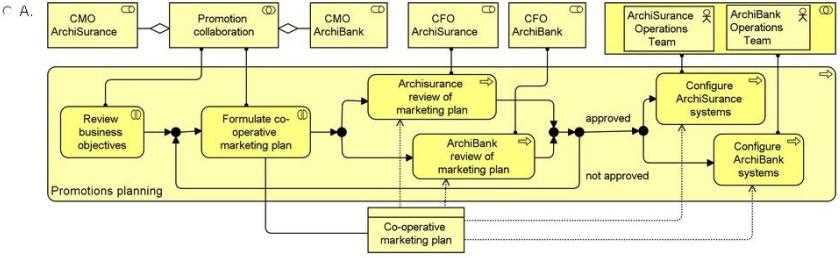
A.Option A
B.Option B
C.Option C
D.Option D
Answer:
B
Question 10
Scenario
Please read this scenario prior to answering the question
The ArchiSurance enterprise document management infrastructure provides critical support for
myriad types of documents and document-based transactions, many of which are executed in high
volume each day. At the core of the infrastructure is the document management systems software,
which has three major modules: a document engine that stores, retrieves and performs a variety of
operations on documents, a workflow engine that hosts document management applications, and an
application engine, which hosts the most sophisticated applications. The application engine invokes
the document and workflow engines as necessary when hosting application components that require
their services.
The claim management application component is critical to ArchiSurance business operations. It is
hosted by the application engine, and launches whenever an individual files a new claim. The claim
management component requires different documents to demonstrate proof of loss depending on
the type of claim filed, the type of insurance that is in force, and various other circumstances. When
the correct documents are filed and verified by an intake operator, proof of loss is complete, and the
claim management component assigns the claim to a claim analyst by reading and updating analyst
status data and applying business rules stored as data.
Due to its business-critical nature, the document management solution is hosted redundantly at two
geographically separate data center sites known as Site A and Site B. Both sites provide identical
infrastructure. Each site contains a highly available data center network (DCN) that is connected to
the highly available ArchiSurance wide area network (WAN). Each claim management server is
connected to its site DCN, and each DCN is a converged network that connects both servers and
storage arrays, including a physical storage array dedicated to the claim management application.
Each site contains four high-powered separate physical servers dedicated to the claim management
application. At any one time, one server is on standby while the other three servers are, respectively,
hosting the document, workflow and application engines. Each active server provides a monitoring
service that is In constant two-way communication with the monitoring service on the standby
server. If a server fails, the surviving monitoring services perform a failover sequence to assume
failed server's workload if it was active. The surviving monitoring services also alert the operation
team on duty.
Refer to the Scenario
A new IT manager has asked you to model the applications and system software elements involved in
document management, including the services they provide, the data objects they handle, and how
they work together.
Which answer best models this information?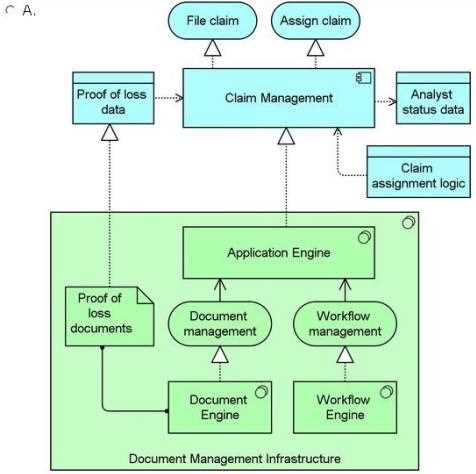
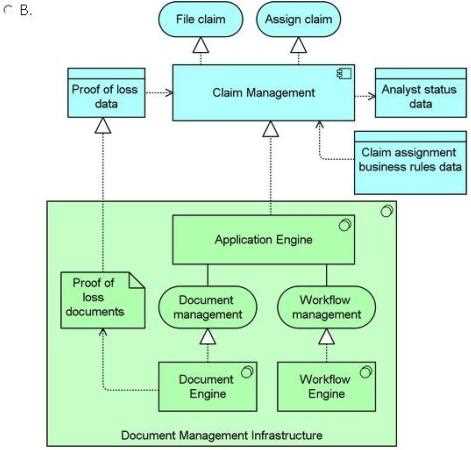
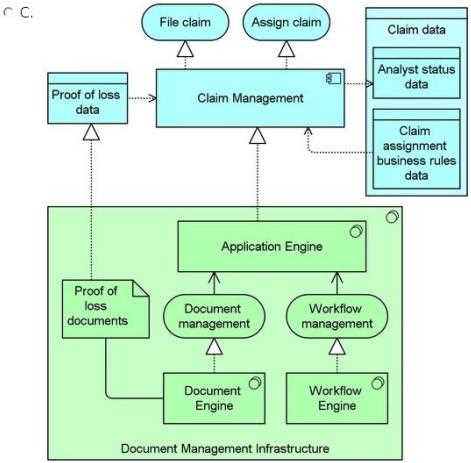
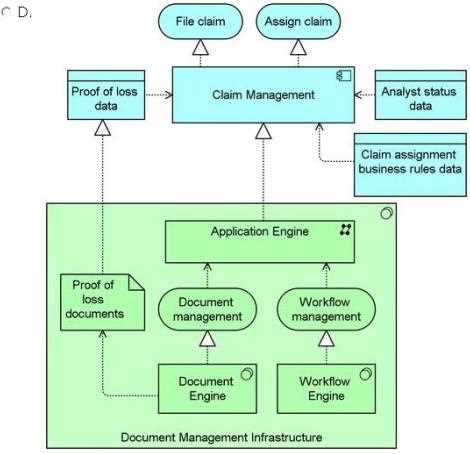
A.Option A
B.Option B
C.Option C
D.Option D
Answer:
A
Question 11
Scenario
Please read this scenario prior to answering the question
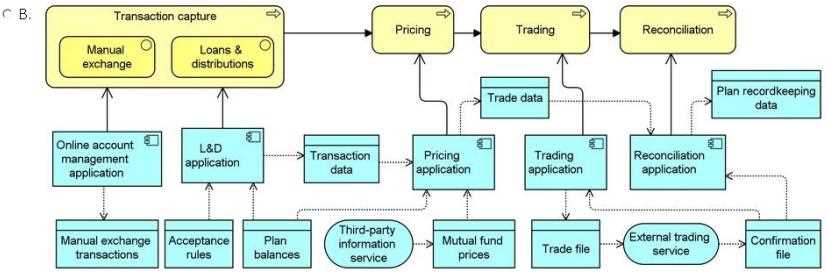
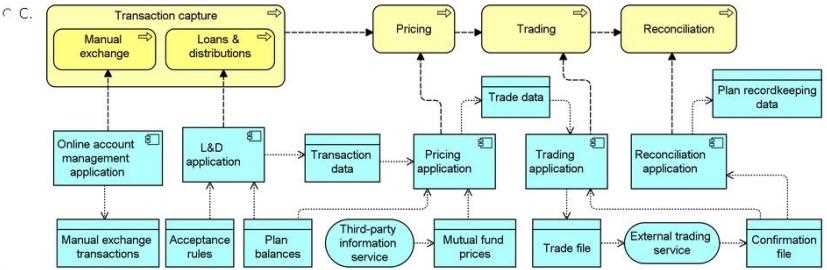
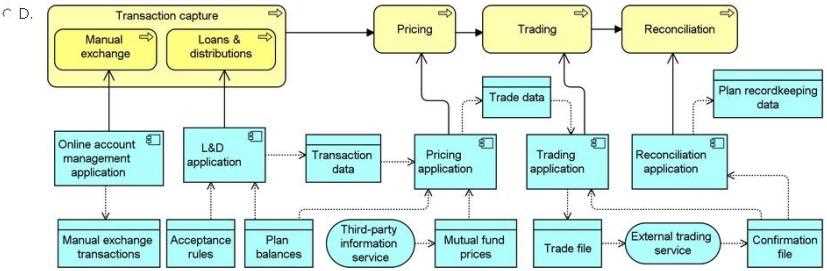
The daily mutual fund trading cycle consists of four key processes: Transaction capture, pricing,
trading and reconciliation. Transaction capture consists of two sub-processes: manual exchange and
loans and distributions (LSD). For transaction capture, retirement plan participants use an online
account management application to enter manual fund exchange transactions. For L&D, plan
participants use a separate application to enter requests. The L&D application determines whether
the request can be fulfilled based on the mutual fund balances held in each plan balances and a set
of business rules. Each day's captured manual exchange transactions accumulate in a transaction
database.
ArchiSurance contracts with a third-party information service to receive a file of mutual fund prices
at the close of each trading day. The pricing application uses this file to convert captured transaction
into trades, and then validates each trade against the mutual fund balances held In each plan. The
pricing generates a trade file with the minimum number of trades necessary. The trading application
sends this file to an external trading service. When the trading application receives a confirmation
file back from the trading service, it passes it to the reconciliation application, which updates the
plan recordkeeping database.
The account management and LSD applications are hosted on separate application server clusters.
Each cluster is a physically separate host that runs application server software on a set of virtualized
hosts. All of these applications use a database server infrastructure that is hosted on another
separate cluster of virtualized servers also on a dedicated physical host. The pricing, consolidation,
trading and reconciliation applications, however, are batch applications that run on the ArchiSurance
mainframe computer. All application hosts are connected via a converged data center network
(DCN), which also connects them to a storage area network (SAN) as well as a wide area network
(WAN) that is used to communicate with the external trading service. The SANincludes two physically
separate storage arrays, one of which holds data for all databases, and another that holds data for all
files.
Refer to the Scenario
A newly-formed team of systems analysts would like to better understand the business processes
and applications for daily fund trading. Describe the business processes and sub-processes, the
applications that they use, the data objects accessed by those applications, and the external
application services that access some of those data objects.
Which is the best answer?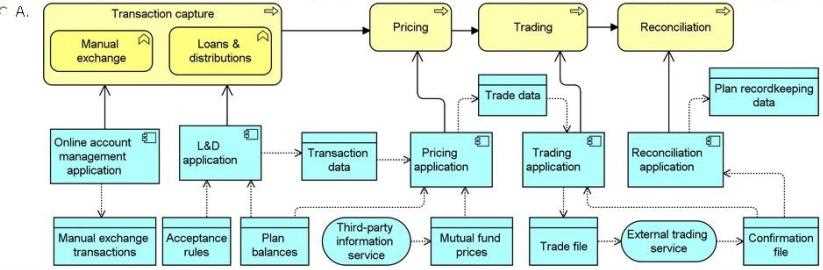
A.Option A
B.Option B
C.Option C
D.Option D
Answer:
D
Question 12
Scenario
Please read this scenario prior to answering the question
ArchiSurance has entered into a legal agreement to acquire ArchiSpecialty, a specialty insurer that
has several lines of business, including insuring organizations that conduct high-stakes contests. Prior
to entering into this agreement, ArchiSurance staff carefully examined the ArchiSpecialty Enterprise
Architecture to develop an integration plan with four successive phases. Each phase of the plan
provides a stable foundation for ArchiSurance to conduct its newly expanded business while making
significant progress toward the targeted integration of ArchiSpecialty operations. The first phase of
the plan, Common Ownership, will begin on the acquisition date specified in the legal agreement.
The second through fourth phases will begin after their predecessors are complete.
During the Common Ownership phase, the two companies' websites will be linked to each other and
their interactive voice response (IVR) system menus will be integrated. During the second phase,
known as Integrated Organizations, the corresponding ArchiSurance and ArchiSpecialty departments
will be combined and all financial processing will be migrated to the original ArchiSurance systems.
In the third Phase, known as Integrated Customer Operations, ArchiSpecialty customer relationship
management (CRM) data will be migrated to the corresponding ArchiSurance applications. In the
fourth and final phase, known as Integrated Operations, the ArchiSpecialty claims data will be
migrated to the corresponding ArchiSurance applications. However, the ArchiSpecialty underwriting
solution for high-stakes contests will be retained due to its unique capabilities.
The underwriting solution for high-stakes contests assists underwriters in creating a policy to insure
against the possibility of a contestant winning an improbable but expensive award, such as $1 million
US for hitting a hole-in-one on a golf course, or a luxury world cruise for a winning spin of a roulette
wheel. In return for a single premium payment, the insurer agrees to pay the award if a contestant
earns it fairly. When an underwriter receives a request for an insurance quote, either from a
promotions company that is planning the contest or from a company with its own promotions
department, he uses the Contest Modeler application to precisely describe the planned contest and
the coverage requested, and to store the contest model in a machine-readable format. Then, the
underwriter uses the Contest Query application, which reads the contest model and queries a
collection of audited contest results to find records of similar contests. Then, the underwriter uses
the Contest Estimator application to estimate the premium for the coverage request, and also to
produce a report with a recommended set of conditions to provide with the quote. After consulting
the report, the underwriter uses the Quoting Tool application to prepare a quote for the customer.
Then, the underwriter sends the quote to the customer via secure email. If the customer accepts the
quote, the underwriter uses the Contract Generator to prepare a contract for the customer, which he
also sends via secure email. In the contract, the customer agrees to employ a contest auditor who
will report the audited results of the contest regardless of whether prizes are awarded. The
underwriter uses the Contest Tracker application to add these reports to the collection of audited
contest results. Note that all reports are delivered in a standard markup language that can be read by
other software programs and either processed in the background or rendered visually.
Refer to the Scenario
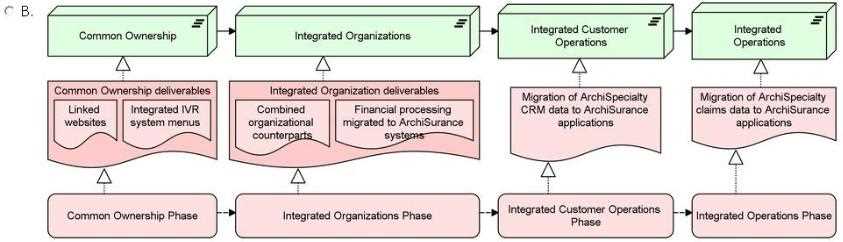
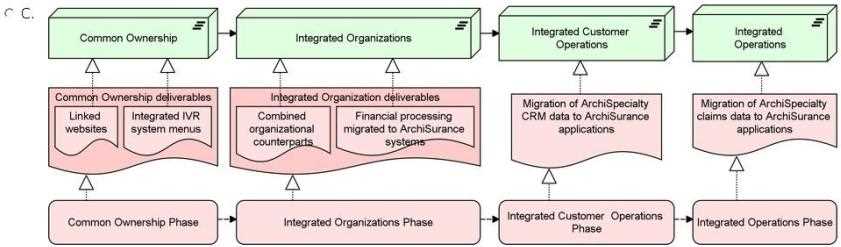
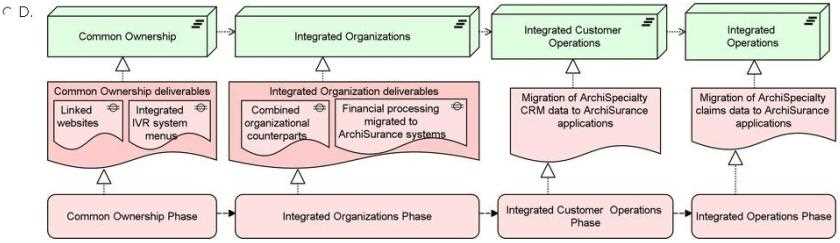
The executive in charge of the ArchiSpecialty acquisition has asked you to illustrate the integration
roadmap. You must show that each phase of the acquisition realizes a separate plateau. For each
plateau, you must identify the deliverables described in the scenario.
Which answer provides the best illustration?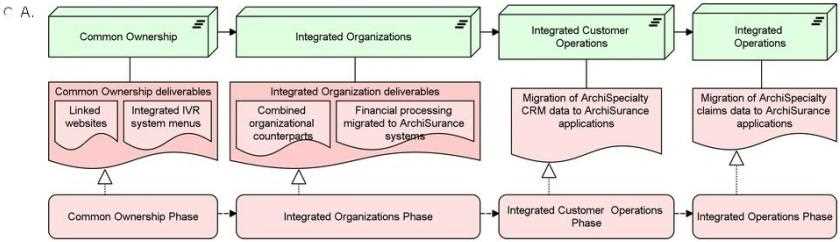
A.Option A
B.Option B
C.Option C
D.Option D
Answer:
B
Question 13
Scenario
Please read this scenario prior to answering the question
The ArchiSuranceTo Go mobile consumer solution is increasingly important to ArchiSurance, which
uses it to sell and renew insurance products, provide customer service, enable accurate and
convenient home recordkeeping, and capture and process claims. The solution consists of three
components. The Consultant lets customers review their existing coverage, and update it based on
common life events, such as getting a new car, moving into a new home, or having a family member
move in or out. If necessary, they can speak or chat with a customer service representative. The
Home Manager helps customers photograph and catalogue their valuable possessions in order to
support the filing of accurate claims in case of loss or damage. The Claim Manager enables
customers to quickly file a claim for loss or damage to an insured auto, home or possession. It
enables customers to describe the incident by referencing information captured with the Consultant
and the Home Manager applications. In addition, it allows the customer to add photographs, audio,
video and text to support a claim, submit the claim, and monitor its progress.
The ArchiSurancetoGo components rely on a number of application services hosted by ArchiSurance.
The first is an Auto Identification and Description (AID) service that the Consultant uses to validate
and complete auto information entered by customers. The second service, Home Identification and
Description (HID) performs the same function for home information, and is used by the Home
Manager. The Consultant also uses the Virtual Agent service to guide customers as they select
coverage options, the Payment Processor service to arrange premium payments, and the Coverage
Activator service to generate policies and put them in force.
ArchiSurance to Go also relies on a number of infrastructure services. The Home Manager uses a
Multimedia Repository service to store and retrieve information about insured homes. The Claim
Manager also uses this service for claim information entered by customers. All three components of
ArchiSuranceTo Go use a Personal Security service to register and authenticate customers, and to
manage their profiles.
Each application service is realized by an application component with the same name. Also, each
infrastructure service is realized by a system software environment with the same name.
ArchiSurance hosts both the application components and system software environments in a virtual
ized server pool within its data center. Each service has its own virtual server. Each server is
connected to a data center network (DCN) which in turn connects to a commercial wide area
network (WAN).
Refer to the Scenario
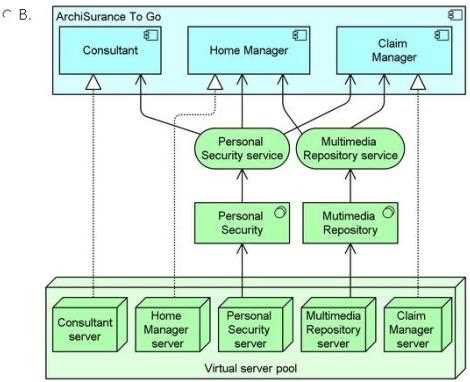
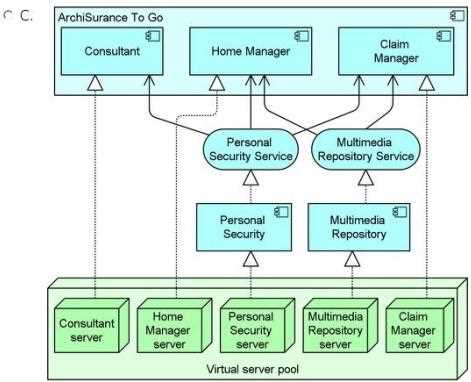
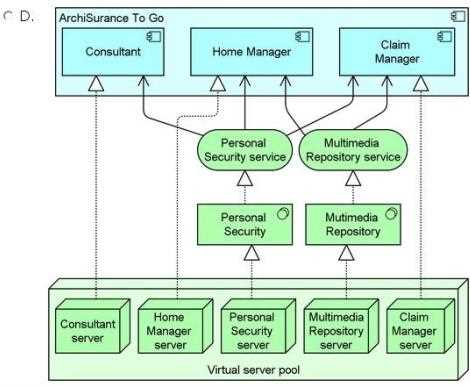
The new head of IT infrastructure would like a better understanding of the applications used by
ArchiSurance to Go mobile solution and the hosting infrastructure that supports these applications.
Which answer provides the best description of the applications and their underlying infrastructure?
(Please note that it is not necessary to model the networks).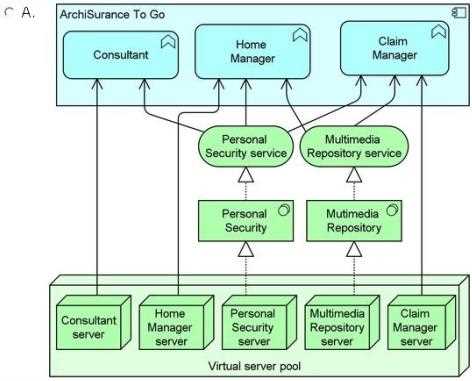
A.Option A
B.Option B
C.Option C
D.Option D
Answer:
D
Question 14
Scenario
Please read this scenario prior to answering the question
The ArchiSurance IT Operations (IT Ops) department has five core responsibilities, and continuously
executes a core business process for each responsibility. (1) The Batch Ops process makes sure that
batch jobs execute completely, successfully, and on time, consistent with their service level
agreements (SLAs). (2) The Online Ops process makes sure that all web applications and content
delivery services are available and performing according to their SLAs. (3) The Security Ops process
protects ArchiSurance IT operations from being damaged by malicious or careless incidents. (4)The
User Support process assists users of ArchiSurance systems with problems or requests. (5) The
Continuous Improvement process monitors and measures the performance ot each of the other
processes and works to solve problems and optimize use of ArchiSurance resources. In order to
enable monitoring, each of the other processes generates monitoring data that is read by the
Continuous Improvement process.
The processes in the System Ops category, which are Batch Ops, Online Ops and Security Ops, each
have a separate sub-process for incident management. These sub-processes are triggered,
respectively, by Batch, Online and Security Incidents. One of the first steps in each incident
management sub-process, is to pass an Incident Alert to each of the other System Ops processes.
This is accomplished by posting the alert to the Alert Buffer.
The Batch Ops process uses a schedule that lists all batch jobs and their dependencies. The schedule
is used by two Batch Ops sub-processes. The Batch Planning sub-process updates this schedule for
use by the Execution Management sub-process.
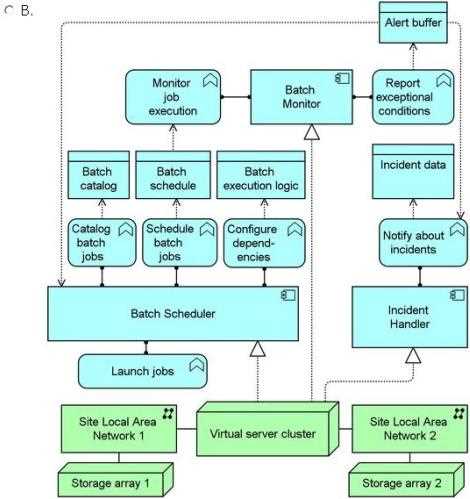
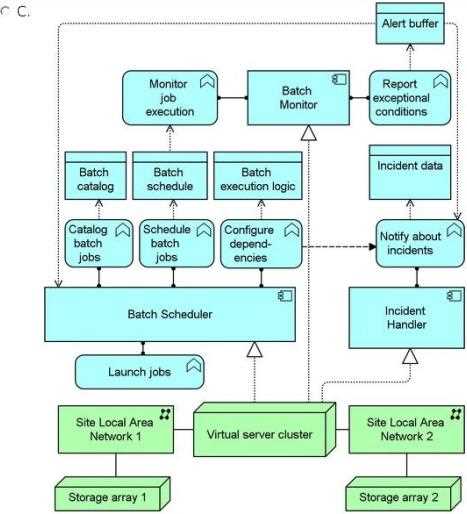
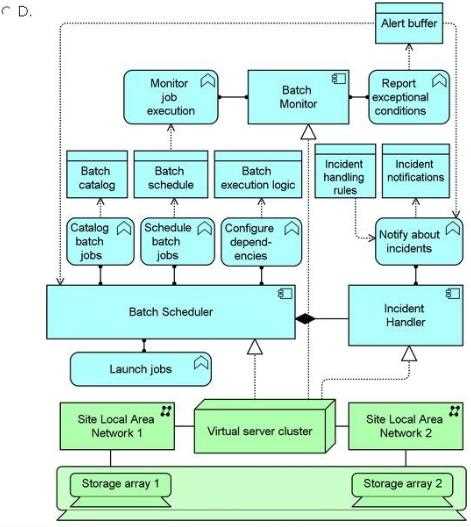
The Batch Ops process uses a number of applications that interact with each other. The Batch
Scheduler application enables users to manage a database of jobs, job schedules and dependencies,
and launches batch jobs according to the database. The Batch Monitor application uses the job
schedules as a reference to monitor job execution, and reports all exceptional conditions to the both
the Batch Scheduler and the Incident Handler applications via the Alert Buffer described earlier In
the scenario. The Incident Handler refers to a set of business rules to determine the systems and
individuals that must be notified of each incident. Based on these determinations, the Incident
Handler produces appropriate notifications.
Due to their critical ity, the Batch Scheduler, Batch Monitor and Incident Handler applications are
hosted redundantly in multiple geographically distributed data centers. In each data center, the three
applications are hosted on a fully redundant virtual server cluster. Each cluster is connected to two
site local area networks, each of which connects to a separate physical storage array.
Refer to the scenario
As part of an IT service management initiative, you have been asked to show how applications and
infrastructure support the Batch Ops process. Model the applications, their functions, the data they
access, and the infrastructure that hosts the applications and data, along with the networks that
connect the servers. It is only necessary to model a single data center.
Which answer provides the most complete and accurate model?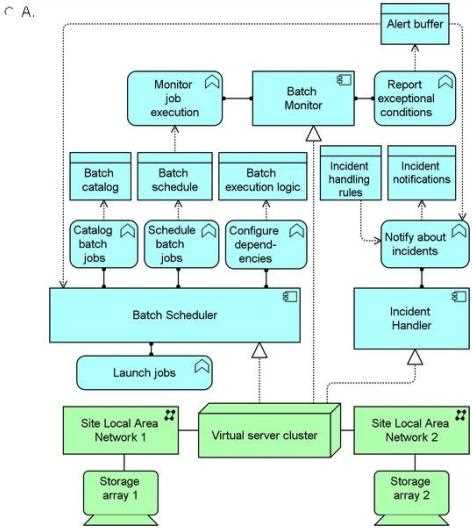
A.Option A
B.Option B
C.Option C
D.Option D
Answer:
A
Question 15
Scenario
Please read this scenario prior to answering the question
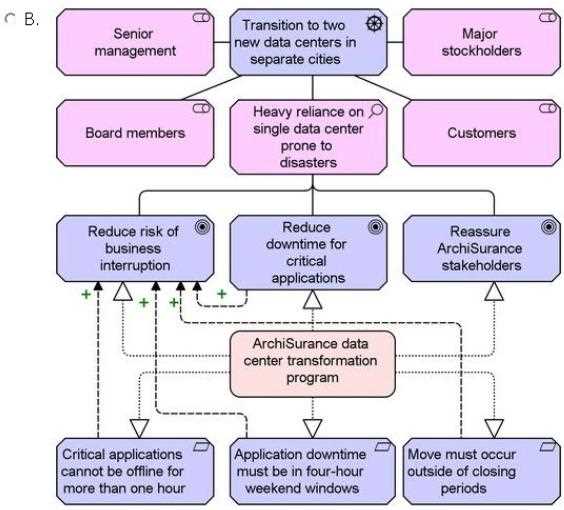
ArchiSurance senior management; board members, customers and major stockholders have long
been concerned about disaster resiliency in light of the company's heavy reliance on a single data
center. The data center is located in an area that is prone to flooding and earthquakes, according to
expert assessments done by consultants retained for this purpose. In addition, the data center is
located under a busy cafeteria, and water occasionally leaks through its ceiling.
To address these problems, ArchiSurance has developed a plan to move from its current data center
to a pair of ready-to-use data centers in separate cities. The data center move is designed to reduce
the risk of business interruption, reduce both planned and unplanned downtime for critical
applications, and reassure ArchiSurance stakeholders. However, a number of limitations make the
planned transition to the new data centers particularly challenging. A number of critical ArchiSurance
applications cannot be offline for more than an hour, and any downtime for these application must
only occur in certain four-hour windows each weekend. Also, the move cannot occur during
quarterly or year-end closing periods in order to avoid interrupting critical processing. Fulfillment of
these specific type of requirements will reduce the risk of business interruption from the data center
move activities themselves.
ArchiSurance management has therefore planned a multi-phase data center transformation
program. All of the activities in each phase are necessary to ensure a progression of stable and fully
functional data center configurations. The first phase consists of detailed scheduling and planning to
produce a comprehensive transformation plan that meets ArchiSurance timing and scheduling
requirements. During the second phase, ArchiSurance is to contract for the hardware and software
required for the new datacenters, as well for refunds for the hardware and software to be returned
from the current data center once it is shut down. During the third phase, the new data centers are
to be set up, and the new hardware and software are to be tested in parallel with what is already in
production. The actual transition between the old and new data centers occurs in the fourth phase,
and the fifth phase involves shutting down and dismantling the old data center, and returning its
hardware and software for contracted refunds. Phases two through five are each to be initiated when
specific conditions are met in the previous phase.
Refer to the Scenario
The head of IT has asked you to help her explain why ArchiSurance decided to transform its data
center infrastructure. You must model the stakeholders, the motivations, and the influencing
relationships between these motivations. You must also model the specific goals realized by the data
center transformation program and the limitations within which this program must operate.
Which answer provides the best explanation?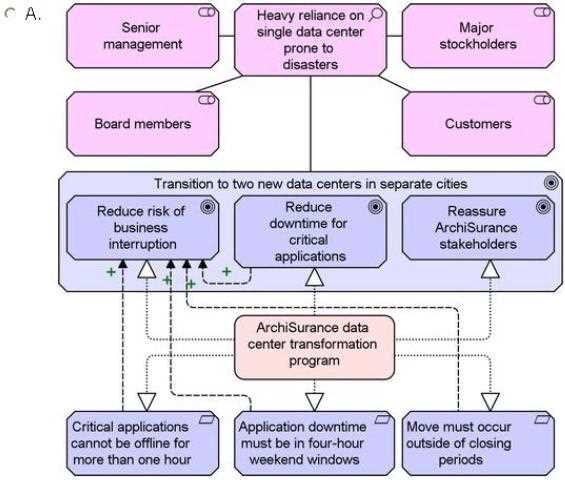
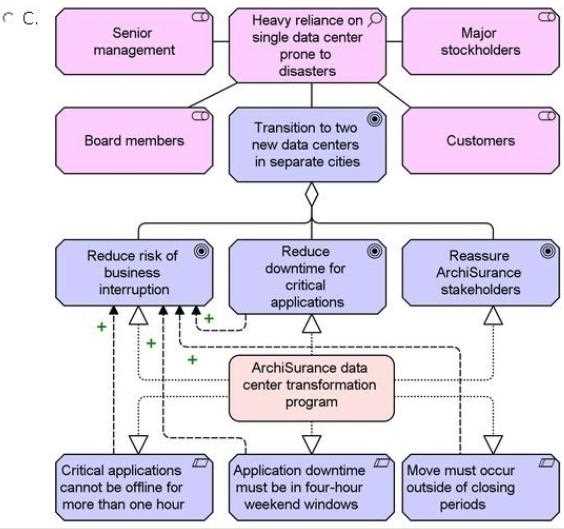
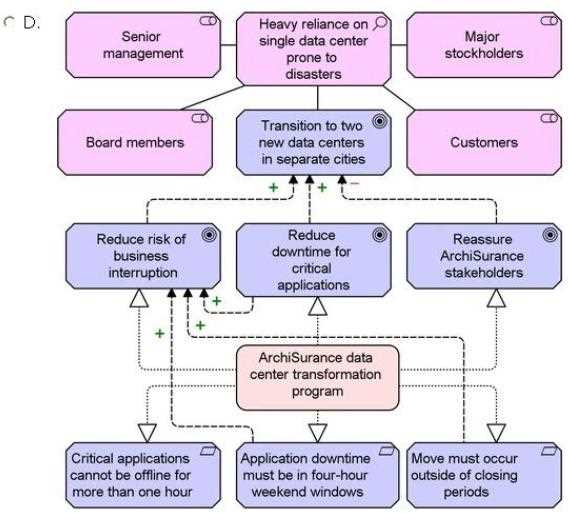
A.Option A
B.Option B
C.Option C
D.Option D
Answer:
A