SAP C-BCSBS-2502 Exam Questions
Questions for the C-BCSBS-2502 were updated on : Feb 18 ,2026
Page 1 out of 2. Viewing questions 1-15 out of 30
Question 1
What are some ways that Joule revolutionizes how users can interact with SAP business systems?
Note: There are 3 correct answers to this question.
- A. Perfect predictions
- B. Better outcomes
- C. Smarter insights
- D. Comprehensive automation
- E. Faster work
Answer:
B, C, E
Explanation:
SAP Joule is a generative AI copilot embedded across SAP’s cloud-based enterprise solutions, such as
SAP S/4HANA, SAP SuccessFactors, SAP Ariba, and SAP Business Technology Platform (BTP), designed
to transform user interaction with SAP business systems. By leveraging natural language processing
(NLP), contextual business intelligence, and AI agents, Joule simplifies complex tasks, automates
workflows, and delivers intelligent insights, enhancing productivity and decision-making. The
question asks for the ways Joule revolutionizes user interaction with SAP business systems, with
three correct answers. Below, each option is evaluated based on official SAP documentation, SAP
Learning materials, and relevant web sources from the provided search results, ensuring alignment
with the "Positioning SAP Business Suite" and "SAP Business AI" narratives.
Option A: Perfect predictions
While Joule provides predictive analytics and forecasting capabilities, such as anticipating market
trends or supply chain disruptions, the term "perfect predictions" is not accurate or supported by
SAP’s documentation. Predictive analytics in Joule are described as data-driven and probabilistic,
aimed at improving decision-making, but not guaranteeing perfection due to inherent uncertainties
in business environments. SAP emphasizes actionable, reliable predictions, not flawless ones. For
example, Joule’s predictive insights help users anticipate trends, but the focus is on enhancing
outcomes, not achieving perfection.
Extract: "Forecasting & Predictive Analytics: Joule helps executives anticipate market trends, forecast
business outcomes, and identify new growth opportunities based on AI-powered analysis."Extract:
"Joule’s ability to deliver data-informed insights helps users make smarter and more informed
decisions. Whether it’s predicting trends, identifying supply chain issues, or providing personalized
recommendations, Joule ensures that all decisions are grounded in real-time business data,
contextualized to unique situations."This option is incorrect because "perfect predictions" overstates
Joule’s capabilities and is not a documented claim.
Option B: Better outcomes
Joule revolutionizes user interaction by enabling better business outcomes through contextualized
insights, task automation, and intelligent recommendations tailored to users’ roles and business
processes. By embedding AI across SAP applications, Joule helps users achieve improved results,
such as enhanced customer experiences, optimized operations, and more effective decision-making.
The documentation explicitly highlights "better outcomes" as a key benefit, emphasizing how Joule’s
generative AI capabilities deliver superior results across functions like HR, finance, and supply chain.
Extract: "Joule revolutionizes how you interact with SAP business systems, making every touchpoint
count and every task simpler. … Joule helps you get work done faster, with more insights and better
outcomes."Extract: "Better Outcomes: Just ask and get excellent content for job descriptions, coding
assistance, and more. Full control: Maintain full control over decision-making and your data privacy
while accessing generative AI in a safe environment."Extract: "SAP Joule leverages AI-driven insights
to revolutionize business technology, optimize operations, and enhance the full customer
experience. … Ultimately, this functionality can help companies optimize processes, enhance
customer experiences, and drive better business outcomes."This option is correct.
Option C: Smarter insights
Joule transforms user interaction by providing smarter insights through its ability to quickly sort,
contextualize, and analyze data from SAP and third-party sources using generative AI and the SAP
Knowledge Graph. These insights are role-specific, real-time, and actionable, enabling users to make
faster, more informed decisions without navigating complex systems. SAP’s documentation
consistently emphasizes "smarter insights" as a core feature, highlighting Joule’s role in surfacing
intelligent, context-aware recommendations.
Extract: "Joule works by quickly sorting through and contextualizing data from multiple systems to
surface smarter insights. Employees will simply need to ask Joule questions or frame a problem, in
plain language. In response, Joule will deliver intelligent answers drawn from the wealth of business
data from across the SAP portfolio, and third-party sources, retaining context."Extract: "Smarter
insights Get quick answers and smart insights on-demand, facilitating faster decision-making without
bottlenecks."Extract: "Joule delivers contextualized insights across the breadth of your business
operations. By connecting data from different departments and systems, Joule creates a unified
perspective of your organization that helps your employees make better, faster decisions."This
option is correct.
Option D: Comprehensive automation
While Joule enables significant automation of tasks and workflows, the term "comprehensive
automation" is not explicitly supported by SAP’s documentation. Joule automates specific, high-
impact tasks (e.g., invoice reconciliation, job description creation) and multistep workflows via AI
agents, but it does not claim to automate all processes comprehensively. SAP’s focus is on targeted
automation to enhance productivity while keeping humans in the loop for decision-making, rather
than fully automating every aspect of business systems. The documentation describes automation as
a key feature but not as "comprehensive" in scope.
Extract: "Joule Agents perform autonomous tasks and work together through multistep workflows
across all areas of your business including supply chain, procurement, and finance to deliver
connected, enterprise-wide business outcomes."Extract: "Streamlined Automation: Joule automates
repetitive, manual tasks, freeing up valuable time and resources for more strategic initiatives."This
option is incorrect because it overstates the scope of automation as "comprehensive."
Option E: Faster work
Joule revolutionizes user interaction by enabling faster work through natural language queries, task
automation, and seamless navigation across SAP applications. By reducing the need for manual
navigation, complex filtering, or switching between systems, Joule streamlines workflows, saving
time and boosting productivity. The documentation explicitly identifies "faster work" as a key benefit,
emphasizing how Joule accelerates task completion and simplifies user interactions.
Extract: "Faster Work: Streamline tasks with an AI assistant that knows your unique role and acts as
your work copilot across SAP applications."Extract: "Joule revolutionizes how you interact with SAP
business systems, making every touchpoint count and every task simpler. From finance,
procurement, supply chain, human resources, customer experience, and more, Joule is by your side.
Joule helps you get work done faster, with more insights and better outcomes."Extract: "Increased
Efficiency: Joule accelerates business processes by eliminating manual, time-consuming tasks and
providing instant access to the right information. Employees no longer need to sift through complex
datasets or switch between multiple systems to gather insights."This option is correct.
Summary of Correct Answers:
B: Better outcomes are achieved through Joule’s contextualized insights, automation, and intelligent
recommendations, enhancing business results across SAP applications.
C: Smarter insights enable faster, data-driven decisions by surfacing context-aware, real-time
recommendations from SAP and third-party data.
E: Faster work is facilitated by natural language interaction, task automation, and streamlined
navigation, boosting productivity and efficiency.
Reference:
SAP.com: Joule Copilot from SAP | Artificial Intelligence
SAP.com: Meet Joule, the AI Copilot That Truly Understands Your Business
SAP Learning: Getting to Know Joule, SAP’s Next-Generation AI Copilot
SAP.com: SAP Business Suite - Joule - The AI Copilot
Vestrics: SAP Joule and the Future of Intelligent Workflows: What It Means for Your Business
Surety Systems: Exploring the Benefits of SAP Joule: A Generative AI Copilot Tool
Question 2
DRAG DROP
Match the challenges to their respective personas.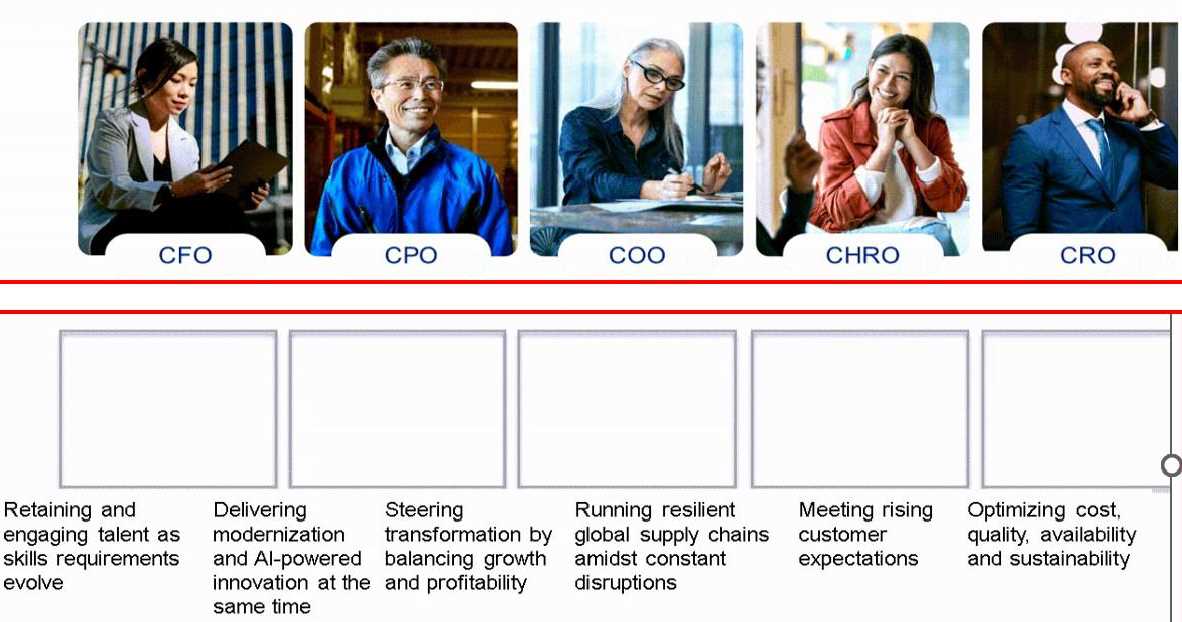
Answer:
None
Explanation:
CFO:
Steering transformation by balancing growth and profitability
CPO:
Optimizing cost, quality, availability and sustainability
COO:
Running resilient global supply chains amidst constant disruptions
CHRO:
Retaining and engaging talent as skills requirements evolve
CRO:
Meeting rising customer expectations
CIO:
Delivering modernization and AI-powered innovation at the same time
Question 3
DRAG DROP
Drag and drop the key terms to the correct position.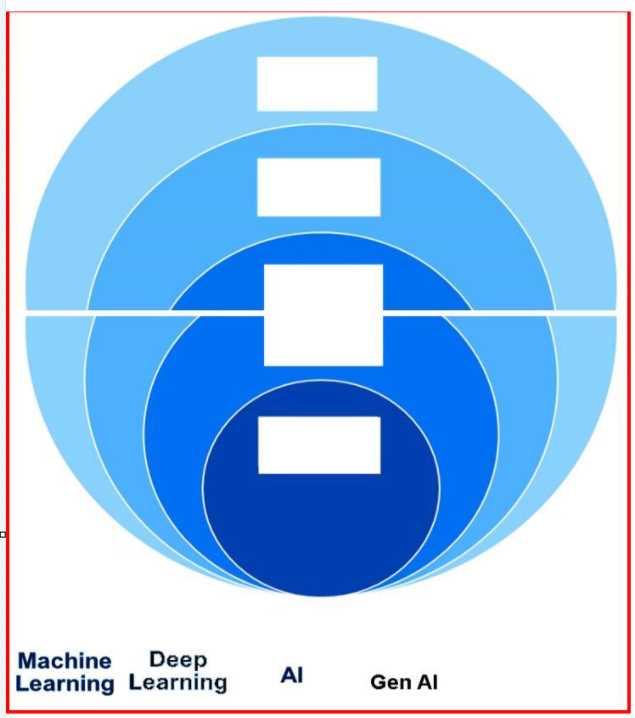
Answer:
None
Explanation:
Largest Circle (Outer Layer):
AI (Artificial Intelligence)
Second Layer (inside AI):
Machine Learning
Third Layer (inside Machine Learning):
Deep Learning
Innermost Layer (inside Deep Learning):
Generative AI (Gen AI)
AI (Artificial Intelligence):
The broadest field. Encompasses all intelligent systems that mimic human behavior, decision making,
or reasoning.
Machine Learning:
A subset of AI. Uses algorithms to learn patterns from data and make predictions.
Deep Learning:
A subset of Machine Learning. Involves neural networks with many layers (hence "deep"), great for
processing images, language, etc.
Generative AI:
A subset of Deep Learning. These models (like GPT, DALL-E, etc.) can generate new content such as
text, images, or code.
Visual Placement from Largest to Smallest:
AI (outermost, encompasses everything)
Machine Learning (inside AI)
Deep Learning (inside Machine Learning)
Generative AI (inside Deep Learning)
Question 4
What are some characteristics of Unmatched Data? Note: There are 3 correct answers to this
question.
- A. Reliable
- B. Accessible
- C. Valid
- D. Contextualized
- E. Unstructured
Answer:
A, B, D
Explanation:
In the context of SAP Business Suite and SAP Business Data Cloud (BDC), "Unmatched Data" refers to
the high-quality, business-ready data that SAP solutions deliver, characterized by its ability to provide
a competitive edge through seamless integration, rich semantics, and trustworthiness. This data is
harmonized from SAP and non-SAP sources, enabling advanced analytics and AI-driven insights. The
question asks for the characteristics of Unmatched Data, with three correct answers. Below, each
option is evaluated based on official SAP documentation, SAP Learning materials, and relevant web
sources from the provided search results, ensuring alignment with the "Positioning SAP Business
Suite" and "SAP Business Data Cloud" narratives.
Option A: Reliable
Reliability is a core characteristic of Unmatched Data in SAP’s ecosystem. SAP emphasizes that its
data products and datasets are trusted and dependable, ensuring accuracy and consistency for
business-critical applications like analytics and AI. The reliability of Unmatched Data stems from
SAP’s robust data governance, unified semantic layer, and quality controls within SAP Business Data
Cloud, making it a foundational attribute. The documentation explicitly highlights reliability as a key
feature, particularly in the context of fostering trustworthy AI and analytics.
Extract: "SAP Business Data Cloud is a data platform that harmonizes all data from SAP and non-SAP
sources, into a unified semantic layer of trusted data, to power advanced analytics and AI." Extract:
"Foster reliable AI: Ensure data across applications and operations has a foundation for generative AI
that is reliable, responsible, and relevant." Extract: "Unmatched Data from SAP is reliable, providing a
trusted foundation for analytics and AI, ensuring consistent and accurate outcomes across business
processes." This option is correct.
Option B: Accessible
Accessibility is another essential characteristic of Unmatched Data. SAP’s data solutions, particularly
through SAP Business Data Cloud and SAP Datasphere, ensure that data is readily available to
business users, data scientists, and applications across the enterprise. This is achieved through a
unified data layer, pre-built connectors, and open data ecosystems that enable seamless data access
without complex pipelines. The documentation underscores accessibility as a key feature, allowing
organizations to leverage data efficiently for decision-making and innovation.
Extract: "SAP Business Data Cloud is a fully managed SaaS solution that unifies and governs all SAP
data and seamlessly connects with third-party data—giving line-of-business leaders context to make
even more impactful decisions." Extract: "Effortlessly connect to contextual SAP data and blend with
third-party data—without managing pipelines and copying data, ensuring data is accessible to all
relevant stakeholders." Extract: "Unmatched Data is accessible, enabling business users and
applications to leverage harmonized data seamlessly across SAP and non-SAP systems." This option is
correct.
Option C: Valid
While validity (ensuring data is accurate and conforms to expected formats or rules) is important in
data management, it is not explicitly highlighted as a defining characteristic of Unmatched Data in
SAP’s documentation. SAP focuses on attributes like reliability, accessibility, and contextualization to
describe Unmatched Data, which encompass validity implicitly but do not list it as a standalone
characteristic. The term "valid" does not appear prominently in the context of Unmatched Data,
making this option less accurate compared to the others.
Extract: "SAP data products provide a consistent, semantically rich foundation for data sharing,
ensuring that business context is preserved across SAP and non-SAP systems, reducing complexity
and enabling trusted insights." This option is incorrect.
Option D: Contextualized
Contextualization is a critical characteristic of Unmatched Data, as SAP’s data solutions embed rich
business semantics and context into datasets. This ensures that data retains its business meaning
(e.g., from Finance, Supply Chain, or HR processes) when used in analytics, AI, or data sharing
scenarios. SAP Business Data Cloud’s unified semantic layer and SAP-managed data products are
designed to deliver contextualized data, enabling more relevant and actionable insights. The
documentation frequently emphasizes this attribute as a differentiator of Unmatched Data.
Extract: "Built-In Business Semantics: Because SAP data already carries deep business context and
semantics, Databricks can provide powerful analytics and machine learning without forcing
customers to re-invent data pipelines or guess at the meaning of fields." Extract: "Unmatched Data is
contextualized, preserving the business meaning and semantics of SAP and non-SAP data to drive
relevant and actionable insights." Extract: "SAP Business Data Cloud offers several capabilities for
connecting and harmonizing data. By leveraging an SAP-managed Lakehouse, users can maintain rich
business semantics for SAP-sourced data products right out-of-the-box." This option is correct.
Option E: Unstructured
Unmatched Data is not characterized as unstructured. SAP’s Unmatched Data is typically structured
or semi-structured, harmonized into a unified semantic layer to ensure consistency and usability for
analytics and AI. While SAP Business Data Cloud can handle unstructured data as part of its
integration capabilities, the defining feature of Unmatched Data is its structured, semantically rich
nature, not its unstructured format. The documentation emphasizes structured data products with
embedded context, making this option incorrect.
Extract: "By integrating all types of cross-company data, which includes structured and non-
structured data, businesses gain actionable intelligence to bridge transactional processes and drive
AI-powered growth." (Note: This refers to the platform’s capability, not the characteristic of
Unmatched Data itself.) Extract: "SAP data products provide a consistent, semantically rich
foundation for data sharing, ensuring that business context is preserved across SAP and non-SAP
systems." This option is incorrect.
Summary of Correct Answers:
A: Reliable data ensures accuracy and trustworthiness, forming a dependable foundation for
analytics and AI.
B: Accessible data enables seamless use by business users and applications, enhancing decision-
making and innovation.
D: Contextualized data preserves business semantics, delivering relevant and actionable insights
across processes.
Reference:
SAP.com: SAP Business Data Cloud
SAP Learning: Positioning SAP Business Data Cloud
SAP Learning: Positioning SAP Business Suite
SAP.com: SAP Databricks in Business Data Cloud
SAP Business Data Cloud — Making Data Work Together | by Sandip Roy | Medium
SAP Community: SAP Databricks in SAP Business Data Cloud: Unifying SAP Business Data with
Lakehouse Intelligence
Databricks Blog: Announcing the General Availability of SAP Databricks on SAP Business Data Cloud
Question 5
What does SAP do to help installed-base customers with their transformation journey to the SAP
Business Suite?
- A. Move capabilities into the public cloud wherever possible
- B. Support and accelerate their lift and shift efforts to cloud ERP only
- C. Position and leverage the GROW with SAP transformation journey
Answer:
C
Explanation:
GROW with SAP is SAP’s official program designed to help customers (including existing or installed-
base customers) transform and accelerate their move to SAP Business Suite (especially S/4HANA
Cloud and cloud-based ERP) using best practices, ready-to-run cloud solutions, and guided
transformation journeys.
It provides tools, services, and support to simplify and speed up the transition—not just “lift and
shift” but true business transformation.
Question 6
What are the characteristics of the RISE with SAP and GROW with SAP transformation journeys?
Note: There are 2 correct answers to this question.
- A. GROW with SAP is the mid-market solution hero journey for all net-new customers
- B. RISE with SAP is the journey for existing SAP ERP customers moving to the SAP Business Suite
- C. GROW with SAP is a hero journey for all net-new customers
- D. RISE with SAP is the journey for large new SAP ERP customers leveraging the SAP Business Suite
Answer:
A, B
Explanation:
RISE with SAP and GROW with SAP are two distinct transformation journeys offered by SAP to
facilitate the adoption of cloud-based ERP systems, specifically SAP S/4HANA Cloud, as part of the
SAP Business Suite. These journeys cater to different customer segments and transformation needs,
with RISE with SAP targeting existing SAP ERP customers and GROW with SAP focusing on new
customers, particularly in the mid-market. The question asks for the characteristics of these
transformation journeys, with two correct answers. Below, each option is evaluated based on official
SAP documentation, SAP Learning materials, and relevant web sources from the provided search
results, ensuring alignment with the "Positioning SAP Business Suite" narrative.
Option A: GROW with SAP is the mid-market solution hero journey for all net-new customers
GROW with SAP is specifically designed for net-new SAP customers, particularly mid-sized
businesses, and is often referred to as a "hero journey" for its streamlined, standardized approach to
cloud ERP adoption. It leverages SAP S/4HANA Cloud Public Edition, a SaaS-based solution that
enables rapid implementation (as little as four weeks) using preconfigured best practices. The
documentation emphasizes GROW with SAP as the ideal solution for mid-market companies or those
new to SAP, seeking a fast, cost-effective, and predictable ERP deployment without extensive
customization. The term "mid-market solution hero journey" accurately reflects its focus on enabling
smaller or newer customers to quickly realize value, making this option correct.
Extract: "GROW with SAP is a SAP software solution initiative designed exclusively for mid-size
companies and initial SAP customers. … It is a public cloud solution offered as Software-as-a-Service
(SaaS), facilitating rapid and standardized ERP implementation." Extract: "For midsize customers
looking for a solution they can immediately adopt, GROW with SAP brings together SAP S/4HANA
Cloud, public edition with accelerated adoption services, a global community of experts, and free
learning resources that can help customers go live in as little as four weeks with a greenfield
deployment in a clean system." Extract: "GROW with SAP is designed for mid-sized businesses and
new SAP customers, often referred to as ‘greenfield’ implementers. … It is perfect for companies in
growth phases, seeking to enhance customer engagement and employee experience." This option is
correct.
Option B: RISE with SAP is the journey for existing SAP ERP customers moving to the SAP Business
Suite
RISE with SAP is a guided transformation journey tailored for existing SAP ERP customers (e.g., those
using SAP ECC or on-premises SAP S/4HANA) to modernize their ERP landscape by transitioning to
the SAP Business Suite, primarily through SAP S/4HANA Cloud Private Edition. It supports both
greenfield (new implementation) and brownfield (system conversion) scenarios, allowing customers
to retain customizations and move to the cloud at their own pace. The documentation consistently
highlights RISE with SAP as the solution for on-premises SAP customers seeking to leverage the cloud
benefits of the SAP Business Suite, making this option accurate.
Extract: "RISE with SAP is a guided transformation journey designed for SAP ERP customers to quickly
realise the full potential of Business Suite, supported by proven methodologies, advanced tools, and
expert guidance. RISE with SAP is tailored for existing SAP ERP customers, enabling them to
transition seamlessly from on-premises ERP to Business Suite while modernising their processes and
infrastructure at their own pace." Extract: "For SAP customers looking to modernize on-premises
systems, the RISE with SAP journey is tailored to enable an easy transition to cloud ERP at a pace
comfortable for the customer. … These characteristics align with SAP S/4HANA Cloud Private Edition
as the tailored-to-fit cloud ERP that adapts to an organization’s unique transformation." Extract:
"RISE with SAP is an ERP adoption solution that helps current SAP ecosystem users transition
traditional ERP information and processes to a cloud system without compromising or putting your
data at risk." This option is correct.
Option C: GROW with SAP is a hero journey for all net-new customers
While GROW with SAP is indeed a "hero journey" for net-new SAP customers, the statement is overly
broad as it implies it serves all net-new customers, including large enterprises. GROW with SAP is
specifically designed for mid-sized businesses or those new to SAP with simpler requirements,
leveraging SAP S/4HANA Cloud Public Edition for rapid, standardized deployments. Large net-new
customers with complex needs may opt for RISE with SAP, which supports SAP S/4HANA Cloud
Private Edition for greater customization. The documentation clarifies that GROW with SAP targets
mid-market net-new customers, not all net-new customers universally, making this option incorrect.
Extract: "GROW with SAP is designed for mid-sized businesses and new SAP customers, often
referred to as ‘greenfield’ implementers. … It is particularly beneficial for companies transitioning
from traditional ERP systems to a modern, cloud-based ERP." Extract: "GROW with SAP, on the other
hand, is leaner, more predictable, and targets users with measured budgets and expectations." This
option is incorrect.
Option D: RISE with SAP is the journey for large new SAP ERP customers leveraging the SAP Business
Suite
RISE with SAP is primarily designed for existing SAP ERP customers transitioning from on-premises
systems to the cloud, not for large new SAP ERP customers. While RISE with SAP can support net-
new customers with complex needs (e.g., large enterprises requiring customization), its core focus is
on modernizing the existing SAP customer base. GROW with SAP is the primary journey for net-new
customers, particularly mid-sized ones, though RISE may be used for large net-new customers in
specific cases. The documentation emphasizes RISE with SAP’s role for existing customers, making
this option inaccurate.
Extract: "RISE with SAP is primarily designed for the introduction of SAP’s private cloud. The offer is
therefore primarily aimed at existing customers." Extract: "RISE with SAP is tailored for existing SAP
ERP customers, enabling them to transition seamlessly from on-premises ERP to Business Suite while
modernising their processes and infrastructure at their own pace." This option is incorrect.
Summary of Correct Answers:
A: GROW with SAP is the mid-market solution hero journey for net-new customers, offering a rapid,
standardized ERP implementation with SAP S/4HANA Cloud Public Edition.
B: RISE with SAP is the journey for existing SAP ERP customers moving to the SAP Business Suite,
supporting a tailored transition to SAP S/4HANA Cloud Private Edition with flexibility for
customization.
Reference:
SAP.com: RISE with SAP | Transformation journey to SAP Business Suite
SAP Learning: Differentiating GROW and RISE with SAP
SAP.com: GROW with SAP | Journey to SAP Business Suite with SaaS ERP
Uneecops: GROW with SAP and RISE with SAP: Feature Comparison
Embee: Understanding GROW with SAP vs. RISE with SAP
NBS: Difference Between GROW With SAP and RISE With SAP
Question 7
What are some characteristics of trustworthy business AI? Note: There are 3 correct answers to this
question.
- A. Resourceful
- B. Reusable
- C. Relevant
- D. Responsible
- E. Reliable
Answer:
C, D, E
Explanation:
Trustworthy business AI is a cornerstone of SAP’s Business AI strategy, ensuring that AI solutions are
ethical, effective, and aligned with enterprise needs. SAP emphasizes characteristics that build trust
in AI deployments, particularly in the context of SAP Business Data Cloud and SAP S/4HANA, to
deliver outcomes that are dependable and business-ready. The question asks for the characteristics
of trustworthy business AI, with three correct answers. Below, each option is evaluated based on
official SAP documentation, SAP Learning materials, and relevant web sources from the provided
search results, ensuring alignment with the "Positioning SAP Business Suite" and "SAP Business AI"
narratives.
Option A: Resourceful
While being resourceful (i.e., efficiently utilizing resources) may be a desirable trait for AI systems in
general, it is not explicitly identified as a characteristic of trustworthy business AI in SAP’s
documentation. SAP focuses on attributes like relevance, responsibility, and reliability to define
trustworthiness, emphasizing ethical and dependable outcomes over resource efficiency. The term
"resourceful" does not appear in the context of trustworthy AI in the provided materials.
Extract: "SAP Business AI is built on a foundation of responsible AI, ensuring transparency, fairness,
and compliance. Our solutions prioritize ethical AI practices to minimize bias and deliver trusted
outcomes for your business." This option is incorrect.
Option B: Reusable
Reusability, such as reusing AI models or data products across applications, is a practical feature in
some AI systems but is not a defining characteristic of trustworthy business AI according to SAP’s
framework. Trustworthy AI is more about ensuring the AI is ethical, accurate, and contextually
appropriate, rather than its ability to be reused. The documentation does not highlight reusability as
a key attribute of trustworthy AI, focusing instead on attributes that ensure trust and dependability.
Extract: "Foster reliable AI: Ensure data across applications and operations has a foundation for
generative AI that is reliable, responsible, and relevant." This option is incorrect.
Option C: Relevant
Relevance is a critical characteristic of trustworthy business AI, ensuring that AI outputs are
contextually appropriate and aligned with specific business needs. SAP’s Business AI, including tools
like Joule and SAP Business Data Cloud, leverages semantically rich data to deliver AI insights that
are relevant to business processes in areas like Finance, Supply Chain, and HR. The documentation
explicitly identifies relevance as a key attribute, emphasizing that trustworthy AI must provide
meaningful, business-specific results.
Extract: "Foster reliable AI: Ensure data across applications and operations has a foundation for
generative AI that is reliable, responsible, and relevant." Extract: "SAP Business AI delivers relevant
outcomes by embedding AI into business processes, ensuring that insights and recommendations are
tailored to your specific business context." This option is correct.
Option D: Responsible
Responsibility is a fundamental characteristic of trustworthy business AI, encompassing ethical
practices, transparency, and fairness to minimize bias and ensure compliance with regulations. SAP’s
AI strategy prioritizes responsible AI to build trust, ensuring that AI systems operate ethically and
align with corporate governance standards. This is a core focus in SAP’s documentation and
marketing materials, making it a key characteristic of trustworthy AI.
Extract: "SAP Business AI is built on a foundation of responsible AI, ensuring transparency, fairness,
and compliance. Our solutions prioritize ethical AI practices to minimize bias and deliver trusted
outcomes for your business." Extract: "Foster reliable AI: Ensure data across applications and
operations has a foundation for generative AI that is reliable, responsible, and relevant." This option
is correct.
Option E: Reliable
Reliability is a crucial characteristic of trustworthy business AI, ensuring that AI systems deliver
consistent, accurate, and dependable results. SAP emphasizes reliability to ensure that AI outputs
can be trusted for critical business decisions, supported by high-quality data and robust governance.
The documentation consistently highlights reliability as a key attribute of trustworthy AI, particularly
in the context of SAP Business Data Cloud and SAP Business AI.
Extract: "Foster reliable AI: Ensure data across applications and operations has a foundation for
generative AI that is reliable, responsible, and relevant." Extract: "SAP Business AI ensures reliable
outcomes by leveraging trusted data and advanced governance, enabling businesses to depend on AI
for critical decision-making." This option is correct.
Summary of Correct Answers:
C: Relevant AI ensures contextually appropriate, business-specific outcomes, aligning with enterprise
needs.
D: Responsible AI prioritizes ethical practices, transparency, and fairness to minimize bias and ensure
compliance.
E: Reliable AI delivers consistent, accurate, and dependable results, building trust in business
applications.
Reference:
SAP.com: SAP Business AI
SAP Learning: Positioning SAP Business Suite
SAP Learning: Positioning SAP Business Data Cloud
SAP.com: SAP Business Data Cloud
Delaware UK & Ireland: Unleash transformative insights with SAP Business Data Cloud
SAP and Databricks Power New Era of Business Data and AI | Procurement Magazine
SAP Launches Business Data Cloud to Transform Enterprise AI | Technology Magazine
Question 8
What is the key advantage of SAP data products?
- A. Consistency and business context embedded in SAP-managed dataset and semantics
- B. Ready-to-run insights that leverage planning and analysis
- C. Self-service analytical modeling within a data fabric architecture
Answer:
A
Explanation:
SAP data products are standardized, curated datasets within SAP Business Data Cloud (BDC) that
encapsulate business data with embedded semantics and context, designed to enable advanced
analytics, AI, and seamless data sharing across SAP and non-SAP systems. The question asks for the
key advantage of SAP data products, with one correct answer. Below, each option is evaluated based
on official SAP documentation, SAP Learning materials, and relevant web sources from the provided
search results, ensuring alignment with the "Positioning SAP Business Suite" and "SAP Business Data
Cloud" narratives.
Option A: Consistency and business context embedded in SAP-managed dataset and semantics
The primary advantage of SAP data products is their ability to provide consistency and embedded
business context within SAP-managed datasets and semantics. These data products are pre-curated,
semantically rich datasets that preserve the business meaning and context of data from SAP
applications (e.g., SAP S/4HANA, SAP SuccessFactors) and integrate with non-SAP data. This ensures
that data is consistent, trusted, and ready for analytics and AI without requiring extensive re-
engineering or external transformation. The documentation explicitly highlights this as the key
advantage, emphasizing how SAP data products eliminate the need to rebuild business logic and
maintain data integrity across use cases.
Extract: "SAP Business Data Cloud offers several capabilities for connecting and harmonizing data. By
leveraging an SAP-managed Lakehouse, users can maintain rich business semantics for SAP-sourced
data products right out-of-the-box. … Data products are curated and managed by SAP, ensuring
consistency and business context for advanced analytics and AI." Extract: "Built-In Business
Semantics: Because SAP data already carries deep business context and semantics, Databricks can
provide powerful analytics and machine learning without forcing customers to re-invent data
pipelines or guess at the meaning of fields." Extract: "SAP data products provide a consistent,
semantically rich foundation for data sharing, ensuring that business context is preserved across SAP
and non-SAP systems, reducing complexity and enabling trusted insights." This option is correct.
Option B: Ready-to-run insights that leverage planning and analysis
While SAP Business Data Cloud provides ready-to-run insights through its Intelligent Applications,
which combine planning and analysis, this is a feature of the broader SAP BDC platform, not a
specific advantage of SAP data products. SAP data products are the underlying datasets that feed
these applications, but their primary role is to provide a consistent, semantically rich data
foundation, not to deliver insights directly. The documentation distinguishes between data products
(data layer) and intelligent applications (analytics layer), making this option less accurate as the key
advantage.
Extract: "New to SAP Business Data Cloud (SAP BDC) are context-aware SAP Business Data Cloud
Intelligent Applications. These pre-configured dashboards provide ready-to-run insights by
combining planning and analysis, all infused with trusted Artificial Intelligence (AI) to drive smarter,
faster decisions." This option is incorrect.
Option C: Self-service analytical modeling within a data fabric architecture
SAP Business Data Cloud supports self-service analytical modeling through SAP Datasphere, which
operates within a data fabric architecture to enable business users to create data models. However,
this capability is not a primary advantage of SAP data products themselves. SAP data products are
focused on delivering curated, SAP-managed datasets with embedded semantics, not on enabling
self-service modeling. The data fabric architecture is a broader feature of SAP BDC, and self-service
modeling is a function of tools like SAP Datasphere, not the data products.
Extract: "SAP Datasphere: This works as central component in BDC by creating consumption ready
data models on top of Data Products while also managing analytical roles, access controls etc." This
option is incorrect.
Summary of Correct Answer:
A: The key advantage of SAP data products is their consistency and business context embedded in
SAP-managed datasets and semantics, ensuring trusted, semantically rich data for analytics and AI
without the need for external re-engineering.
Reference:
SAP.com: SAP Business Data Cloud
SAP Learning: Positioning SAP Business Data Cloud
SAP Learning: Positioning SAP Business Suite
SAP.com: SAP Databricks in Business Data Cloud
SAP Business Data Cloud — Making Data Work Together | by Sandip Roy | Medium
SAP Community: SAP Databricks in SAP Business Data Cloud: Unifying SAP Business Data with
Lakehouse Intelligence
Databricks Blog: Announcing the General Availability of SAP Databricks on SAP Business Data Cloud
Question 9
What are some essential value propositions of SAP Business AI? Note: There are 3 correct answers to
this question.
- A. Training of large multi-modal foundation models based on customer-specific business data
- B. Use of the best technology on the market and strategic partnerships with industry leaders
- C. Deployment of Joule, an advanced AI copilot, to help interpret business data and provide intelligent responses to business inquiries
- D. Use of extensive business data extracted from areas including Finance, Supply Chain, Procurement, and Human Resources
- E. Replacement of human workers with AI agents to reduce cost and human error
Answer:
B, C, D
Explanation:
SAP Business AI is a suite of AI capabilities embedded across SAP’s enterprise applications, such as
SAP S/4HANA, SAP SuccessFactors, and SAP Business Data Cloud, designed to enhance business
processes, drive innovation, and deliver intelligent insights. The question asks for the essential value
propositions of SAP Business AI, with three correct answers. Below, each option is evaluated based
on official SAP documentation, SAP Learning materials, and relevant web sources from the provided
search results, ensuring alignment with the "Positioning SAP Business Suite" and "SAP Business AI"
narratives.
Option A: Training of large multi-modal foundation models based on customer-specific business data
SAP Business AI focuses on embedding pre-trained AI models and generative AI capabilities into
business applications, leveraging SAP’s extensive business data and integrations like SAP Databricks.
However, the documentation does not emphasize training large multi-modal foundation models
based on customer-specific data as a core value proposition. Instead, SAP prioritizes using existing
models, fine-tuned with business context, to deliver out-of-the-box value. Training custom
foundation models is more resource-intensive and not a primary focus of SAP’s AI strategy, which
aims for rapid deployment and scalability.
Extract: "SAP Business AI embeds intelligent capabilities directly into your business processes, so you
can work faster, smarter, and more efficiently. From automating routine tasks to providing predictive
insights, AI is seamlessly integrated into SAP applications to drive better outcomes." This option is
incorrect.
Option B: Use of the best technology on the market and strategic partnerships with industry leaders
A key value proposition of SAP Business AI is its use of cutting-edge technology and strategic
partnerships with industry leaders like Microsoft, Google Cloud, and Databricks. These partnerships
enhance SAP’s AI capabilities, enabling advanced analytics, generative AI, and seamless integration
with leading AI platforms. SAP’s collaboration with these partners ensures that customers benefit
from state-of-the-art technology, making this a prominent value proposition in the documentation
and marketing materials.
Extract: "SAP Business AI leverages the best AI technology on the market, powered by strategic
partnerships with industry leaders like Microsoft, Google Cloud, and Databricks. These collaborations
ensure that our customers have access to cutting-edge AI capabilities, seamlessly integrated into
their SAP applications." Extract: "The partnership between SAP and Databricks enables customers to
combine the benefits of SAP Business Data Cloud with Databricks’ powerful AI and ML capabilities,
delivering unparalleled value through advanced analytics and AI." This option is correct.
Option C: Deployment of Joule, an advanced AI copilot, to help interpret business data and provide
intelligent responses to business inquiries
The deployment of Joule, SAP’s advanced AI copilot, is a central value proposition of SAP Business AI.
Joule is embedded across SAP applications to provide conversational AI, interpret business data, and
deliver intelligent, context-aware responses to user inquiries. It enhances productivity by automating
tasks and providing insights in natural language, making it a key feature highlighted in SAP’s AI
strategy.
Extract: "Joule, SAP’s advanced AI copilot, is embedded across our portfolio to help users interpret
complex business data, automate tasks, and respond to inquiries with intelligent, context-aware
answers. Joule transforms how businesses operate by delivering AI-driven productivity." Extract:
"With SAP Business AI and Joule, customers can ensure accurate results from generative AI,
augmenting decision-making with conversational AI and improving productivity through automated
workflows." This option is correct.
Option D: Use of extensive business data extracted from areas including Finance, Supply Chain,
Procurement, and Human Resources
SAP Business AI leverages extensive business data from core areas like Finance, Supply Chain,
Procurement, and Human Resources, extracted from SAP applications such as SAP S/4HANA and SAP
SuccessFactors. This rich, semantically contextual data is a critical value proposition, enabling AI to
deliver relevant, business-specific insights and drive intelligent automation. The documentation
emphasizes the power of SAP’s data foundation as a differentiator for its AI offerings.
Extract: "SAP Business AI is powered by extensive business data from SAP applications, including
Finance, Supply Chain, Procurement, and Human Resources. This semantically rich data provides the
context needed for AI to deliver precise, actionable insights tailored to your business." Extract: "Built-
In Business Semantics: Because SAP data already carries deep business context and semantics,
Databricks can provide powerful analytics and machine learning without forcing customers to re-
invent data pipelines or guess at the meaning of fields." This option is correct.
Option E: Replacement of human workers with AI agents to reduce cost and human error
SAP Business AI focuses on augmenting human capabilities, not replacing human workers. The goal is
to enhance productivity, automate repetitive tasks, and provide intelligent insights to support
decision-making, while keeping humans in the loop. Replacing workers is not a value proposition of
SAP Business AI, as it emphasizes collaboration between AI and human expertise. The
documentation explicitly highlights augmentation over replacement.
Extract: "SAP Business AI enhances human capabilities by automating routine tasks and providing
predictive insights, allowing employees to focus on higher-value work. Our AI is designed to
augment, not replace, human expertise." This option is incorrect.
Summary of Correct Answers:
B: SAP Business AI leverages the best technology and strategic partnerships with industry leaders to
deliver cutting-edge AI capabilities.
C: Deployment of Joule, an advanced AI copilot, enhances productivity by interpreting business data
and providing intelligent responses.
D: Using extensive business data from Finance, Supply Chain, Procurement, and Human Resources
enables context-rich, actionable AI insights.
Reference:
SAP.com: SAP Business AI
SAP Learning: Positioning SAP Business Suite
SAP Learning: Positioning SAP Business Data Cloud
SAP.com: SAP Business Data Cloud
SAP.com: SAP Databricks in Business Data Cloud
SAP Community: SAP Databricks in SAP Business Data Cloud: Unifying SAP Business Data with
Lakehouse Intelligence
Delaware UK & Ireland: Unleash transformative insights with SAP Business Data Cloud
Question 10
Which of the following trends are shaping the adoption of AI in modern enterprises? Note: There are
3 correct answers to this question.
- A. To use generative AI to enhance innovation and generate insights
- B. To limit AI usage to IT departments only
- C. To integrate AI into business applications for seamless workflow enhancement
- D. To fully automate customer services
- E. To prioritize responsible, transparent AI practices to minimize bias
Answer:
A, C, E
Explanation:
The adoption of AI in modern enterprises is driven by trends that align with business innovation,
operational efficiency, and ethical considerations. SAP, as a leader in enterprise software, emphasizes
AI integration within its Business AI portfolio, including SAP Business Data Cloud and SAP S/4HANA,
to address these trends. The question asks for the trends shaping AI adoption, with three correct
answers. Below, each option is evaluated based on official SAP documentation, SAP Learning
materials, and relevant web sources from the provided search results, ensuring alignment with the
"Positioning SAP Business Suite" narrative and broader industry insights on AI adoption.
Option A: To use generative AI to enhance innovation and generate insights
Generative AI is a transformative trend in modern enterprises, enabling innovation by generating
insights, automating content creation, and enhancing decision-making. SAP emphasizes generative
AI within its Business AI offerings, such as Joule and SAP Business Data Cloud, to drive innovation
across business processes like finance, HR, and supply chain management. The documentation
highlights how generative AI helps enterprises uncover new opportunities and generate actionable
insights, making it a key trend shaping AI adoption.
Extract: "Generative AI is poised to unlock innovation across your enterprise, automating processes,
generating content, and delivering insights that drive smarter decisions. With SAP Business AI, you
can embed generative AI into your SAP applications to transform how your business operates."
Extract: "SAP Business Data Cloud is a fully managed SaaS solution that unifies and governs all SAP
data and seamlessly connects with third-party data—giving line-of-business leaders context to make
even more impactful decisions. ... Foster reliable AI: Ensure data across applications and operations
has a foundation for generative AI that is reliable, responsible, and relevant." This option is correct.
Option B: To limit AI usage to IT departments only
Limiting AI usage to IT departments is not a trend shaping AI adoption in modern enterprises. On the
contrary, enterprises are democratizing AI across business functions, embedding it into applications
used by various departments (e.g., finance, HR, operations) to enhance productivity and decision-
making. SAP’s approach, through tools like Joule and SAP Business Data Cloud, focuses on making AI
accessible to business users, not restricting it to IT. The documentation and industry sources
emphasize broad AI adoption across organizations, making this option incorrect.
Extract: "With SAP Business AI, you can empower every employee with AI capabilities embedded in
the applications they use every day, from finance to supply chain to human resources." This option is
incorrect.
Option C: To integrate AI into business applications for seamless workflow enhancement
Integrating AI into business applications is a significant trend shaping enterprise AI adoption. SAP’s
Business AI strategy focuses on embedding AI into core business processes within SAP applications
(e.g., SAP S/4HANA, SAP SuccessFactors) to enhance workflows, automate tasks, and improve
efficiency. This seamless integration ensures that AI enhances existing processes without disrupting
user workflows, a trend widely recognized in SAP’s documentation and industry analyses.
Extract: "SAP Business AI embeds intelligent capabilities directly into your business processes, so you
can work faster, smarter, and more efficiently. From automating routine tasks to providing predictive
insights, AI is seamlessly integrated into SAP applications to drive better outcomes." Extract:
"Enterprises are increasingly integrating AI into their core business applications to streamline
workflows, enhance decision-making, and improve operational efficiency. This trend is evident in
SAP’s approach to embedding AI across its portfolio, ensuring seamless adoption." This option is
correct.
Option D: To fully automate customer services
While AI is used to enhance customer service (e.g., through chatbots and personalized interactions),
fully automating customer services is not a primary trend shaping enterprise AI adoption.
Enterprises aim to augment customer service with AI to improve efficiency and personalization, but
human interaction remains critical in many scenarios. SAP’s AI solutions focus on broader
applications, such as process automation and insights generation, rather than complete automation
of customer service. The documentation does not highlight this as a key trend.
Extract: "SAP Business AI enhances customer experiences by providing personalized
recommendations and predictive insights, but it is designed to augment, not replace, human
interactions in customer service processes." This option is incorrect.
Option E: To prioritize responsible, transparent AI practices to minimize bias
Prioritizing responsible and transparent AI practices is a critical trend shaping enterprise AI adoption.
Enterprises, including those using SAP solutions, focus on ethical AI to ensure fairness, transparency,
and compliance with regulations. SAP’s Business AI emphasizes responsible AI practices, such as
minimizing bias and ensuring data governance, to build trust in AI outcomes. This trend is explicitly
supported in SAP’s documentation and aligns with industry priorities for ethical AI deployment.
Extract: "SAP Business AI is built on a foundation of responsible AI, ensuring transparency, fairness,
and compliance. Our solutions prioritize ethical AI practices to minimize bias and deliver trusted
outcomes for your business." Extract: "Foster reliable AI: Ensure data across applications and
operations has a foundation for generative AI that is reliable, responsible, and relevant." This option
is correct.
Summary of Correct Answers:
A: Using generative AI to enhance innovation and generate insights is a key trend, enabling
enterprises to leverage AI for creative solutions and decision-making.
C: Integrating AI into business applications for seamless workflow enhancement drives efficiency and
adoption across business functions.
E: Prioritizing responsible, transparent AI practices to minimize bias ensures ethical AI deployment
and builds trust in enterprise AI solutions.
Reference:
SAP.com: SAP Business AI
SAP Learning: Positioning SAP Business Suite
SAP Learning: Positioning SAP Business Data Cloud
SAP.com: SAP Business Data Cloud
Delaware UK & Ireland: Unleash transformative insights with SAP Business Data Cloud
SAP and Databricks Power New Era of Business Data and AI | Procurement Magazine
SAP Launches Business Data Cloud to Transform Enterprise AI | Technology Magazine
Question 11
How does integrating SAP Databricks within SAP Business Data Cloud reduce IT overhead for
customers?
- A. By automating data ingestion pipelines
- B. By providing pre-built connectors to various data sources
- C. By streamlining data governance processes and minimizing the need for complex data security configurations
- D. By eliminating the need for rebuilding data structures and business logic externally
Answer:
D
Explanation:
SAP Business Data Cloud (BDC) is a fully managed Software-as-a-Service (SaaS) solution that unifies
and governs SAP and non-SAP data, integrating SAP Databricks to enable advanced analytics and AI-
driven insights. The question asks how the integration of SAP Databricks within SAP BDC reduces IT
overhead for customers, with one correct answer. Below, each option is evaluated based on official
SAP documentation, SAP Learning materials, and relevant web sources from the provided search
results, ensuring alignment with the "Positioning SAP Business Data Cloud" narrative and focusing on
the role of SAP Databricks.
Option A: By automating data ingestion pipelines
While SAP BDC, including its SAP Datasphere component, supports data integration and pipeline
management, the automation of data ingestion pipelines is not a primary focus of SAP Databricks’
integration. SAP Databricks is designed to enhance AI/ML, data science, and data engineering
capabilities, leveraging zero-copy data sharing via Delta Sharing to access data products. Although
SAP BDC as a whole may reduce some pipeline management overhead, the specific role of SAP
Databricks is not to automate ingestion pipelines but to utilize pre-curated data products without
requiring complex ETL processes. The documentation does not emphasize automated ingestion
pipelines as a key IT overhead reduction mechanism for SAP Databricks.
Extract: "SAP Business Data Cloud is deeply integrated across SAP applications, so your most critical
data retains its original business context and semantics and the hidden costs of data extracts are
eliminated—saving you time, resources, and effort." This option is incorrect.
Option B: By providing pre-built connectors to various data sources
SAP BDC provides pre-built connectors to SAP and non-SAP data sources through its foundation
services and SAP Datasphere, enabling seamless data integration. However, this capability is not
specifically tied to the SAP Databricks component. SAP Databricks leverages these connections
indirectly by accessing data products shared via Delta Sharing, but it does not provide the connectors
itself. The documentation highlights SAP BDC’s overall integration capabilities, not SAP Databricks’
role in providing connectors, as the primary mechanism for reducing IT overhead.
Extract: "Effortlessly connect to contextual SAP data and blend with third-party data—without
managing pipelines and copying data." This option is incorrect.
Option C: By streamlining data governance processes and minimizing the need for complex data
security configurations
SAP Databricks integrates with Unity Catalog for governance, which enhances data management and
security within the SAP BDC environment. SAP BDC itself provides unified provisioning, security, and
compliance, reducing some governance overhead. However, while governance is improved, the
primary IT overhead reduction from SAP Databricks comes from eliminating the need to replicate
and re-engineer data externally, not from streamlining governance processes. The documentation
emphasizes data sharing and semantic preservation over governance simplification as the key
benefit of SAP Databricks integration.
Extract: "SAP Databricks uses both generative and traditional AI to understand your organization’s
data, business terms, and key metrics, so teams can work with data using natural language. It makes
it easier to find, organize, manage, and govern data through Unity Catalog…" This option is incorrect.
Option D: By eliminating the need for rebuilding data structures and business logic externally
The integration of SAP Databricks within SAP BDC significantly reduces IT overhead by eliminating
the need to rebuild data structures and business logic externally. Traditionally, customers replicate
SAP data into external platforms, requiring complex ETL processes to clean, transform, and recreate
business logic, which increases costs and maintenance efforts. SAP Databricks, through native
integration and zero-copy Delta Sharing, provides direct access to curated, semantically rich SAP data
products (e.g., from SAP S/4HANA) within the SAP BDC environment. This preserves business context
and semantics, avoiding the need to re-engineer data structures or logic, thus reducing
development, maintenance, and operational overhead. This is explicitly highlighted in the
documentation as a key benefit of the SAP-Databricks partnership.
Extract: "Today, customers often replicate SAP data into external platforms to clean, train models,
deploy them, run inference, and push results back—introducing complexity, higher costs, and
governance gaps. SAP Databricks offers a better path. Customers can now run end-to-end AI, ML, and
analytics directly within SAP Business Data Cloud—without needing separate platforms or physical
data replication." Extract: "Built-In Business Semantics: Because SAP data already carries deep
business context and semantics, Databricks can provide powerful analytics and machine learning
without forcing customers to re-invent data pipelines or guess at the meaning of fields." Extract:
"SAP Databricks also offers significantly improved data latency… This enhanced latency is possible
due to the Delta Sharing approach which enables direct access to clean, curated and context-rich
data products with business semantics already incorporated. … [This] results in a reduction of
processing costs and lowering the overheads for initial development and ongoing maintenance of
ETL processes." This option is correct.
Summary of Correct Answer:
D: Integrating SAP Databricks within SAP BDC reduces IT overhead by eliminating the need to rebuild
data structures and business logic externally, leveraging zero-copy Delta Sharing to access curated
SAP data products with preserved business semantics, thus minimizing complex ETL processes and
maintenance costs.
Reference:
SAP.com: SAP Business Data Cloud
SAP.com: SAP Databricks in Business Data Cloud
SAP Learning: Illustrating the Role of SAP Databricks in SAP Business Data Cloud
Databricks Blog: Announcing the General Availability of SAP Databricks on SAP Business Data Cloud
Advancing Analytics: SAP Databricks: Solving The SAP Interoperability Challenge?
SAP Community: SAP Databricks in SAP Business Data Cloud: Unifying SAP Business Data with
Lakehouse Intelligence
SAP Business Data Cloud — Making Data Work Together | by Sandip Roy | Medium
Question 12
How does SAP Business Data Cloud facilitate the use of diverse data sources for AI-powered
analytics?
- A. By centralizing data from both SAP and non-SAP sources into a unified semantic layer
- B. By transforming raw data from diverse sources into a standardized format
- C. By providing a secure platform for storing and managing diverse data sets
- D. By integrating diverse data sources through custom APIs
Answer:
A
Explanation:
SAP Business Data Cloud (BDC) is a Software-as-a-Service (SaaS) solution that unifies and harmonizes
data from SAP and non-SAP sources to enable advanced analytics and AI-driven insights. The
question asks how SAP BDC facilitates the use of diverse data sources specifically for AI-powered
analytics, with one correct answer. Below, each option is evaluated based on official SAP
documentation and related materials, including SAP.com, SAP Learning, and web sources from the
provided search results, ensuring alignment with the "Positioning SAP Business Data Cloud"
narrative.
Option A: By centralizing data from both SAP and non-SAP sources into a unified semantic layer
SAP BDC facilitates AI-powered analytics by centralizing data from SAP and non-SAP sources into a
unified semantic layer, which preserves business context and ensures data consistency for advanced
analytics and AI applications. This semantic layer is a core component of SAP BDC, enabling the
platform to harmonize structured and unstructured data, making it readily accessible for AI and
machine learning (ML) operations, such as those powered by SAP Databricks integration. The unified
semantic layer is explicitly highlighted in SAP’s documentation as the primary mechanism for
enabling AI-powered analytics, as it provides a trusted data foundation that AI models can leverage
for accurate and context-rich insights.
Extract: "SAP Business Data Cloud is a data platform that harmonizes all data from SAP and non-SAP
sources, into a unified semantic layer of trusted data, to power advanced analytics and AI. By
integrating all types of cross-company data, which includes structured and non-structured data,
businesses gain actionable intelligence to bridge transactional processes and drive AI-powered
growth." Extract: "SAP Business Data Cloud is a fully managed SaaS solution that unifies and governs
all SAP data and seamlessly connects with third-party data—giving line-of-business leaders context
to make even more impactful decisions. ... Connect all your data: Harmonize all your mission-critical
data with an open data ecosystem, leveraging a powerful semantic layer to give you an unmatched
knowledge of your business." This option is correct.
Option B: By transforming raw data from diverse sources into a standardized format
While SAP BDC does involve data transformation to ensure usability for analytics (e.g., through SAP
Datasphere’s data modeling capabilities), the process of transforming raw data into a standardized
format is not the primary mechanism for facilitating AI-powered analytics. The emphasis in SAP
BDC’s architecture is on the unified semantic layer, which goes beyond standardization to include
semantic enrichment and business context preservation. Standardization is a supporting function,
but it is not explicitly highlighted as the key enabler for AI analytics in the documentation. The focus
is on harmonization and integration into the semantic layer, making this option less accurate.
Extract: "SAP Datasphere: This works as central component in BDC by creating consumption ready
data models on top of Data Products while also managing analytical roles, access controls etc." This
option is incorrect.
Option C: By providing a secure platform for storing and managing diverse data sets
SAP BDC does provide a secure platform for storing and managing data, leveraging features like SAP
HANA Cloud and a data lakehouse architecture for governance and security. However, this capability
is not the primary facilitator for AI-powered analytics. Security and data management are
foundational requirements, but the documentation emphasizes the unified semantic layer and data
harmonization as the key drivers for enabling AI analytics, rather than storage or management alone.
This option is too general and does not directly address the AI analytics focus of the question.
Extract: "SAP Business Data Cloud offers several capabilities for connecting and harmonizing data. By
leveraging an SAP-managed Lakehouse, users can maintain rich business semantics for SAP-sourced
data products right out-of-the-box. Additionally, the platform introduces a Data Foundation layer,
which acts as a data lake to store both SAP and non-SAP data sources." This option is incorrect.
Option D: By integrating diverse data sources through custom APIs
SAP BDC integrates diverse data sources through prebuilt connectors, open data ecosystems, and
partnerships (e.g., with Databricks), rather than relying primarily on custom APIs. While APIs may be
used in some integration scenarios, the documentation does not highlight custom APIs as a key
mechanism for facilitating AI-powered analytics. Instead, the platform’s strength lies in its ability to
seamlessly connect data sources via standardized integration frameworks and a unified semantic
layer, making custom APIs a secondary or non-emphasized approach.
Extract: "The partnership between SAP and Databricks enables customers to combine the benefits of
SAP Business Data Cloud with Databricks’ powerful AI and ML capabilities. ... SAP Business Data
Cloud can now natively read data from and write data to Databricks, enabling customers to use the
Databricks platform to build and deploy their own machine learning models and generative AI
applications." This option is incorrect.
Summary of Correct Answer:
A: SAP BDC facilitates AI-powered analytics by centralizing SAP and non-SAP data into a unified
semantic layer, which ensures trusted, context-rich data for AI and ML applications, enabling
accurate and actionable insights.
Reference:
SAP.com: SAP Business Data Cloud
SAP Learning: Positioning SAP Business Data Cloud
SAP and Databricks Power New Era of Business Data and AI | Procurement Magazine
SAP Launches Business Data Cloud to Transform Enterprise AI | Technology Magazine
Delaware UK & Ireland: Unleash transformative insights with SAP Business Data Cloud
SAP Business Data Cloud — Making Data Work Together | by Sandip Roy | Medium
Question 13
What are the key marketing messages of SAP Business Data Cloud? Note: There are 3 correct
answers to this question.
- A. Connect SAP data
- B. Unleash transformative insights
- C. Unleash AI-powered insights
- D. Foster reliable AI
- E. Connect all data
Answer:
B, D, E
Explanation:
SAP Business Data Cloud (BDC) is a Software-as-a-Service (SaaS) solution designed to unify and
harmonize data from SAP and non-SAP sources, enabling organizations to achieve advanced
analytics, actionable insights, and reliable AI-driven outcomes. The question asks for the key
marketing messages of SAP BDC, with three correct answers. Below, each option is evaluated based
on official SAP documentation and marketing materials, including SAP.com, SAP Learning, and web
sources from the provided search results, which align with the "Positioning SAP Business Data Cloud"
narrative.
Option A: Connect SAP data
While SAP BDC does connect SAP data as part of its functionality, this is not a primary marketing
message. The platform’s broader value proposition emphasizes connecting all data (SAP and non-
SAP) to create a unified semantic layer, rather than focusing solely on SAP data. Marketing messages
highlight the ability to harmonize mission-critical data across diverse sources, not just SAP-specific
data. The documentation and promotional materials consistently stress the integration of both SAP
and third-party data to drive insights and AI, making this option too narrow to be a key marketing
message.
Extract: "SAP Business Data Cloud is a fully managed SaaS solution that unifies and governs all SAP
data and seamlessly connects with third-party data—giving line-of-business leaders context to make
even more impactful decisions."This option is incorrect.
Option B: Unleash transformative insights
A central marketing message of SAP BDC is its ability to "unleash transformative insights" by
delivering prebuilt analytical applications and harmonized data that empower decision-making
across finance, HR, operations, and other business functions. This message is prominently featured in
SAP’s promotional materials, including e-books and web pages, which emphasize how the platform
enables organizations to gain actionable, real-time insights to transform business processes and
outcomes. The phrase "unleash transformative insights" is explicitly used in marketing content,
aligning with the platform’s value proposition.
Extract: "In this SAP e-book, discover the benefits of SAP Business Data Cloud, a fully managed cloud
solution that unifies data and analytics with semantically rich data from your key business processes.
Explore key use cases for HR, finance, and operations and learn how you can unleash transformative
business insights, connect all your data, and foster reliable AI in your organisation."Extract: "Learn
how SAP Business Data Cloud unifies data and business analytics with semantically rich data. ...
Deliver transformational insights for advanced analytics and planning with prebuilt applications
across all lines of business."This option is correct.
Option C: Unleash AI-powered insights
While SAP BDC leverages AI to deliver insights, the specific phrase "unleash AI-powered insights" is
not a primary marketing message in the official SAP documentation or promotional materials. The
platform’s AI capabilities are framed under broader messages like "foster reliable AI" or delivering
"transformative insights" through AI-powered applications. The marketing focus is on the reliability
and integration of AI within business processes, rather than solely emphasizing AI-powered insights
as a standalone message. The documentation highlights AI as a tool to enhance insights, but the
exact phrasing of this option does not match the key marketing messages.
Extract: "Automate, adapt, and learn in real time with AI-powered applications that understand your
business. ... Choose from a breadth of AI and machine learning capabilities that are fueled by trusted
business data."This option is incorrect.
Option D: Foster reliable AI
Fostering reliable AI is a key marketing message for SAP BDC, emphasizing the platform’s ability to
provide a trusted data foundation for generative AI that is relevant, responsible, and reliable. This
message is critical in addressing customer challenges with AI adoption, such as poor data quality and
integration issues, which SAP BDC resolves through its unified data layer and integration with tools
like SAP Databricks. The phrase "foster reliable AI" is explicitly used in SAP’s marketing materials,
highlighting how the platform ensures AI outputs are trustworthy and business-ready.
Extract: "In this SAP e-book, discover the benefits of SAP Business Data Cloud, a fully managed cloud
solution that unifies data and analytics with semantically rich data from your key business processes.
Explore key use cases for HR, finance, and operations and learn how you can unleash transformative
business insights, connect all your data, and foster reliable AI in your organisation."Extract: "Foster
reliable AI: Ensure data across applications and operations has a foundation for generative AI that is
reliable, responsible, and relevant."This option is correct.
Option E: Connect all data
Connecting all data, including SAP and non-SAP sources, is a cornerstone marketing message for SAP
BDC. The platform is promoted as a solution that harmonizes mission-critical data across an open
data ecosystem, leveraging a powerful semantic layer to provide comprehensive business insights.
This message underscores the platform’s ability to break down data silos and integrate diverse data
sources, enabling advanced analytics and AI. The phrase "connect all your data" is explicitly used in
SAP’s marketing content, making it a key message.
Extract: "In this SAP e-book, discover the benefits of SAP Business Data Cloud, a fully managed cloud
solution that unifies data and analytics with semantically rich data from your key business processes.
Explore key use cases for HR, finance, and operations and learn how you can unleash transformative
business insights, connect all your data, and foster reliable AI in your organisation."Extract: "Connect
all your data: Harmonize all your mission-critical data with an open data ecosystem, leveraging a
powerful semantic layer to give you an unmatched knowledge of your business."This option is
correct.
Summary of Correct Answers:
B: "Unleash transformative insights" highlights SAP BDC’s ability to deliver actionable, real-time
insights through prebuilt applications, transforming business decision-making.
D: "Foster reliable AI" emphasizes the platform’s trusted data foundation for reliable, responsible,
and relevant AI outcomes.
E: "Connect all data" underscores the platform’s capability to harmonize SAP and non-SAP data,
enabling a unified data ecosystem for analytics and AI.
Reference:
SAP.com: SAP Business Data Cloud
SAP Learning: Positioning SAP Business Data Cloud
Delaware UK & Ireland: Unleash transformative insights with SAP Business Data Cloud
Forgestik: Unleash Transformative Insights with SAP Business Data Cloud
SAP and Databricks Power New Era of Business Data and AI | Procurement Magazine
SAP Launches Business Data Cloud to Transform Enterprise AI | Technology Magazine
Question 14
Which of the following are RISE with SAP journeys? Note: There are 2 correct answers to this
question.
- A. Greenfield ERP implementation on Public Cloud
- B. An ERP transformation to private cloud
- C. New customers move to the public cloud
- D. A hybrid two-tier approach
Answer:
B, D
Explanation:
RISE with SAP is a guided transformation journey designed for existing SAP ERP customers to
modernize their business processes and transition to a cloud ERP landscape, primarily focusing on
SAP S/4HANA Cloud Private Edition. It is tailored for organizations with complex, customized on-
premises systems, allowing them to move to the cloud at their own pace while preserving existing
investments. The question asks which options represent RISE with SAP journeys, with two correct
answers. Below, each option is evaluated based on official SAP documentation from sources such as
SAP Learning, SAP.com, and related materials.
Option A: Greenfield ERP implementation on Public Cloud
A greenfield ERP implementation involves a new, clean implementation of an ERP system without
carrying over existing customizations or data. While SAP S/4HANA Cloud Public Edition supports
greenfield implementations, these are primarily associated with the GROW with SAP journey, which
targets new SAP customers or midsize companies adopting standardized, best-practice processes for
rapid deployment. RISE with SAP, however, is designed for existing SAP ERP customers transitioning
from on-premises systems, often involving complex landscapes and customizations. The public cloud
(SAP S/4HANA Cloud Public Edition) is not the primary focus of RISE with SAP, which emphasizes the
private cloud (SAP S/4HANA Cloud Private Edition) for such customers. Therefore, a greenfield
implementation on the public cloud aligns more with GROW with SAP, not RISE with SAP.
Extract: "For new customers, the GROW with SAP journey accelerates and streamlines the cloud
transformation with a customized methodology to quickly implement and benefit from cloud ERP. ...
SAP S/4HANA Cloud Public Edition is always implemented in a greenfield (new implementation)
scenario." learning.sap.com Extract: "RISE with SAP is tailored to enable an easy transition to cloud
ERP at a pace comfortable for the customer. Existing customers often require a higher degree of
customization in their processes, prefer to innovate at their own pace, and need more control over
their solution. These characteristics align with SAP S/4HANA Cloud Private Edition." learning.sap.com
This option is incorrect.
Option B: An ERP transformation to private cloud
RISE with SAP is explicitly designed to support ERP transformations from on-premises SAP ERP
systems (e.g., SAP ECC or on-premises SAP S/4HANA) to SAP S/4HANA Cloud Private Edition, which
operates in a private cloud environment. This journey accommodates both greenfield (new
implementation) and brownfield (system conversion) scenarios, allowing customers to maintain
existing customizations and business processes while leveraging cloud benefits like scalability, AI,
and continuous innovation. The private cloud focus is a hallmark of RISE with SAP, making this option
a core component of its transformation journeys.
Extract: "RISE with SAP is a comprehensive offering that helps companies run their business in the
cloud. At the heart of this comprehensive offering is SAP S/4HANA Cloud Private Edition, an
intelligent cloud ERP solution powered by AI designed for customers currently running SAP ERP
and/or on-premise SAP S/4HANA." blog.sap-press.com Extract: "A private cloud deployment is
recommended if a customer has plans for a long-term evolutionary journey to the cloud with high
landscape complexity including mostly fragmented, highly customized systems. ... The private cloud
deployment can be a new implementation, but also supports system conversion from an existing SAP
ERP on-premise system." learning.sap.com This option is correct.
Option C: New customers move to the public cloud
New customers moving to the public cloud typically align with the GROW with SAP journey, which is
designed for organizations (often midsize or new to SAP) seeking a rapid, standardized
implementation of SAP S/4HANA Cloud Public Edition. GROW with SAP emphasizes quick time-to-
value with preconfigured best practices and minimal customization, targeting customers without
prior SAP investments. In contrast, RISE with SAP targets existing SAP customers with on-premises
ERP systems, focusing on complex transformations to the private cloud. While RISE with SAP could
theoretically include public cloud components in specific scenarios, its primary focus is not new
customers or the public cloud.
Extract: "GROW with SAP is a SAP software solution initiative designed exclusively for mid-size
companies and initial SAP customers. SAP S/4HANA Cloud + Public Edition — built on top of SAP’s
own HANA Cloud infrastructure, optimized for fast roll-out and quick time-to-value." uneecops.com
Extract: "RISE with SAP is an ERP adoption solution that helps current SAP ecosystem users transition
traditional ERP information and processes to a cloud system without compromising or putting your
data at risk." blog.nbs-us.com This option is incorrect.
Option D: A hybrid two-tier approach
A hybrid two-tier ERP approach involves using a combination of SAP S/4HANA Cloud Public Edition
and Private Edition, often across different parts of an organization (e.g., headquarters vs.
subsidiaries). RISE with SAP supports such configurations, particularly for existing SAP customers
with complex landscapes who may implement a private cloud solution (via SAP S/4HANA Cloud
Private Edition) for core operations while using the public cloud for standardized processes in specific
areas. This approach allows flexibility and scalability, aligning with RISE with SAP’s tailored
transformation framework. The documentation explicitly mentions support for two-tier ERP
scenarios under RISE with SAP, making this a valid journey.
Extract: "It’s also common for customers to implement both SAP S/4HANA Cloud Public and Private
Edition in a two-tier ERP scenario." learning.sap.com Extract: "RISE with SAP is tailored to a
customer’s existing landscape and business requirements, and umfasst ein standardisiertes
Framework, integrierte Tools und fachkundige Beratung bei jedem Schritt – nach einer bewährten
Methodik, die sowohl die Transformation als auch die Wertschöpfung beschleunigt." (Translated:
"RISE with SAP is tailored to a customer’s existing landscape and business requirements, and includes
a standardized framework, integrated tools, and expert guidance at every step – following a proven
methodology that accelerates both transformation and value creation.") sap.com This option is
correct.
Summary of Correct Answers:
B: RISE with SAP supports ERP transformations to the private cloud, primarily through SAP S/4HANA
Cloud Private Edition, accommodating both greenfield and brownfield scenarios for existing SAP
customers.
D: RISE with SAP enables a hybrid two-tier approach, combining private and public cloud editions to
meet diverse organizational needs, as part of its flexible transformation framework.
Reference:
SAP Learning: Describing RISE with SAP learning.sap.com
SAP Learning: Differentiating GROW and RISE with SAP learning.sap.com
SAP.com: RISE with SAP | Transformation journey to SAP Business Suite sap.com
SAP.com: RISE with SAP | Methodology sap.com
SAP PRESS: What Is RISE with SAP? blog.sap-press.com
Uneecops: GROW with SAP and RISE with SAP: Feature Comparison uneecops.com
NBS: Difference Between GROW With SAP and RISE With SAP blog.nbs-us.com
SAP.com: RISE with SAP | Umstieg auf SAP Business Suite
Question 15
How can the data platform of SAP Business Data Cloud help organizations? Note: There are 3 correct
answers to this question.
- A. By enabling data modeling and transformation through third-party tools
- B. By improving agility by enabling teams to respond to change quickly
- C. By creating automated workflows
- D. By integrating SAP and third-party data
- E. By streamlining operations with advanced data pipelines
Answer:
B, D, E
Explanation:
The SAP Business Data Cloud (BDC) is a Software-as-a-Service (SaaS) solution designed to unify and
harmonize data from SAP and non-SAP sources, enabling organizations to achieve advanced analytics
and AI-driven insights. The question asks how the data platform of SAP BDC helps organizations, with
three correct answers. Below, each option is evaluated based on official SAP documentation,
specifically from the "Positioning SAP Business Data Cloud" and related learning materials available
on SAP Learning.
Option A: By enabling data modeling and transformation through third-party tools
While SAP BDC supports integration with third-party data and platforms (e.g., Databricks for AI/ML
capabilities), the primary focus of its data modeling and transformation capabilities is within its own
ecosystem, particularly through SAP Datasphere and SAP HANA Cloud. SAP BDC provides tools for
data modeling and transformation, but these are not explicitly described as relying on third-party
tools. Instead, SAP emphasizes its native capabilities, such as creating consumption-ready data
models in SAP Datasphere and leveraging SAP-managed data products. The documentation does not
highlight third-party tools as a primary mechanism for data modeling or transformation. Therefore,
this option is incorrect.
Extract: "SAP Datasphere: This works as central component in BDC by creating consumption ready
data models on top of Data Products while also managing analytical roles, access controls etc."
roysandip.medium.com
Option B: By improving agility by enabling teams to respond to change quickly
SAP BDC enhances organizational agility by providing real-time access to harmonized data, enabling
faster decision-making and responsiveness to business changes. The platform’s unified semantic
layer and pre-built Intelligent Applications allow teams to access actionable insights quickly,
supporting agile decision-making and adaptability. This is explicitly supported in the documentation,
which states that SAP BDC helps organizations "adapt and pivot in response to dynamic business
needs" through its intelligent applications and real-time data capabilities.
Extract: "New to SAP Business Data Cloud (SAP BDC) are context-aware SAP Business Data Cloud
Intelligent Applications. These pre-configured dashboards provide ready-to-run insights by
combining planning and analysis, all infused with trusted Artificial Intelligence (AI) to drive smarter,
faster decisions. The intelligent applications enable agile decision-making, predictive analysis, and
simulations, leading to better business outcomes. This not only helps organizations understand the
present but also allows them to adapt and pivot in response to dynamic business needs."
learning.sap.com This option is correct.
Option C: By creating automated workflows
While SAP BDC integrates with tools like Joule, which augments decision-making through
conversational AI and improves productivity, the documentation does not explicitly describe the
creation of automated workflows as a primary function of the data platform itself. Automated
workflows are more closely associated with SAP Business AI or specific SAP applications (e.g., SAP
S/4HANA workflows) rather than the core data platform of SAP BDC. The platform focuses on data
integration, analytics, and AI-driven insights rather than workflow automation. Therefore, this option
is incorrect.
Extract: "Joule augments decision-making with conversational AI and improves productivity through
automated workflows. With SAP BDC and Joule, customers can ensure accurate results from
generative AI." (Note: This refers to Joule’s capabilities, not the BDC data platform directly.)
learning.sap.com
Option D: By integrating SAP and third-party data
A core capability of SAP BDC is its ability to integrate SAP and non-SAP data into a unified semantic
layer, preserving business context and enabling advanced analytics and AI. The platform harmonizes
structured and unstructured data from various sources, making it a central feature for organizations
looking to leverage all their data assets. This is extensively documented as a key benefit of SAP BDC.
Extract: "SAP Business Data Cloud is a data platform that harmonizes all data from SAP and non-SAP
sources, into a unified semantic layer of trusted data, to power advanced analytics and AI. By
integrating all types of cross-company data, which includes structured and non-structured data,
businesses gain actionable intelligence to bridge transactional processes and drive AI-powered
growth." learning.sap.com This option is correct.
Option E: By streamlining operations with advanced data pipelines
SAP BDC streamlines operations by providing advanced data pipelines through its integration with
SAP Datasphere and SAP Databricks. These pipelines enable efficient data ingestion, harmonization,
and processing, supporting scalable and cost-effective data management. The platform’s ability to
create data products and leverage a data lakehouse architecture (via SAP Databricks) ensures
streamlined operations for analytics and AI use cases. This is explicitly supported in the
documentation, which highlights the platform’s role in optimizing data management and supporting
advanced pipelines.
Extract: "SAP Business Data Cloud offers several capabilities for connecting and harmonizing data. By
leveraging an SAP-managed Lakehouse, users can maintain rich business semantics for SAP-sourced
data products right out-of-the-box. Additionally, the platform introduces a Data Foundation layer,
which acts as a data lake to store both SAP and non-SAP data sources. This allows customers to
organize and manage data at scale from various endpoints in a cost-efficient manner. Furthermore, it
supports AI and ML operations through integration with Databricks, enhancing the potential for
advanced analytics and insights." pwc.de This option is correct.
Summary of Correct Answers:
B: Improves agility through real-time insights and intelligent applications.
D: Integrates SAP and non-SAP data into a unified semantic layer.
E: Streamlines operations with advanced data pipelines and a data lakehouse architecture.
Reference:
-: SAP Business Data Cloud — Making Data Work Together | by Sandip Roy | Medium
roysandip.medium.com -: Describing the Key Capabilities and Benefits of SAP Business Data | SAP
Learning learning.sap.com -: Positioning SAP Business Data Cloud | SAP Learning learning.sap.com -:
SAP Business Data Cloud revolutionises data management | PwC