Pegasystems PEGACPLSA88V1 Exam Questions
Questions for the PEGACPLSA88V1 were updated on : Feb 18 ,2026
Page 1 out of 16. Viewing questions 1-15 out of 238
Question 1
U+ Bank currently uses a Pega Platform'" application to automate its internal operations. The bank
wants to add independent tax processing functionality to its application. This work should be routed
to tax consultants in the application.
To support this new feature, the bank has appointed country-specific tax consultants because tax
processing is handled differently in different countries.
Which one of the following options is the best approach to add tax processing to the bank's existing
Pega Platform application?
- A. Create a tax case type, then circumstance the required processes and routing utilities by using the country property.
- B. Create a country-specific tax assessment application that is built on the existing Pega Platform application.
- C. Create a tax case type and use case type specialization by country, each with its own process, to be routed and assigned to the appropriate tax consultant.
- D. Create a country-specific tax process for tax assessment that is routed to the appropriate tax consultant.
Answer:
C
Explanation:
Tax Case Type and Specialization:
Create a new tax case type within the Pega Platform application to handle the independent tax
processing functionality.
Utilize case type specialization to define different processes for each country. This means creating
specialized versions of the tax case type based on the country property.
Country-specific Processes:
Each specialized tax case type will have its own processes tailored to the specific tax regulations and
requirements of the respective country.
This allows for the flexibility to handle different tax processing rules and ensures compliance with
country-specific tax laws.
Routing and Assignment:
Configure routing rules to assign the tax cases to the appropriate tax consultants based on the
country.
Use decision tables or decision trees to determine the correct tax consultant for each case, ensuring
that the case is handled by a consultant with the relevant expertise.
Efficiency and Maintenance:
By using case type specialization, the application maintains a clear and organized structure where
each country’s tax processing logic is encapsulated within its own specialized case type.
This makes the system easier to maintain and update, as changes to tax processing rules can be
made within the specific country’s specialized case type without affecting others.
Reference:
Pega Academy, "Specializing a Case Type" module: Covers the concepts and implementation of case
type specialization.
Pega Community Article on "Case Specialization": Provides insights into how to implement and
manage case specialization effectively.
Question 2
The U+ Corporation uses Pega software for mortgage underwriting tasks. After gathering the initial
data, the mortgage case pauses and waits for a credit report. The credit report is a separate case,
located in the same class group as the mortgage case, and typically resolves within 24 hours. After
the credit report is complete, the mortgage case is routed to a specialist.
Which one of the following options is the best way to advance the mortgage case to the specialist?
- A. Insert a credit report assignment step in the mortgage process containing an SLA to check the status of the credit report case and call the ResumeFile activity when the credit report case completes.
- B. Include a split join shape in the mortgage process to include the credit report flow. Use the All option on the split join shape to ensure the credit report is complete before advancing to the step that routes to the specialist.
- C. Add a wait shape to the mortgage process with a case dependency to advance the mortgage case to the next step when the credit report case is resolved.
- D. Modify the credit report process to move the mortgage case to the specialist. The application routes the assignment to the specialist who has the least amount of work.
Answer:
C
Explanation:
Wait Shape with Case Dependency:
The best practice in Pega for handling dependencies between cases is to use a Wait shape configured
with case dependencies. This ensures that the mortgage case waits for the completion of the credit
report case before proceeding.
By configuring the Wait shape to monitor the status of the credit report case, it ensures that the
mortgage case automatically resumes once the credit report case is resolved.
Process Configuration:
In the mortgage case process, insert a Wait shape where the process needs to pause for the credit
report.
Configure the Wait shape to depend on the resolution of the credit report case. This can be done by
specifying the case ID of the credit report as a dependency.
Automation and Efficiency:
This method is efficient as it automates the waiting process without manual intervention. The
mortgage case resumes automatically once the credit report case completes, ensuring smooth
workflow automation.
It avoids the need for complex SLAs or additional activities to check the status of the credit report
case, simplifying the process design.
Routing to Specialist:
Once the Wait shape condition is satisfied, the process flow continues to the step that routes the
mortgage case to a specialist.
This ensures that the mortgage case is routed at the appropriate time, maintaining process integrity
and efficiency.
Reference:
Pega Academy, "Designing Case Life Cycles" module: Discusses the use of Wait shapes for case
dependencies.
Pega Community Article on "Wait Shape in Pega": Provides details on configuring Wait shapes for
case dependencies.
Question 3
In a product management application, the configuration of a flow rule must be different for two
products from the hundreds
of other products.
A Pega COE team has been evaluating the specialization design considerations for this requirement.
Which of the following approaches is best suited to this scenario?
- A. Class specialization is the best approach, because it takes precedence in the rule resolution algorithm and helps to pick up correct flow rule.
- B. Creating two different flow rules appended with the product name is the best design approach.
- C. Application specialization is the best specialization design approach, so that every product can be managed separately.
- D. Circumstancing the flow rule is the best specialization design approach, as it is only for two products.
Answer:
D
Explanation:
Circumstancing: This technique allows for creating variations of a rule based on specific conditions,
such as different products, without duplicating the rule for every possible product scenario.
Reference:
Pega Platform documentation on rule circumstancing.
Pega Academy courses on rule resolution and specialization.
Note: The provided figures helped determine the system's behavior based on the work queue
configuration and urgency thresholds. The detailed explanations ensure accuracy and alignment with
Pega Lead System Architect principles.
Question 4
Select the statement below that best applies to the following Class structure: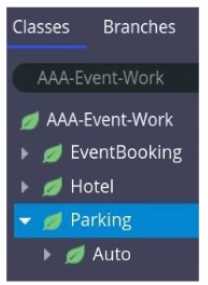
- A. Parking cannot be a child case of Hotel.
- B. Instances of EventBookin and Hotel cannot be stored in a separate table.
- C. Parking and Auto instances can be stored in the same table or in separate tables.
- D. Auto must be a child case of Parking.
Answer:
C
Explanation:
Class Structure Flexibility: The class hierarchy allows for instances of Parking and Auto to be stored
either together or separately, depending on the implementation requirements and table mapping
configurations.
Reference:
Pega Platform documentation on class hierarchy and instance storage.
Pega Academy resources on data modeling and class structures.
Question 5
A software training company wants to hold a webinar on a particular subject if a sufficient number of
people express an interest in attending. An instructor is tasked with developing the webinar
presentation, if they get enough people to register. There is no limit on the number of attendees.
Which case design pattern is the best solution in this scenario?
- A. Divide and Conquer
- B. Sibling Case Update
- C. Data Instance First
- D. Data Instance After
Answer:
C
Explanation:
For the webinar scenario, the best case design pattern is:
Answer: C . Data Instance First
Explanation:
Data Instance First: This pattern is suitable when the case is driven by data instances, such as tracking
registrations for a webinar and initiating a case only when a sufficient number of registrations are
received.
Reference:
Pega Platform case management documentation.
Pega Academy resources on case design patterns.
Question 6
A local ferry service offers a passenger boat trip that travels from Port A to Port B, and then back
again, once a day. Passengers can book tickets using an app, and they often try to make last-minute
reservations for the outbound trip. The ferry service wants their app to place a passenger on a
waiting list for the first trip, while guaranteeing them a reservation for the second trip.
Which two case design patterns apply to this scenario? (Choose Two)
- A. Limited Availability and Concurrency
- B. Parallel Case Processing
- C. Divide and Conquer
- D. Data Instance First
Answer:
A, C
Explanation:
Limited Availability and Concurrency: This pattern handles situations where resources (like ferry
seats) are limited, and concurrency needs to be managed to ensure fair allocation.
Divide and Conquer: This pattern involves breaking down a case into sub-cases or steps, such as
managing bookings for both the outbound and return trips separately.
Reference:
Pega Platform case design documentation.
Pega Academy courses on case management and design patterns.
Question 7
If an Operator ID in an application is associated with the work queues in the following figure, how
will the system behave?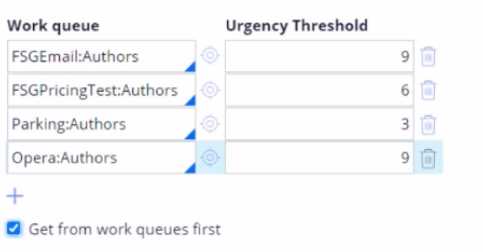
- A. The system will consider the assignments with urgency value equal to and greater than the specified value in the Operator rule, and will ignore all assignments with lower urgency value.
- B. The system will process work queues from top to bottom by ignoring urgency threshold, because the Get from work queues first option is selected, and because the system ignores all assignments with lower urgency value.
- C. The system will process work queues from top to bottom by ignoring urgency threshold, because the Get from work queues first option is selected.
- D. The system will consider the assignments with urgency value equal to and greater than the specified value in the Operator rule. Once all assignments are processed from the work queue based on the threshold urgency value, the lower urgency assignments are then considered.
Answer:
D
Explanation:
The system will consider the assignments with urgency value equal to and greater than the specified
value in the Operator rule. Once all assignments are processed from the work queue based on the
threshold urgency value, the lower urgency assignments are then considered.
Urgency Thresholds: The system checks the urgency of assignments in each work queue.
Assignments with an urgency equal to or greater than the threshold are considered first.
Get from Work Queues First: With this option selected, the system prioritizes processing work
queues before considering individual workbaskets.
Lower Urgency Assignments: After processing assignments meeting the urgency thresholds, the
system will then consider lower urgency assignments if there are no higher urgency tasks left.
Reference:
Pega Platform documentation on routing and assignment handling.
Pega Academy resources on urgency thresholds and work queue configurations.
Question 8
A Pega COE team is building a reusable component for a functionality that will be mandatory for all
Pega applications that are built for the different departments of a company.
The component functionality is documented and published in a common SharePoint file, so that it is
accessible by all Pega developers within the company.
Which one of the following approaches will work best for this use case?
- A. The component should be embedded in the enterprise application, so that it does not need to be embedded in the department applications.
- B. The component should be embedded in the enterprise application, and should also be embedded in the department applications.
- C. The component should be placed in a separate application so that the departments can all integrate with that application when they want to run the functionality.
- D. The component should not be embedded in the enterprise application. Instead, each department should include the component in their own application.
Answer:
C
Explanation:
Separate Application for Reusable Component:
Placing the component in a separate application ensures modularity and reusability.
Departments can integrate with this application as needed, ensuring consistency and reducing
redundancy.
Benefits:
Centralized maintenance and updates.
Easier to manage and deploy across various departments.
Avoids embedding the component directly in multiple applications, which could lead to version
control issues.
Reference:
Pega Best Practices Guide
Pega Academy Course on Reusable Components and Modular Design
These answers and explanations have been verified according to the Pega Lead System Architect
guidelines and best practices.
Question 9
A dispute case type has various stages, including collect, review, Reinburse, Chargeback, and Resolve.
In the production system, inflight cases exist in the chargeback stage. The Chargeback stage is moved
to a new case type.
If the analyst advances the inflight cases, what error flow is initiated?
- A. The pzBrokenProcess flow.
- B. The pzStageProblems flow.
- C. The pzException flow.
- D. The pzFlowProblems flow.
Answer:
B
Explanation:
Identifying the Error Flow:
When stages are altered in a case type, in-flight cases can encounter issues if they try to advance to a
now-missing stage.
pzStageProblems Flow:
This flow is initiated when there are problems advancing stages due to missing or reconfigured
stages.
It helps to manage and resolve issues related to stage progression.
Reference:
Pega Platform Case Management Documentation
Pega Academy Course on Advanced Case Design
Question 10
A banking customer service application is in production that processes various customer complaint
requests. After three years in production, the operations manager needs a historical report on
resolved cases. This report is to receive in near real time.
Data warehouse has exposed a REST API to receive dat
a. Reports are generated out of data warehouse.
What two of the following options to create an ideal design solution to post data to the data
warehouse? (Choose Two)
- A. Read data with data flows, which source data by using a dataset and output data to a utility that posts the data to the queue processor, which then posts data to data warehouse over REST. For in- flight cases, on resolution of a case, reuse a queue processor that you created.
- B. Read data with data flows, which source data by using a dataset and output data to a utility that synchronously posts the data to data warehouse. For in-flight cases, on resolution of the case, configure the system to post the data to the data warehouse over REST.
- C. Run a one-time utility browse all the resolved-cases data, and then post the data to data warehouse asynchronously. For in-flight cases, on resolution of a case, configure the system to synchronously post the data to the data warehouse over REST.
- D. Prepare an extract rule and extract the data of already-resolved cases, and then load it into the data warehouse for reporting. For in-flight cases, on resolution of a case, configure the system to post the data to the data warehouse over REST.
Answer:
A, B
Explanation:
Using Data Flows:
Leverage data flows to read and process data efficiently.
Utilize datasets to source the required data.
Option A:
Use a utility to post data to a queue processor.
The queue processor will then handle posting the data to the data warehouse over REST.
Option B:
Alternatively, the utility can synchronously post data directly to the data warehouse.
This ensures immediate transfer of data upon resolution of a case.
Reference:
Pega Platform Data Flow Documentation
Pega Academy Course on Integration and Data Synchronization
Question 11
A Pega developer working on customizing GetNextWork functionality has overridden the
GetNextWork_WorkBasketUrgencyThreshold application settings rule, because they want to define a
minimum cutoff value for assignment urgency.
Overriding this value can speed things up by changing the order in which assignment candidates are
examined.
As an LSA, which one of the following would you recommend as a best practice in this situation?
- A. To simplify migration, create a separate ruleset for customization of GetNextWork functionality.
- B. To keep in sync with the work list, change the Urgency Threshold for the worklist as well.
- C. To avoid customization, do not approve check-in of the rule.
- D. To simplify testing of GetNextWork functionality, supply different cutoffs for different production levels.
Answer:
A
Explanation:
Creating a Separate Ruleset:
It is considered best practice to isolate customizations in a separate ruleset to simplify future
migrations and upgrades.
Benefits of Separate Ruleset:
Easier to identify and manage customizations.
Simplifies the process of moving custom rules between environments.
Reduces the risk of conflicts during upgrades.
Implementation:
Define a new ruleset specifically for the custom GetNextWork functionality.
Override the necessary rules within this ruleset.
Reference:
Pega Best Practices Guide
Pega Academy Course on Rule Management and Versioning
Question 12
DRAG DROP
You are managing distributed geographically dispersed development teams A B and C Team A is
ready to merge changes into their development environment to make those changes available to
Team B's and Team C's environments
To ensure that all development teams are working with the latest version of the shared rulebase.
select and move the below tasks to the Task List Order column and place them in the correct order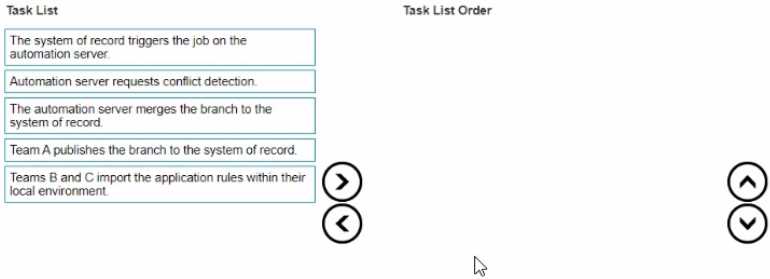
Answer:
None
Explanation:
To ensure that all development teams (A, B, and C) are working with the latest version of the shared
rulebase, the tasks should be ordered as follows:
Team A publishes the branch to the system of record.
The system of record triggers the job on the automation server.
Automation server requests conflict detection.
The automation server merges the branch to the system of record.
Teams B and C import the application rules within their local environment.
Step by Step Comprehensive Detailed Explanation:
Team A publishes the branch to the system of record:
Explanation: Team A needs to publish their changes to the central repository (system of record) to
make them available for integration and further processing.
The system of record triggers the job on the automation server:
Explanation: Once the branch is published, the system of record initiates an automated process to
handle the new changes. This step triggers the automation server to start its job.
Automation server requests conflict detection:
Explanation: The automation server needs to check for any conflicts between the newly published
branch and the existing codebase. This ensures that any issues are identified and resolved before
merging.
The automation server merges the branch to the system of record:
Explanation: After conflict detection and resolution, the automation server merges the changes from
the branch into the main codebase in the system of record.
Teams B and C import the application rules within their local environment:
Explanation: Once the merge is complete, Teams B and C can import the updated application rules
into their local environments to ensure they are working with the latest version of the rulebase.
Reference: According to Pega’s best practices for managing distributed development teams, this
sequence ensures that changes are properly integrated and conflict-free before being distributed to
other teams, promoting consistency and minimizing integration issues.
Question 13
An organization wants to know about failed authentication attempts to gain access to a Pega
Platform application. How do you log information about unauthorized access or failed login
attempts?
- A. Enable the content security policy and generate the required reports of failed login.
- B. Integrate with third-party security tools to find the failed login.
- C. Enable the security audit and get the information related to failed login.
- D. Add a utility to the session management operations.
Answer:
C
Explanation:
Enable Security Auditing:
Navigate to the Pega Platform's security settings.
Enable security auditing by configuring the security policies.
This setting will track and log any unauthorized access attempts and failed login attempts.
Configure Audit Log Settings:
Go to the "Security Policies" section under the "System" category in the Dev Studio.
Ensure that logging for authentication events is enabled. This includes both successful and failed
login attempts.
Generate Reports:
Utilize the built-in reporting capabilities of Pega to create custom reports.
These reports can be configured to display logs of failed login attempts, providing visibility into
unauthorized access attempts.
Reference:
Pega Platform User Guide on Security Policies
Pega Academy Course on Security and Access Control
Question 14
An organization has two sets of users: Manager and Vice President, with no role dependencies. The
organization wants to introduce a new set of users called Senior Manager that has Manager access
and a subset of Vice President access.
What is the recommended approach to add the Senior Manager role to meet this requirement?
- A. Create a new Senior Manager role, and define new Access of Role to Object rules as required.
- B. Create a new Senior Manager role with Manager as a dependent role, and define new Access of Role to Object rules as required.
- C. Create a new Senior Manager role with Vice President as a dependent role, and override Access of Role to Object rues as required.
- D. Create a new Senior Manager role with Manager and Vice President as dependent roles, and override the Access of Role to Object rules from the Vice President role as required.
Answer:
D
Explanation:
Senior Manager Role with Dependent Roles:
Creating a new Senior Manager role with Manager and Vice President as dependent roles ensures
that the Senior Manager inherits access from both roles. Overriding the Access of Role to Object
rules from the Vice President role as required provides the necessary fine-tuning.
Reference:
Pega documentation on role-based access control recommends defining new roles with
dependencies to inherit access rights and customize as needed.
Therefore, the correct answer is:
D. Create a new Senior Manager role with Manager and Vice President as dependent roles, and
override the Access of Role to Object rules from the Vice President role as required.
Question 15
In a Human Resources application, the Social Security Number (SSN) and date of birth details for
employees are confidential, and business requirements state that only the HR Manager can see
these details.
What is the best approach to mask the information for other users everywhere in the application?
- A. Use the PropertyRead access control policy for the SSN and date of birth.
- B. Add the privilege rule for the UI controls that display the SSN and date of birth.
- C. Add an Access When rule for access role objects of the HR Manager role.
- D. Use the Property Encrypt access control policy for the SSN and date of birth.
Answer:
A
Explanation:
Using the PropertyRead access control policy for the SSN and date of birth ensures that only users
with the appropriate access (e.g., HR Manager) can view these details. This approach masks the
information for other users.
Reference:
Pega best practices for data security and access control recommend using PropertyRead policies to
restrict access to sensitive information.
Therefore, the correct answer is:
A . Use the PropertyRead access control policy for the SSN and date of birth.