oracle 1Z0-151 Exam Questions
Questions for the 1Z0-151 were updated on : Mar 07 ,2026
Page 1 out of 6. Viewing questions 1-15 out of 90
Question 1
Which three are valid ways to populate a display item?
- A. initial Value property
- B. User input
- C. When-Button-Pressed trigger
- D. Calculation
- E. Executing a query
Answer:
A, C, D
Explanation:
C: You can use the attachable PL/SQL libraries to implement a flexible message function formessages
that are displayed programmatically by the built-in routines MESSAGE orCHANGE_ALERT_MESSAGE,
or by assigning a message to a display item from a triggeror procedure.
D: Creating Calculated Items
Change the Item Type to Display Item.
Set the Calculation Mode property to Formula.
Set the Formula property to the required formula.
Incorrect answers:
B: Display items and text items are fairly similar and share many of the same properties. The biggest
difference between the two is that a user can navigate to a text item and change its value. This is not
possible with a display item. As its name implies, it merely displays information.
Note: Display items do not allow any user interaction - they merely display data and never accept
cursor focus.
Use a display item for the following situations:
* Null-canvas fields
* Context fields
* Fields that act as titles or prompts
Question 2
You must be careful when coding a When-Button-Pressed trigger, because it does not accept
restricted built-ins.
- A. True
- B. False
Answer:
B
Explanation:
The When-Button-Pressed trigger:
* Fires when the operator clicks a button
* Accepts restricted and unrestricted built-ins
* Is used to provide convenient navigation, and to display LOVs and many other frequently used
functions
Question 3
An LOV must be displayed several times in your form; therefore, good performance when displaying
LOV is essential. In a When-New-Form-instance trigger, you want to save the ID of the LOV in a global
variable so that you can use it in any code to display the LOV.
Which built-in would you use to get the ID of the LOV?
- A. SHOW_LOV
- B. FIND_LOV
- C. GET_ITEM_PROPERTY
- D. GET_LOV_PROPERTY
- E. GET_APPLICATION_PROPERTY
Answer:
B
Explanation:
Referencing Objects by Internal ID
Finding the object ID:
lov_id := FIND_LOV('my_lov')
Question 4
The Orders form, you want to enable users to use Microsoft Excel to create and print an invoice for
the customer. The file should be created on the user's computer so that it can be printed with the
local printer.
Which WebUtil package would you use to implement this requirement?
- A. CLIENT_GET_FILE_NAME
- B. CLIENT_HOST
- C. CLIENT_OLE2
- D. CLIENT_TEXT_IO
- E. CLIENT_Win_API
- F. WEBUTIL_FILE
- G. WEBUTIL_UTIL
Answer:
C
Explanation:
Note: Performing OLE Automation on the Client
You can use any OLE2 package on the client by prefixing it with CLIENT_. You can see the list of the
OLE2 package procedures and functions in the Forms Builder ObjectNavigator under the Built-in
Packages node.
Note 2: With WebUtil, you can do the following on the clientmachine: open a file dialog box, read
and write image or text files, execute operating system commands, perform OLE automation, and
obtain information about the client machine
Question 5
View the Exhibit.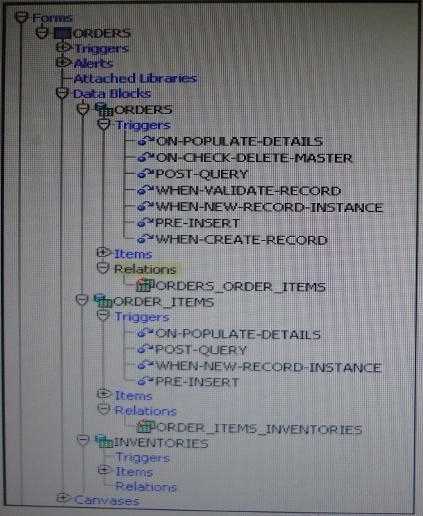
What four facts can you determine by examining the Object Navigator?
- A. The Orders block is a detail block.
- B. The Order_Items block is a detail block.
- C. An order can be deleted only if it has no order items.
- D. If an order is deleted, all of its order items are deleted.
- E. You cannot delete order items without deleting the order.
- F. You can delete an order without deleting its order items.
- G. The Orders block is a master block.
- H. The Order_Items block is a master block.
- I. If you delete an order item, all of its associated inventory items are deleted.
- J. The inventories block is a master block.
Answer:
BCHG
Question 6
When users enter address information, you want them to be able to select the state from a static list
of values. You have not used a list of states before, and there is no database table that contains state
information.
What is the first step in creating such a list of values as quickly as possible?
- A. invoke the LOV wizard.
- B. Create a new record group that is based on a SQL query.
- C. Create a new static record group.
- D. Create a list item instead; a list of values is not appropriate for a static list.
Answer:
A
Explanation:
ow to create LOV in Oracle forms?
List of Values(LOV) are used either when a selected list is too long and hence would not be
appropriate for a drop down, but needs a search form to select the value.
Steps to create LOV functionality:
* Click on the LOV icon in the object navigator and choose a manual/automatic wizard. This will
create a record group.
* Open a search form in the Dialog Page
* Select values inside this form.
* Return selected values to the original page.
Question 7
Customers log in to your Orders application by using their customer ID, which is saved as a global
variable. When the Orders form first comes up, you want it to be populated with the customer's
orders, and you do not want customers to be able to query for another customer's orders.
You code the following triggers:
When-New Form instance on the Orders form:
GO_BLOCK('orders');
EXECUTE_QUERY;
You also have a button in the Control block labeled Query Orders with a When-Button Pressed trigger
that has the same code as the When New-Form instance trigger.
To test the form, you run it and log in a Customer 104. When you click Query Orders, all orders are
shown, not just those for Customer 104.
What is the best way to correct this issue to ensure that the customer can never query another
customer's orders?
- A. Delete the Key-Exeqry trigger and add the its first line after the call to GO_BLOCK in the When- New-Form-instance trigger.
- B. Change the last line of the When-Button-Pressed code to: DO_KEY ('EXECUTE_QUERY');
- C. Delete the Key-Exqry trigger and put its code in an On-Select trigger.
- D. Delete the Key-Exqry trigger and put its code in a Pre-Query trigger.
Answer:
B
Explanation:
Note: EXECUTE_QUERY procedure
Clears the current block, opens a query, and fetches anumber of selected records. If there are
changes tocommit, Forms Builder prompts the operator to committhem before continuing EXECUTE-
QUERYprocessing
Question 8
The Orders form, whose properties have not been changed from the default, has two non-base table
text items to display the sales representative's first and last names.
You want to ensure that entries made in these Items correspond to an existing employee, so you
write a When-Validate-Item trigger for the Sales_Rep_First_Name text item:
SELECT LAST_NAME Into :last_name FROM employees
WHERE first_name = :first_name;
EXCEPTION
WHEN NO_DATA_FOUND THEN
MESSAGE ('There is no sales rep by this name');
When you test the form and enter a first name that does not exist in the database, the message that
you specified appears, but the cursor goes to the Sales_Rep_Last_Name item. You want the cursor to
remain in the Sales_Rep__First Name item until a correct first name is entered.
Also, as you continue to test the form, at times, the cursor does not leave the Sales_Rep_First_Name
item after you enter a name, but no error message appears.
Which two things can you do to correct these problems?
- A. Add the code to handle the FORM_TRIGGER_FAILURE exception.
- B. Raise the FORM_TRIGGER_FAILURE exception.
- C. Add code to handle the TOO_MANY_ROWS exception.
- D. Raise the TOO_MANY_ROWS exception.
- E. Code an On-Error trigger.
- F. Code an On-Message trigger.
- G. Write a When-Validate-Item trigger for the Sales_Rep_Last_Name item.
- H. Move the code to a form-level When-Validate-Item trigger.
- I. Change the form's validation Unit property to Record.
Answer:
B, C
Question 9
Which three statements are true about the PL/SQL Packages panel in the Forms debugger?
- A. You can select an option button to view server packages.
- B. You can view packages only while the runtime process executes PL/SQL.
- C. You can view the values of variables that are defined in the package specification.
- D. You ran select an option button to view the packages that have not yet been instantiated.
Answer:
A, B, C
Explanation:
PL/SQL Packages Panel: This panel is used only to browse and examine the PL/SQL packages which
are been instantiated while executing the form.
Question 10
View the Exhibit.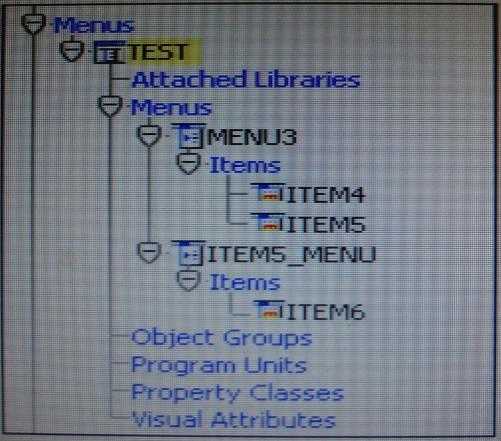
You are creating a menu for use with several forms. You create the structure of the menu in the
Menu Editor.
As shown in the Object Navigator in the Exhibit, which objects are menu items?
- A. MENU3 only
- B. ITEM6 only
- C. MENU3, ITEM4, ITEM5, ITEM5_MENU, and ITEMG
- D. ITEM4, ITEM5, and ITEM6 only
- E. ITEM4 and ITEM5 only
- F. ITEM 4 and ITEM6 only
- G. ITEM5 and ITEM only
- H. MENU3 and ITEM5_MENU only
Answer:
D
Explanation:
MENU3 and ITEM5_MENU are menus.
Question 11
Which symbol when used in an object's Property Palette, indicates an inherited property that has
been changed?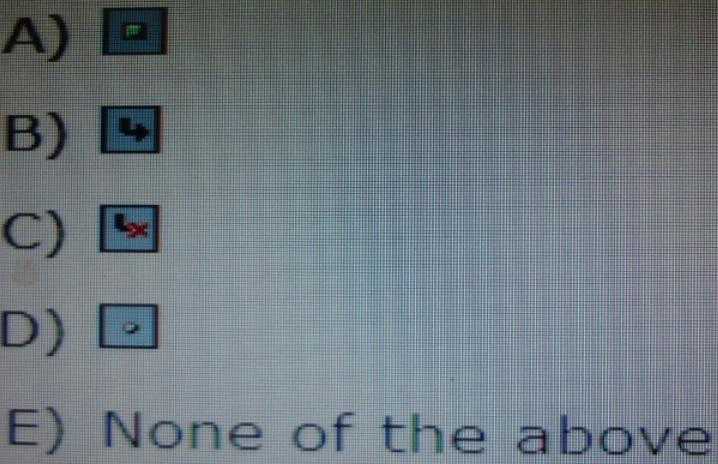
- A. Option A
- B. Option B
- C. Option C
- D. Option D
Answer:
C
Question 12
View the Exhibit.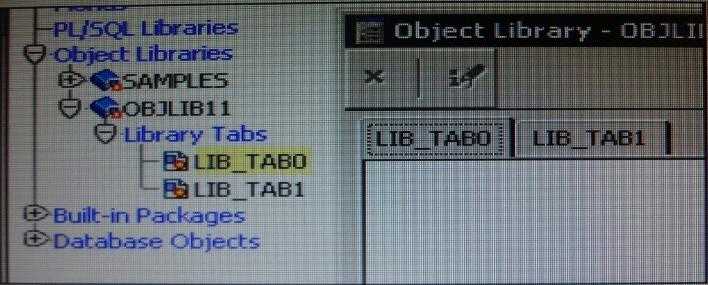
You have just created a new object library as shown in the Exhibit. You want the tabs to have
descriptive names.
You cannot change the names of the default object library tabs, so you must create new tabs in order
to have descriptive names.
- A. True
- B. False
Answer:
B
Question 13
You have written a Forms application that your users log in to with their database login.
Which Forms component is utilized first when a user runs the application?
- A. Forms Client (applet)
- B. Forms Runtime
- C. Forms Servlet
- D. Forms Listener Servlet
Answer:
C
Question 14
You have been assigned to maintain a Forms application that was designed by a developer who has
left the company.
The CV_Tools canvas contains several buttons. There is limited space on the canvas, but the first
button is not quite wide enough to display its complete label. In the Layout Editor, you widen the
button slightly and find that the width of all the buttons increases so that they now overlap each
other.
What could have caused this problem?
- A. The buttons inherit their properties from the same property class.
- B. The buttons were created by dragging them from an object group.
- C. The buttons were created by using a Smart Class.
- D. All other buttons were subclassed from the first button.
- E. All other buttons were copied from the first button.
- F. The first button was subclassed from another button.
- G. The first button was copied from another button.
Answer:
D
Explanation:
D (not F): With subclassing you can make an exact copy, and then alter the properties of some
objects if desired. If you change the parent class, the changes also apply to the properties of the
subclassed object that you have not altered. However, any properties that you override remain
overridden. This provides a powerful object inheritance model.
Incorrect answers:
A: A property class is a named object that contains a list of properties and their settings. You can use
property classes to increase productivity and improve network performance.
Here are some of the uses of a property class:
* It increases productivity by setting standard or frequently used values for common properties and
associates them with several form builder objects.
* It defines standard properties not just for one particular object but also for several at a time. This
results in increased productivity, because it eliminates the time spent on setting identical properties
for several objects.
* It improves network performance by increasing the efficiency of message diffing.
C: A SmartClass is a special member of an Object Library. It can be used to easily subclass existing
objects in a form using the SmartClass option from the right mouse button popup menu.
E, G: When you copy an object, a separate, unique version of that object is created in the target
module. Any objects owned by the copied object also get copied. Changes made to a copied object in
the source module do not affect the copied object in the target module.
Question 15
You have a form with a single multi-record block. During a session, a user performs an insert and
clicks Save
What is the behavior of the record being inserted violates a database constraint?
- A. The record is posted to the database but not committed. The form redisplays the record with an error message so that the user can correct the data. Navigation to another record cannot occur until the correct data is committed or the new record is deleted. If the user exits the form without correcting the entry, a database rollback is performed.
- B. The record is committed to the database. The form redisplays the record with an error message so that the user can correct the data. The user is unable to exit the form or move to another record until the correct data is committed of the new record is deleted.
- C. A database rollback is performed. The form redisplays the record with an error message so that the user can correct the entry. The user is able to navigate to another record or exit the form.
- D. A database rollback is performed. The form redisplays the record with an error message so that an correct the entry. Navigation to another record cannot occur until the correct data is committed or the record is deleted.
- E. The record is committed to the database. The form redisplays the record with a warning in case the user would like to correct the entry. The user is able to navigate to another record or exit the form.
Answer:
C