oracle 1Z0-082 Exam Questions
Questions for the 1Z0-082 were updated on : Mar 13 ,2026
Page 1 out of 10. Viewing questions 1-15 out of 142
Question 1
Which two statements are true about undo and undo tablespaces?
- A. There can be only one undo tablespace created in a database.
- B. An instance will crash if the active undo tablespace is lost.
- C. An undo tablespace may be owned by only one instance.
- D. undo segments are owned by SYSTEM.
- E. undo segments are owned by SYSBACKUP.
Answer:
B, C
Question 2
You start your database instance in NOMOUNT state. Which two actions are performed?
- A. The control files are opened.
- B. The consistency of the database is checked.
- C. All required background processes are started.
- D. SYS can access the database.
- E. Memory is allocated for the SG1
Answer:
C, E
Question 3
Examine these commands: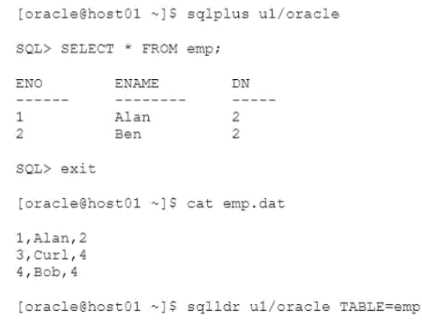
Which two statements are true about the sqiidr execution?
- A. It generates a sqi script that it uses to load data from EMP.DAT TO EMP.
- B. It overwrites the data for Alan and adds data for Curl and Bob
- C. It appends data from EMP.DAT TO EMP.
- D. It overwrites all data in emp with data from emp.dat.
- E. It generates a log that contains control file entries, which can be used with normal SQL'Loader operations.
Answer:
A, C
Question 4
Examine the description of the members table:
Examine the partial query:
SELECT city, last__name 1NAME FROM members
You want to display all cities that contain the string an. The cities must be returned in ascending
order, with the last names further sorted in descending order.
Which two clauses must you add to the query?
- A. ORDER BY 1, LNAME DESC
- B. ORDER BY 1, 2
- C. WHERE city LIKE *%AN%*
- D. WHERE city = =%AN%'
- E. WHERE city IN (•%AN%')
- F. ORDER BY last_narae DESC, city ASC
Answer:
A, C
Question 5
Which three statements are true about the naming methods and their features supported by Oracle
database used to resolve connection information?
- A. Local naming can be used if Connect-Time Failover Is required.
- B. A client can connect to an Oracle database instance even If no client side network admin has been configured.
- C. Directory Naming requires setting the TNS_ADMIN environment variable on the client side.
- D. Local Naming requires setting the TNS_ADMIN environment variable on the client side.
- E. Directory Naming can be used if Connect-Time Failover is required.
- F. Easy Connect supports TCP/IP and SSL.
Answer:
A, B, C
Question 6
Which two statements are true about interval data types?
- A. INTERVAL year TO month columns support yearly intervals.
- B. The value in an interval day to SECOND column can be copied into an interval year to month column.
- C. INTERVAL day to second columns support fractions of seconds.
- D. INTERVAL year to month columns only support monthly Intervals within a single year.
- E. INTERVAL year to month columns only support monthly intervals within a range of years.
- F. The year field in an interval year to month column must be a positive value.
Answer:
A, C
Question 7
Which two statements are true about Database Instances and Real Application Clusters (RAC)?
- A. A RAC database can have one Instance.
- B. A RAC database can have instances on separate servers.
- C. Two RAC databases can share their instances.
- D. A RAC database must have three or more Instances.
- E. A RAC database must have two or more instances.
Answer:
A, B
Question 8
Which compression method is recommended for Direct-Path Insert operations?
- A. COLUMN STORE COMPRESS BASIC
- B. COLUMN STORE COMPRESS ADVANCED
- C. RON STORE COMPRESS BASIC
- D. ROW STORE COMPRESS ADVANCED
Answer:
C
Question 9
Which three statements are true about sequences in a single instance Oracle database?
- A. Sequences can always have gaps.
- B. A sequence can Issue duplicate values.
- C. A sequence's unallocated cached values are lost if the instance shuts down.
- D. Two or more tables cannot have keys generated from the same sequence.
- E. A sequence can only be dropped by a DBA.
- F. A sequence number that was allocated can be rolled back if a transaction fails.
Answer:
B, C, D
Question 10
The orders table has a column ORDER_DATE of data type date.
The default display format for a date Is DD-MON-RR.
Which two where conditions demonstrate the correct usage of conversion functions?
- A. WHERE order_date > TO_CHAR(ADD_MONTHS(SYSDATE, 6), 'MON DD YYYY')
- B. WHERE TO_CHAR(order_date, 'MON DD YYYY') = 'JAN 20 2019'
- C. WHERE order_date > TO_DATE<ADD_MONTHS(SYSDATE, c) , 'MON DD YYYY')
- D. WHERE order_date IN (TO_DATE ('Oct 21 2018', 'Mon DD YYYY'), TC_CHAR('Nov 21 2018', 'Mon DD YYYY'))
- E. WHERE order date > TO DATE('JUL 10 2018', *MON DD YYYY')
Answer:
B, E
Question 11
Examine this command:
Which two statements are true?
- A. Compressed objects in SALES01.DBF will be uncompressed In SALES02.DBF after the move.
- B. DML may be performed on tables with one or more extents in this data file during the execution of this command.
- C. It overwrites any existing file with the name SALES02.DBF.dbf in /u02 by default.
- D. The "to" clause containing the new file name must be specified even if Oracle Managed Files (OMF) is used.
- E. Tables with one or more extents in this data file may be queried during the execution of this command.
Answer:
B, E
Question 12
The customers table has a cust_last_name column of data type varchar2.
The table has two rows whose "jst_last_name values are Andersen and Ausson.
Which query produces output for cust_last_xame containing Oder for the first row and Aus for the
second?
- A. SELECT REPLACE<TRIM<TRAILING 'son* FROM cust_last_name), 'An', *O'> FROM customers;
- B. SELECT REPLACE(SUBSTR(cust_last_name, -3), 'An', 'O') FROM customers;
- C. SELECT REPLACE(REPLACE(cust_last_name, 'son', ''), 'An', 'O'> FROM customers;
- D. SELECT INITCAP (REPLACE(TRIM('son' FROM cust_last_name), 'An', 'O*)) FROM customers;
Answer:
A
Question 13
Examine this description of the books table containing 100 rows: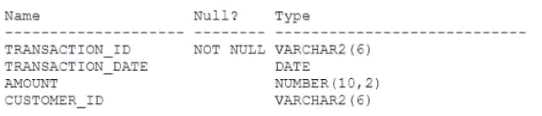
Now examine this sequence of statements Issued In a new session;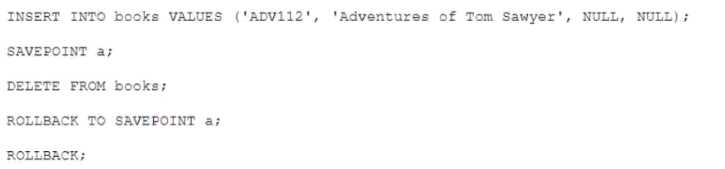
Examine this description of the books table containing 100 rows:
Which three statements are true?
- A. The second rollback command restores the row that was inserted.
- B. The first rollback command leaves the table's 100 original rows locked.
- C. The second rollback command rolls back the rollback to savepoint a command.
- D. The first rollback command leaves the inserted row locked.
- E. The first RollBack command restores the row that was inserted.
- F. The second rollback command restores the 100 rows that were in the table originally.
- G. The first rollback command restores the 100 rows that were in the table originally.
Answer:
A, C, E
Question 14
Examine the description of the customers table:
You need to display last names and credit limits of all customers whose last name starts with A or B in
lower or upper case, and whose credit limit Is below 1000.
Examine this partial query:
SELECT cust_last_name, cust_credit_limit FROM customers
Which two where conditions give the required result?
A)
B)
C)
D)
E)
- A. Option A
- B. Option B
- C. Option C
- D. Option D
- E. Option E
Answer:
C, E
Question 15
You currently have an active transaction in your session and have been granted select access to
vstransaction.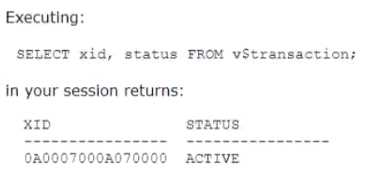
In which three situations will re-executing this query still return a row but with a different XID,
indicating a new transaction has started?
- A. after successfully executing a commit or rollback followed by a select statement
- B. after successfully executing a create table as select statement followed by a select for update statement
- C. after successfully executing a commit or rollback followed by a DML statement
- D. after successfully executing a create table statement followed by a create index statement
- E. after successfully executing a DML statement following a failed DML statement
- F. after successfully executing a truncate statement followed by a DML statement
Answer:
B, C, F