Nutanix NCS-CORE Exam Questions
Questions for the NCS-CORE were updated on : Feb 18 ,2026
Page 1 out of 21. Viewing questions 1-15 out of 302
Question 1
A consultant deploys a Nutanix cluster with AOS and ESXi. The cluster is managed by a vCenter
server.
After installation, what should the consultant do to ensure the cluster will support network
segmentation?
- A. Connect both CVM eth0 and eth2 interfaces to vSwitchNutanix.
- B. Manually assign an IP address to the CVM eth2 interface.
- C. Connect both CVM eth0 and eth2 interfaces to the assigned portgroups.
- D. Add another vSwitch to the cluster.
Answer:
C
Explanation:
After deploying a Nutanix cluster with AOS and ESXi managed by a vCenter server, the consultant
should ensure that both CVM eth0 and eth2 interfaces are connected to the assigned portgroups on
the standard or distributed switch. This setup allows for network segmentation and proper traffic
isolation, which is crucial for maintaining network security and efficiency in a virtualized
environment.
Reference: Nutanix Bible, Nutanix University NCS-Core 6.8 learning materials
Question 2
A consultant and customer agree on a scope of services regarding the deployment of a new Nutanix
cluster.
Which two products does this scope apply to? (Choose two.)
- A. Foundation
- B. Flow
- C. X-Ray
- D. Prism Central
Answer:
A, D
Explanation:
The scope of services for the deployment of a new Nutanix cluster would apply to both Foundation
and Prism Central. Foundation is the initial software used for deploying Nutanix nodes and creating
clusters, essential for setting up the environment. Prism Central is used for managing multiple
clusters and is integral to the operational scope of the service, providing centralized management
capabilities.
Reference: Nutanix Bible, Nutanix University NCS-Core 6.8 learning materials
Question 3
Refer to the exhibit.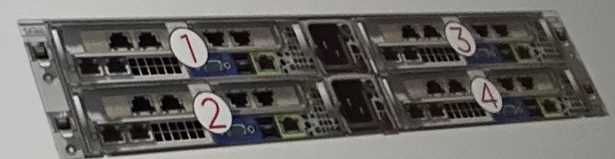
The customer has an existing NX-3160 block and is adding a second node into it.
Where should the node be installed?"
- A. 1
- B. 2
- C. 3
- D. 4
Answer:
B
Explanation:
Based on the exhibit which shows an NX-3160 block with marked slots, the correct slot for installing a
new node in the existing NX-3160 block is slot 2. This configuration is typically aligned with the
chassis' design for orderly expansion and maintaining balanced power and cooling distribution
among the nodes.
Reference: Nutanix Bible, Nutanix University NCS-Core 6.8 learning materials
Question 4
A consultant is setting up Prism Central to manage multiple Nutanix clusters. The customer requires
til redundancy and tre aby to manage up to 12,500 VMs.
Which deployment option should the consultant use to meet the requirements?
- A. Maximum CPU and memory allowed for the server hosting the Prism Central VM
- B. Prism Central cluster mode
- C. Prism Central Scale-out deployment
- D. Large Prism Central VM with the maximum CPU and memory allowed
Answer:
C
Explanation:
To meet the customer's requirements for high availability and the ability to manage up to 12,500
VMs, the consultant should use Prism Central Scale-out deployment. This deployment mode allows
Prism Central to be scaled out across multiple instances, significantly enhancing both performance
and resilience, ensuring that the management and operations of a large number of VMs can be
handled efficiently and without a single point of failure.
Reference: Nutanix Bible, Nutanix University NCS-Core 6.8 learning materials
Question 5
A consultant is unable to ping the CVM from the hypervisor using the external interface. The
customer's network is configured with the 10.3.12.0/24 subnet without VLAN tagging. The CVM and
hypervisor are using the same address space.
What is causing this issue?
- A. The 1GbE and 10GbE NICs have not been separated.
- B. The default gateway is incorrect.
- C. The switch is trunked without a native VLAN.
- D. The CVM/hypervisor only communicates over 192.168.5.0/24.
Answer:
B
Explanation:
If a consultant is unable to ping the CVM from the hypervisor using the external interface in a
network without VLAN tagging, and both are using the same subnet, the issue might be related to an
incorrect default gateway configuration. The default gateway must be correctly set to ensure proper
routing of packets between the CVM and the hypervisor. An incorrect gateway can prevent successful
communication even if both devices are on the same subnet.
Reference:
Nutanix University - NCS-Core 6.8 Learning Path
The Nutanix Bible, Networking chapter (
https://www.nutanixbible.com/
)
Question 6
A consultant discovers that while the Foundation VM and the consultant's laptop are able to ping
each other nodes are rea discovered while trying to run Foundation on the customer's network.
What should the consultant do to resolve the issue?
- A. Connect to same switch as the cluster and ping.
- B. Install Java on the Foundation VM.
- C. Enable IPv6 and multicast on the switch.
- D. Enable IPv6 and multicast on the laptop.
Answer:
C
Explanation:
When Foundation VM and a laptop can ping each other but nodes are not being discovered, it
suggests a network protocol issue. The consultant should enable IPv6 and multicast on the switch.
Multicast is required for node discovery in many environments, especially when using Nutanix
Foundation, as it helps in the detection and communication between nodes and the Foundation VM.
Reference:
Nutanix University - NCS-Core 6.8 Learning Path
The Nutanix Bible, Foundation chapter (
https://www.nutanixbible.com/
)
Question 7
A consultant is deploying a new Nutanix cluster. The nodes have the following network interfaces.
◦ 2x 10G NICS
◦ 2x 25G NICS
The consultant is using the default virtual switch configurations for AHV. After creating 10 VMs, the
consultant observes inconsistent network speeds from the VMs on the AHV host.
What should the consultant do to resolve this issue?
- A. Configure load balancing on the virtual switch for both 106 and 25G interfaces.
- B. Configure a separate virtual switch with 10G NICs on vs o and 256 NICs on vs.
- C. Configure Active/Backup for both the 10G and 25G interfaces.
- D. Configure all network interfaces with LACP on the same virtual switch.
Answer:
D
Explanation:
To resolve inconsistent network speeds from the VMs on an AHV host equipped with both 10G and
25G NICs, the consultant should configure all network interfaces with Link Aggregation Control
Protocol (LACP) on the same virtual switch. This configuration will allow for better load balancing and
bandwidth aggregation across multiple network interfaces, improving overall network throughput
and reducing bottlenecks.
Reference:
Nutanix University - NCS-Core 6.8 Learning Path
The Nutanix Bible, Networking chapter (
https://www.nutanixbible.com/
)
Question 8
In which part of the Knowledge Transfer can the customer learn how to create, escalate, comment,
and close cases?
- A. Operations Guide
- B. Demonstration of the Support Portal
- C. Demonstration of features
- D. Handover Slides and Checklist
Answer:
B
Explanation:
The best way for the customer to learn how to create, escalate, comment, and close cases is through
a demonstration of the Support Portal. This portion of the Knowledge Transfer focuses on showing
customers how to effectively use the Support Portal, which is an essential tool for managing support
tickets and communicating with Nutanix support. This hands-on demonstration helps ensure that
customers are familiar with the functionalities and can navigate the portal effectively.
Reference:
Nutanix University - NCS-Core 6.8 Learning Path
The Nutanix Bible, Support and Maintenance chapter (
https://www.nutanixbible.com/
)
Question 9
Which two files should be downloaded to deploy Foundation VM on VMware ESXI or AHV
Hypervisors? (Choose two.)
- A. foundation_VM-version-disk-0.geow2
- B. foundation_VM-version. tar
- C. foundation_VM-version. vmdk
- D. foundation-version.tar.gz
Answer:
B C
Explanation:
To deploy the Foundation VM on VMware ESXi or AHV Hypervisors, the two necessary files are:
foundation_VM-version.tar which contains the complete Foundation VM package.
foundation_VM-version.vmdk, which is the virtual disk file for VMware environments.
These files are required to create and boot the Foundation VM in these hypervisor environments,
facilitating the deployment and configuration of the Nutanix nodes within the cluster.
Reference: Nutanix Bible, Nutanix University NCS-Core 6.8 learning materials
Question 10
A consultant needs to image nodes that cannot be discovered with the Foundation VM
The nodes are connected to a flat stitch and
are already part of a Nutanix cluster.
What course of action would result in Foundation success?
- A. Use the customer's top of rack switch.
- B. Buy a new flat switch.
- C. Bare metal image the nodes.
- D. Change the physical connections.
Answer:
C
Explanation:
If nodes cannot be discovered using the Foundation VM and they are already part of a Nutanix
cluster, the best course of action is to bare metal image the nodes. This process involves re-imaging
the nodes from scratch, which can resolve discovery and communication issues that may be caused
by existing configurations or errors within the cluster's networking setup.
Reference: Nutanix Bible, Nutanix University NCS-Core 6.8 learning materials
Question 11
Refer to the exhibit.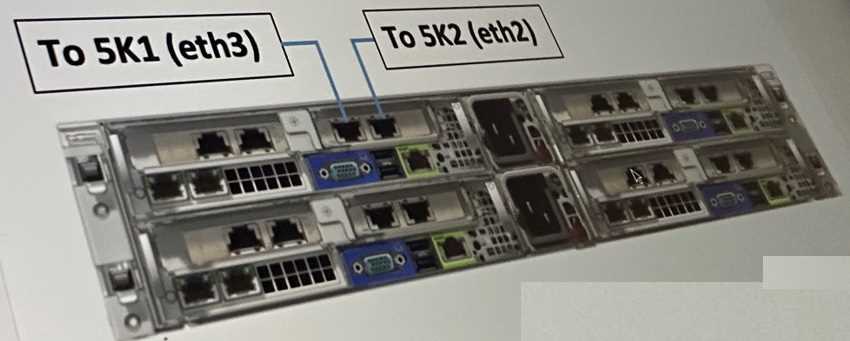
On a four-node NX-3460 cluster, two 10G NiCs are connected to redundant Cisco ToR 5K switches as
shown in the first exhibit Port On a four-node NX-3460 cluster, two 10G NICs are connected to
redundant Cisco TOR Sk switches as shown in the fist exthibt. Port failover must be tested.
The network configuration output from the CVM is shown in the second exhibit. To test fallover, a
shut command is executed on the switchport that connects the node to the 5k1 switch.
Refer to the exhibit.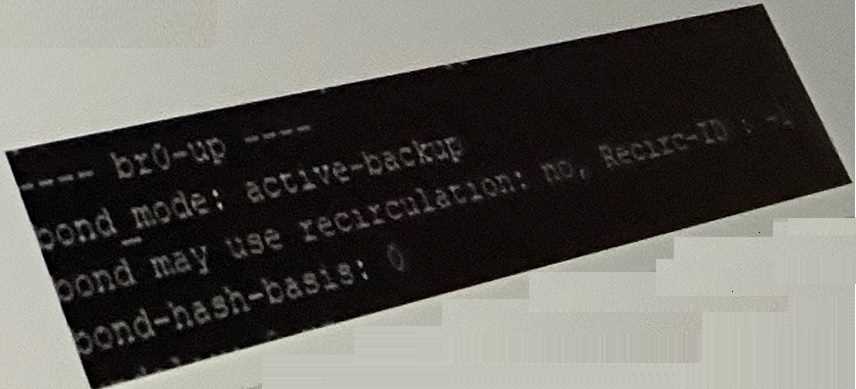
- A. Active link is disconnected. Passive link takes over.
- B. Passive link is disconnected. Active link takes over.
- C. Active link takes over. HA Failover takes place.
- D. Passive link takes over. HA Failover takes place.
Answer:
A
Explanation:
In the scenario described, the configuration shown in the exhibit indicates that there is an "active-
backup" bond mode. If a shut command is executed on the switchport that connects the node to the
5k1 switch (assuming it's the active link), the passive link should take over. This response ensures no
loss of connectivity as the passive link becomes active in the absence of the primary (active) link.
Reference: Nutanix Bible, Nutanix University NCS-Core 6.8 learning materials
Question 12
A consultant completes a manual cluster creation of AHV. When the consultant logs into Prism
Element, critical error messages appear regarding the hypervisor and NTP.
What component or setting, if misconfigured, would cause these errors?
- A. Cluster name
- B. Name Server
- C. Cluster Virtual IP
- D. Data Services IP
Answer:
B
Explanation:
If the consultant logs into Prism Element and sees critical error messages related to the hypervisor
and NTP, this could likely be caused by misconfigured Name Server settings. The Name Server (DNS)
is essential for resolving domain names into IP addresses, which are required for NTP operations and
overall cluster health checks and communications within the Nutanix environment.
Reference: Nutanix Bible, Nutanix University NCS-Core 6.8 learning materials
Question 13
A customer has a mail server and needs Nutanix to send email notifications about errors that might
occur in Prism. The following information is included under SMTP Server Settings
◦
IP Address of mail server
◦
Port Security Mode
◦
From email address
What should the consultant set up before arriving onsite?
- A. SMTP server to allow emails from all IPs in customer network
- B. SMTP server to allow emails from Cluster VIP and CVM IP addresses
- C. SMTP to allow emails from Cluster VIP
- D. SMTP server to allow emails from Host IP addresses
Answer:
B
Explanation:
Before arriving onsite, the consultant should set up the SMTP server to allow emails from both the
Cluster Virtual IP Address (VIP) and the Controller Virtual Machine (CVM) IP addresses. This setup
ensures that Prism can successfully send email notifications through the customer's mail server
about any errors or notifications generated by the Nutanix environment, as both the Cluster VIP and
CVM IPs are sources from which Prism sends alerts.
Reference: Nutanix Bible, Nutanix University NCS-Core 6.8 learning materials
Question 14
A consultant is discussing VLAN tagging for a newly deployed Nutanix system. The customer requests
that the the vlan dor the CVMs
and AHV hosts be placed in the customer's management VLAN 10. The customer also has VLAN 20
for production VM traffic and
VLAN 30 for backup/replication traffic.
Which VLAN should the consultant recommend for CVM and host traffic?
- A. VLAN 10
- B. VLAN 0
- D. VLAN 20
- E. VLAN 30
Answer:
A
Explanation:
For a newly deployed Nutanix system where the customer has specified VLAN 10 for management
traffic, the consultant should recommend using VLAN 10 for both CVM and AHV host traffic. This
VLAN designation ensures that all management, monitoring, and internal cluster communication are
on a dedicated network, separate from production VM traffic (VLAN 20) and backup/replication
traffic (VLAN 30), thereby enhancing network security and performance.
Reference:
Nutanix University - NCS-Core 6.8 Learning Path
The Nutanix Bible, Network Configuration chapter (
https://www.nutanixbible.com/
)
Question 15
After a consultant runs a bare metal Foundation, the imaging process fails.
In which two locations can the consultant find the logs? (Choose two.)
- A. On the CVM - /home /nutanix/foundation/logs
- B. On the Hypervisor - /home/nutanix/foundation/logs
- C. On the Foundation VM - /home/nutanix/foundation/logs
- D. View Logs link on the Foundation Imaging progress screen
Answer:
C, D
Explanation:
After a failed bare metal Foundation imaging process, the consultant can find relevant logs in two
primary locations: on the Foundation VM at "/home/nutanix/foundation/logs" and via the "View
Logs" link available on the Foundation Imaging progress screen. These logs are crucial for diagnosing
issues during the imaging process as they provide detailed error messages and operational data.
Reference:
Nutanix University - NCS-Core 6.8 Learning Path
The Nutanix Bible, Foundation chapter (
https://www.nutanixbible.com/
)