Juniper JN0-649 Exam Questions
Questions for the JN0-649 were updated on : Feb 18 ,2026
Page 1 out of 5. Viewing questions 1-15 out of 65
Question 1
Referring to the exhibit, you have placed the cos multifield classifier on all edge interfaces and
configured the relevant CoS parameters.
In this scenario, which two statements are correct? (Choose two.)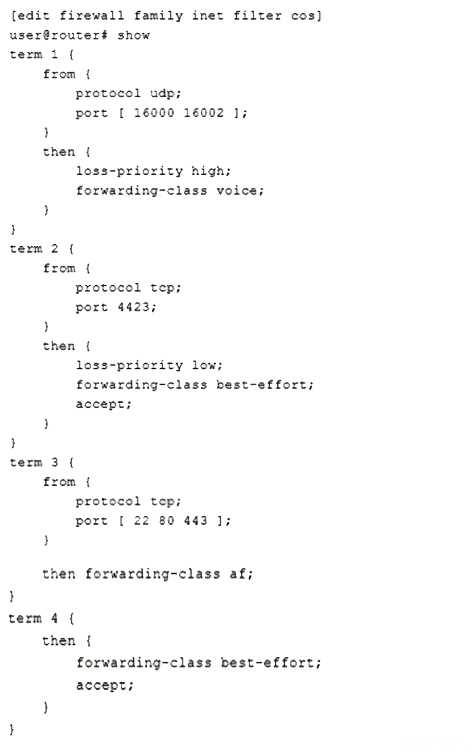
- A. SSH traffic using the default port will be placed in the af forwarding class and accepted.
- B. SSH traffic using the default port will be placed in the best-effort forwarding class and accepted.
- C. UDP traffic using the 16000 port will be placed in the voice forwarding class and accepted.
- D. UDP traffic using the 16000 port will be placed in the best-effort forwarding class and accepted.
Answer:
A, C
Question 2
Your network is multihomed to two ISPs. The BGP sessions are established; however, the ISP peers
are not receiving any routes.
Which two statements are correct about troubleshooting your configuration? (Choose two.)
- A. Verify the import policies on your router.
- B. Verify that the BGP routes are active in your routing table.
- C. Verify the export policies on your router.
- D. Verity that the multihop settings are configured on your router.
Answer:
C, D
Question 3
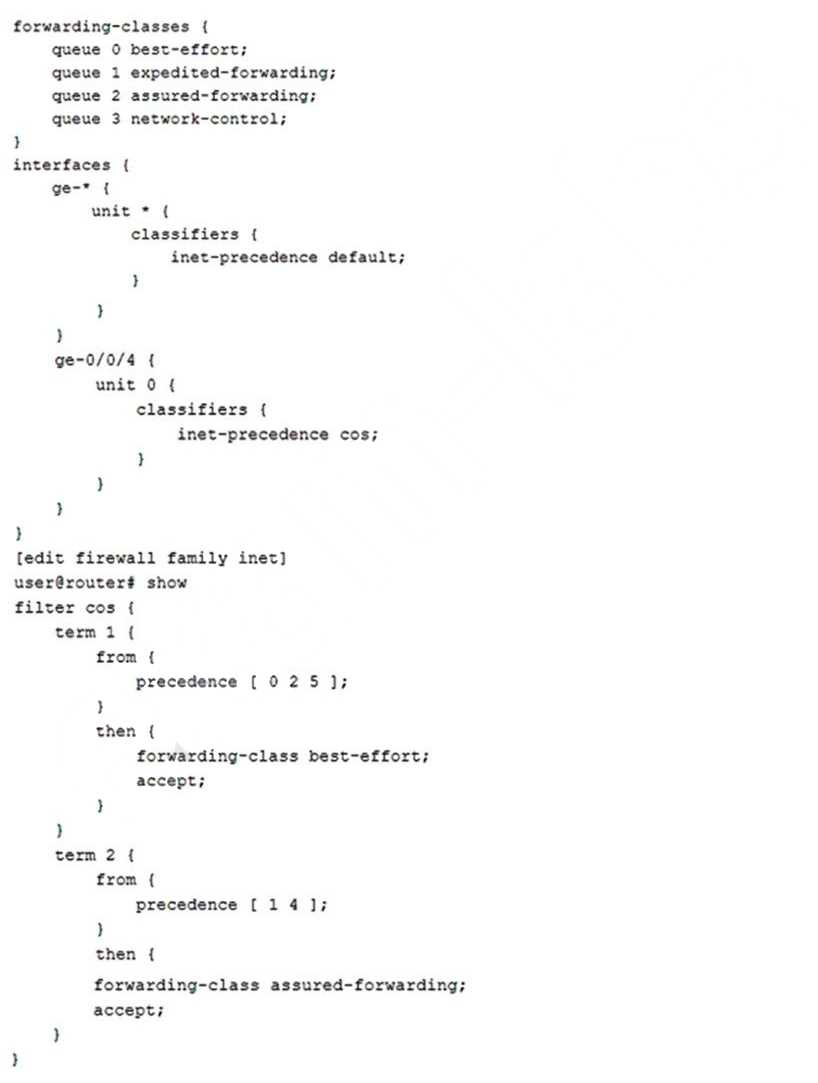
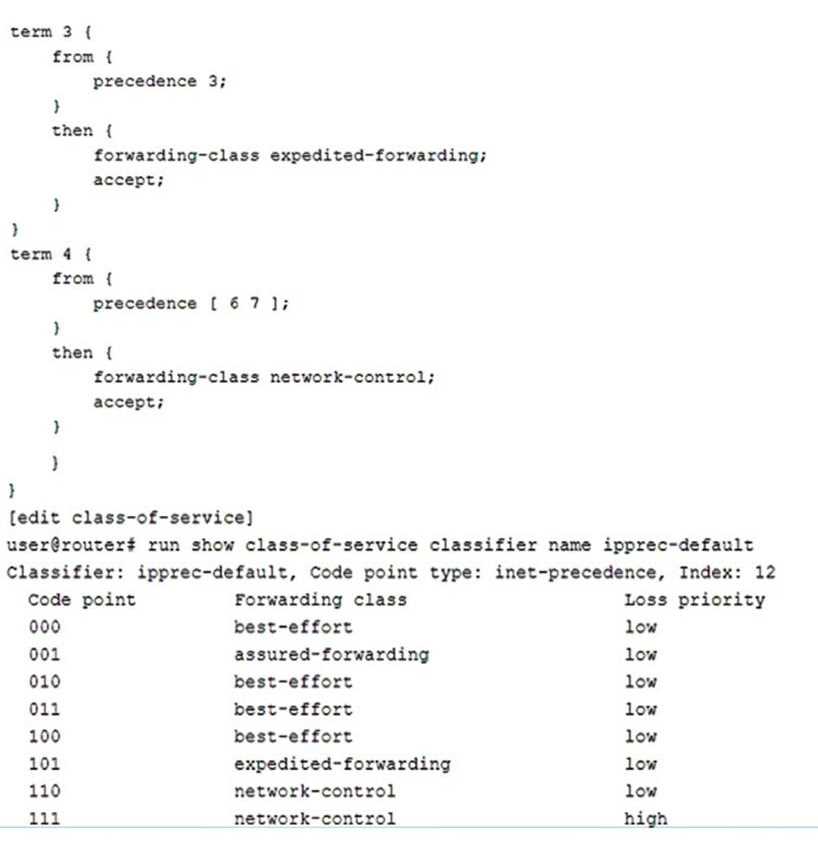
Referring to the exhibit, traffic ingresses on interface ge-0/0/3 and egresses on interface ge-0/0/4.
Which queue does traffic with the IP precedence value of 100 use?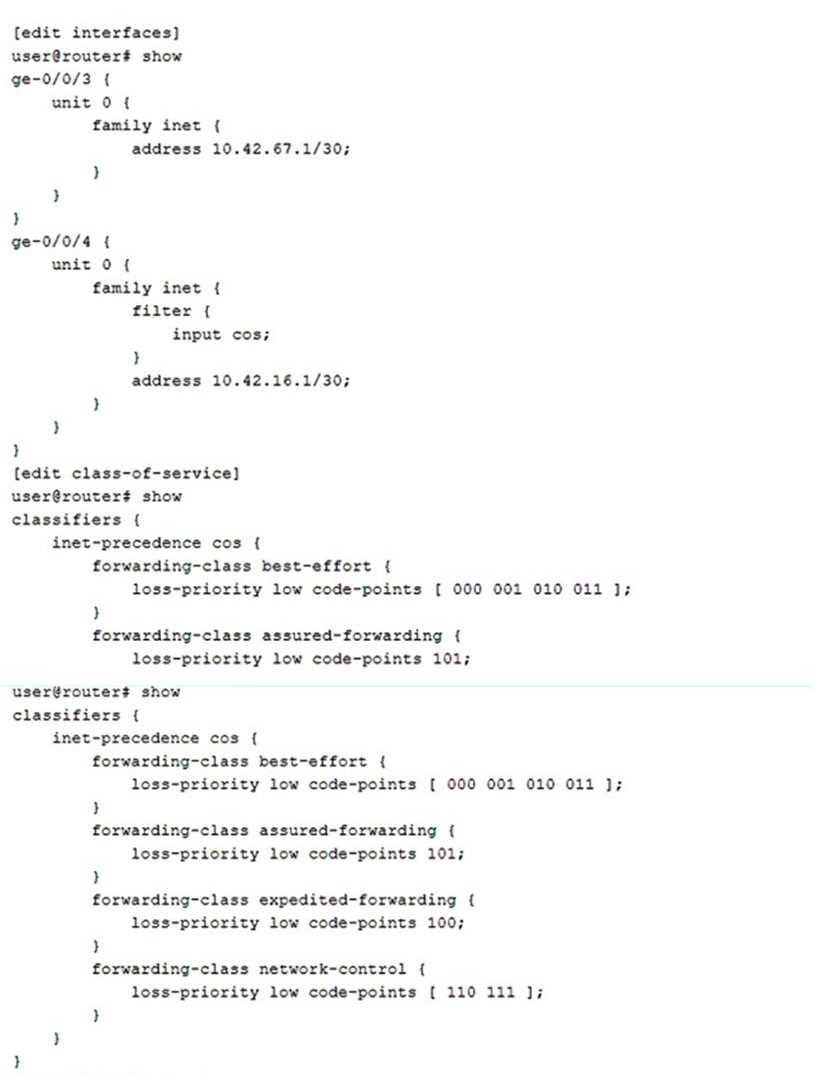
- A. network-control
- B. assured-forwarding
- C. best-effort
- D. expedited-forwarding
Answer:
D
Question 4
Referring to the exhibit, which statement is correct when a failure exists on the link between host2
and switch5 on this EVPN-VXLAN fabric?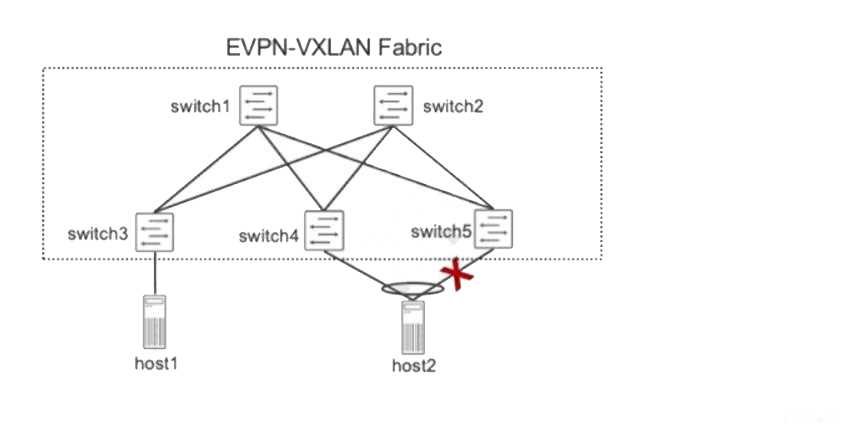
- A. The switch5 device will send a Type 2 route to all peers.
- B. The switch5 device will send a Type 4 route to all peers.
- C. The switch5 device will send a Type 1 route to all peers.
- D. The switch5 device will send a Type 3 route to all peers.
Answer:
D
Question 5
You are deploying IP phones in your enterprise networks. When plugged in, the IP phones must
automatically negotiate the power requirements for the new connection with the EX Series switches.
In this scenario, which protocol should be used to enable this behavior?
- A. CDP
- B. MP-BGP
- C. LLDP-MED
- D. LLDP
Answer:
C
Question 6
Referring to the exhibit, which statement is correct?
- A. The route is learned from a multihop BGP session.
- B. The route is learned from only one neighbor.
- C. The route is learned from a multipath BGP session.
- D. The route is learned from three different neighbors.
Answer:
B
Question 7
Referring to the exhibit, how will router E quickly learn that the remote MAC addresses are no longer
reachable through the router attached to the failed link?
- A. Router E receives Type 2 withdrawal messages from router D.
- B. Router E receives Type 1 withdrawal messages from router D.
- C. Router E receives Type 1 withdrawal messages from router C.
- D. Router E receives Type 2 withdrawal messages from router C.
Answer:
B
Question 8
You are deploying IP phones in your enterprise networks. When plugged in, the IP phones must be
automatically provided with the correct VLAN ID needed for sending voice traffic to the EX Series
switches.
In this scenario, which two solutions are required to accomplish this task? (Choose two.)
- A. Enable LLDP-MED on appropriate access interfaces.
- B. Create two VLANs and assign them as VLAN members to the appropriate access interfaces.
- C. Enable the voice VLAN feature with the appropriate access interfaces and VLAN ID for voice traffic.
- D. Use LLDP on appropriate interfaces.
Answer:
A, C
Question 9
You are deploying IP phones in your enterprise network that must receive their power through their
Ethernet connection. You are using your EX Series switch's PoE ports that support IEEE 802.3af.
In this scenario, what is the maximum amount of power allocated to each interface?
- A. 10.2 W
- B. 15.4 W
- C. 30 W
- D. 50 W
Answer:
B
Question 10
You are deploying an 802.1X solution and must determine what would happen if clients are unable to
re-authenticate to the RADIUS server.
In this scenario, which configuration would provide access to the network if the supplicant is already
authenticated?
- A. move
- B. permit
- C. deny
- D. sustain
Answer:
D
Question 11
Referring to the exhibit, which two statements are correct? (Choose two.)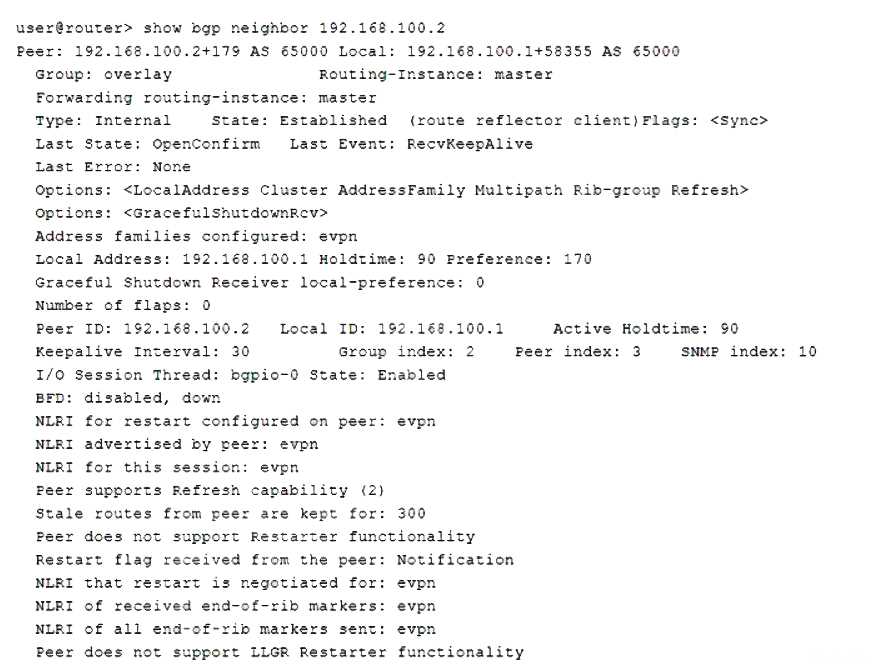
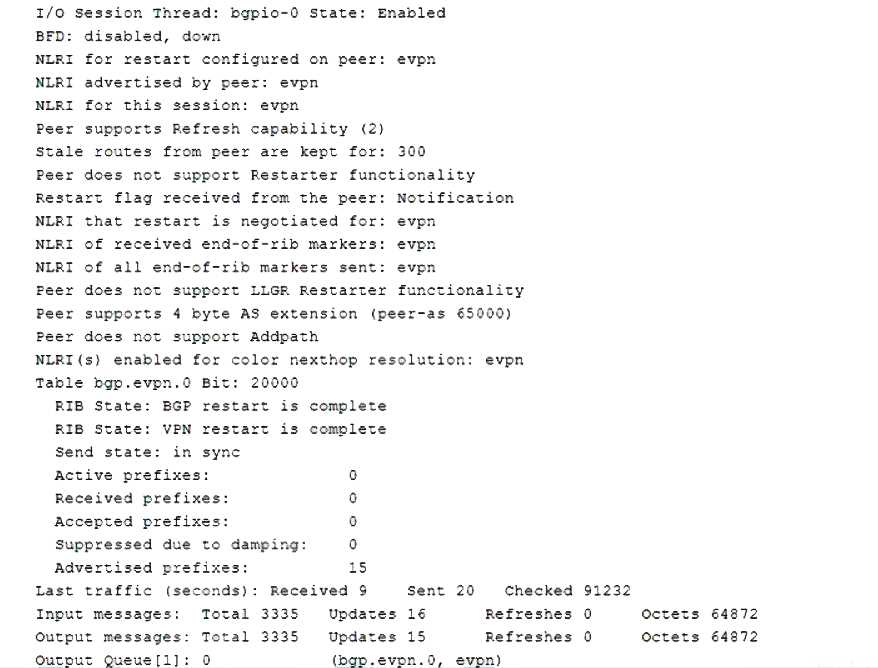
- A. The BGP neighbor can advertise L3 VPN related routes.
- B. The BGP neighbor cannot advertise EVPN related routes.
- C. The BGP neighbor can advertise EVPN related routes.
- D. The BGP neighbor cannot advertise L3 VPN related routes.
Answer:
A, C
Question 12
You are asked to establish full connectivity between all devices in the BGP network.
Referring to the exhibit, which two configuration changes will allow BGP route advertisements?
(Choose two.)
- A. On R2, include the loops 2 statement at the [edit protocols bgp family inet unicast] hierarchy.
- B. On R1 and R3, include the loops 2 statement at the [edit protocols bgp family inet unicast] hierarchy.
- C. On R1 and R3, include the advertise-peer-as statement at the [edit protocols bgp group external] hierarchy.
- D. On R2, include the advertise-peer-as statement at the [edit protocols bgp group external] hierarchy.
Answer:
B, D
Explanation:
https://www.juniper.net/documentation/us/en/software/junos/bgp/topics/ref/statement/advertise-peer-as-edit-protocols-bgp.html
Question 13
Referring to the exhibit, which two statements are correct? (Choose two.)
- A. The maximum wattage that this switch can allocate to attached Ethernet devices is 100 watts.
- B. If the total power consumption exceeds 90 watts, the ge-0/0/11 interface will continue to receive power.
- C. PoE is not enabled on the ge-0/0/0 interface.
- D. The ge-0/0/10 interface supports PoE+.
Answer:
A, D
Explanation:
POE is enabled in the interface ge-0/0/0 but nothing is connected to it. switch is in AT mode (poe+)
and interface ge-0/0/11 supports poe+ judging by maximun wattage
Question 14
You are asked to configure 802.1X on your access ports to allow only a single device to authenticate.
In this scenario, which configuration would you use?
- A. single supplicant mode
- B. multiple supplicant mode
- C. single-secure supplicant mode
- D. MAC authentication mode
Answer:
C
Explanation:
Single supplicant mode authenticates only the first end device that connects to an authenticator
port. All other end devices connecting to the authenticator port after the first has connected
successfully, whether they are 802.1X-enabled or not, are permitted access to the port without
further authentication. If the first authenticated end device logs out, all other end devices are locked
out until an end device authenticates. Single-secure supplicant mode authenticates only one end
device to connect to an authenticator port. No other end device can connect to the authenticator
port until the first logs out.
Question 15
There are two BGP routes to 10.200.200.0/24 received from two external peers. Route 1 comes from
a neighbor with a router ID of 10.10.100.1 and a peer IP address of 10.10.30.1, and route 2 comes
from a neighbor with a router ID of 10.10.200.1 and a peer IP address of 10.10.50.1. Both routes
have the same MED value, origin value, AS path length, and local preference number.
In this scenario, which statement is correct about the active route?
- A. Route 1 will be active because of the peer IP address.
- B. Route 2 will be active because of the peer IP address.
- C. Route 1 will be active because of the router ID.
- D. Route 2 will be active because of the router ID.
Answer:
C
Explanation:
The router determines the router ID for each peer that advertised a path to the route destination. A
lower router ID value is preferred over a higher router ID value. 10. The router determines the peer
ID for each peer that advertised a path to the router destination. A lower peer ID value is preferred
over a higher peer ID value. The peer ID is the IP address of the established BGP peering session.