Juniper JN0-363 Exam Questions
Questions for the JN0-363 were updated on : Feb 18 ,2026
Page 1 out of 6. Viewing questions 1-15 out of 86
Question 1
Which two LSA types are permitted in OSPF totally stubby areas? (Choose two.)
- A. Type 5
- B. Type 3
- C. Type 7
- D. Type 1
Answer:
A, B
Question 2
What are two types of SIDs used in segment routing? (Choose two.)
- A. link
- B. interface
- C. adjacency
- D. node
Answer:
C, D
Question 3
Which two statements are correct about IS-IS interface metrics? (Choose two.)
- A. By default, an IS-IS interface has a maximum metric value of 1023.
- B. Wide metrics enable IS-IS interface to have a maximum metric value of around 16 million.
- C. Wide metrics enable an IS-IS interface to have a maximum metric value of 1023.
- D. By default, an IS-IS interface has a maximum metric value of 63.
Answer:
BD
Explanation:
metric—Metric value. Range: 1 through 63, or 1 through 16,777,215 (if you have configured wide
metrics) Default: 10 (for all interfaces except lo0), 0 (for the lo0 interface)
Question 4
Which two statements are correct about segment routing? (Choose two.)
- A. Segment routing adjacencies require very little resources to maintain.
- B. Label assignments can be advertised through OSPF updates.
- C. There are no segment routing adjacencies to maintain.
- D. Label assignments can be advertised through LDP updates.
Answer:
AB
Explanation:
Segment routing is a source routing paradigm that allows a source router to define the path that a
packet will take through the network by assigning an ordered list of segments—identifiers that
specify a forwarding path for the packet through the network. Segment Routing can be implemented
over an MPLS architecture or with IPv6 (SRv6).
A . Segment routing does not require a full mesh of adjacencies or state per transit path in the
network, which is often the case with conventional MPLS signaling protocols like RSVP-TE. It
leverages the existing IGP topology for forwarding without the need to maintain a state for each LSP
(Label Switched Path), hence requiring very little resources to maintain.
B . In segment routing, labels (or segments) are distributed via IGP routing protocols like OSPF or IS-
IS with extensions to carry segment routing information. These protocols are enhanced with
Segment Routing extensions to distribute labels. For example, OSPFv2 is extended with Segment
Routing extensions defined in RFC 8665.
C . This statement is not entirely correct. While it is true that segment routing does not require the
maintenance of a state for each path (LSP), the concept of "segment routing adjacencies" is a
mischaracterization. Segment routing leverages the existing adjacencies formed by the underlying
IGP.
D . Label assignments in segment routing are not advertised through LDP (Label Distribution
Protocol) updates. Segment routing does away with LDP and instead uses IGP extensions to
distribute labels.
Reference::
Juniper Networks documentation on Segment Routing: Segment Routing Overview
Juniper Networks technical documentation providing guidance on configuring OSPF with Segment
Routing extensions.
IETF RFC 8665: OSPF Extension for Segment Routing.
Question 5
You are troubleshooting two OSPF routers that have an adjacency that remains in the ExStart state.
What would cause this problem?
- A. mismatched OSPF hello intervals on the OSPF interfaces
- B. mismatched authentication settings on the OSPF interfaces
- C. mismatched MTU settings on the OSPF interfaces
- D. mismatched subnet settings on the OSPF interfaces
Answer:
C
Explanation:
https://www.cisco.com/c/en/us/support/docs/ip/open-shortest-path-first-ospf/13684-12.html#anc13
Neighbors Stuck in Exstart/Exchange State The problem occurs most frequently when you attempt to
run OSPF between a Cisco router and another vendor router. The problem occurs when the
maximum transmission unit (MTU) settings for neighboring router interfaces do not match. If the
router with the higher MTU sends a packet larger that the MTU set on the neighboring router, the
neighbor router ignores the packet. When this problem occurs, the output of the show ip ospf
neighbor command displays output similar to what is shown in this figure.
A mismatched Maximum Transmission Unit (MTU) setting on OSPF interfaces can cause routers to
get stuck in the ExStart state. OSPF requires that both sides of a link have the same MTU to form a
full adjacency.
Reference::
OSPF Troubleshooting, Juniper Networks Documentation
MTU and OSPF, Juniper Networks Documentation
Question 6
Which new field is added to an IPv6 header as compared to IPv4?
- A. flow label
- B. checksum
- C. fragment offset
- D. version
Answer:
A
Explanation:
https://www.omnisecu.com/tcpip/ipv6/comparison-between-ipv4-header-and-ipv6-
header.php#:~:text=IPv6%20header%20is%20much%20simpler%20than%20IPv4%20header.&text=T
he%20size%20of%20IPv6%20header,are%20128%20bit%20binary%20numbers.&text=In%20IPv4%20
header%2C%20the%20source,are%2032%20bit%20binary%20numbers
.
The flow label is a new field added to IPv6 headers that was not present in IPv4 headers. It is used to
identify packets that require special handling by routers, particularly for quality-of-service (QoS)
purposes.
Reference::
IPv6 Header Format, Juniper Networks Documentation
IPv6 Overview, Juniper Networks Documentation
Question 7
Which BGP message type is used to re-advertise routes that have already been sent to a peer and
acknowledged using TCP?
- A. update
- B. keepalive
- C. notification
- D. refresh
Answer:
A
Explanation:
In BGP (Border Gateway Protocol), the Update message is used to advertise new routes to a peer or
to withdraw previously advertised routes. If there's a change in the routing information or if a new
route needs to be advertised, BGP uses an Update message. This message is crucial for maintaining
the most current and accurate routing information among BGP peers.
The other message types serve different purposes:
Keepalive: This message type is used to maintain the connection between BGP peers and ensure that
the link is still active. Keepalive messages are periodically sent between peers when there is no other
BGP activity to maintain the session.
Notification: This message is used to indicate errors or other significant events to a BGP peer. If a BGP
error condition is detected, a Notification message is sent and the BGP session is typically closed.
Refresh: This is not a standard BGP message type. However, in the context of BGP, Route Refresh is a
capability (not a message type) that allows a BGP router to request a full or partial re-advertisement
of routes from a peer. This helps in re-synchronizing routing tables without tearing down the BGP
session.
The BGP Update message is used to advertise routable destinations and includes route
advertisements, route withdrawals, and path attribute modifications. Update messages are used to
re-advertise routes that have already been acknowledged.
Reference::
BGP Operations and Message Types Overview, Juniper Networks Documentation
BGP Update Message, Juniper Networks Documentation
Question 8
By default, which two statements are correct about switch ports on a Junos device? (Choose two.)
- A. Trunk ports receive and transmit untagged traffic.
- B. Access ports receive and transmit tagged traffic.
- C. Trunk ports receive and transmit tagged traffic.
- D. Access ports receive and transmit untagged traffic.
Answer:
CD
Explanation:
On a Junos device, trunk ports are configured to receive and transmit tagged traffic only, while access
ports are configured to receive and transmit untagged traffic.
Reference::
Understanding Access and Trunk Interfaces, Juniper Networks Documentation
VLANs and Trunking, Juniper Networks Documentation
Question 9
Click the Exhibit button.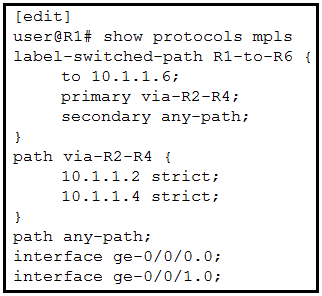
All devices in the network are configured correctly and the path requirements are valid.
Referring to the exhibit, which two statements are correct? (Choose two.)
- A. The primary LSP will be signaled, and its state will be up.
- B. The secondary LSP will not be signaled, and its state will be down.
- C. The secondary LSP will be signaled, and its state will be up.
- D. The primary LSP will not be signaled, and its state will be down.
Answer:
AC
Explanation:
According to the exhibit, the primary LSP is configured with a strict path via R2 to R4. Since the
configuration shows valid next-hops and there is no indication of any issues, the primary LSP will be
signaled and its state will be up. The secondary LSP with any-path is also configured and will be
signaled as a backup; therefore, its state will be up as well, ready to take over if the primary fails.
Reference::
MPLS LSP Configuration, Juniper Networks Documentation
Configuring Primary and Secondary LSPs, Juniper Networks Documentation
Question 10
Click the Exhibit button.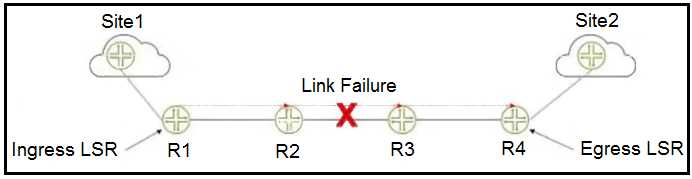
Referring to the exhibit, you have an established RSVP LSP between R1 and R4 when you experience
a link failure between R2 and R3.
Which two statements are correct? (Choose two.)
- A. R2 sends a ResvTear message upstream to R1 signaling the link failure.
- B. R3 sends a PathTear message downstream to R4 signaling the link failure.
- C. R2 sends a PathTear message upstream to R1 signaling the link failure.
- D. R3 sends a ResvTear message downstream to R4 signaling the link failure.
Answer:
AD
Explanation:
Upon a link failure in an RSVP-signaled LSP, the router upstream of the failure (R2) sends a PathTear
message upstream to the ingress router (R1), and the router downstream of the failure (R3) sends a
ResvTear message downstream to the egress router (R4). These messages signal the failure and
initiate tear down of the LSP state in the respective directions.
Reference::
RSVP-TE Overview, Juniper Networks Documentation
Understanding RSVP Signal Failures, Juniper Networks Documentation
Question 11
When would you use the qualified-next-hop statement with a static route?
- A. You can use it to install the static route into different routing tables.
- B. You can use it to send unwanted traffic to a null route.
- C. You can use it to specify multiple next hops with different preferences.
- D. You can use it to resolve the next hop if the next hop is not directly connected.
Answer:
C
Explanation:
https://www.juniper.net/documentation/us/en/software/junos/static-routing/topics/ref/statement/qualified-next-hop-edit-routing-options.html
https://www.juniper.net/documentation/us/en/software/junos/static-routing/topics/topic-map/static-route-prefer-qualified-next-hop.html:Qualifiednexthopsallowyoutoassociateoneor
more properties with a particular next-hop address. You can set an overall preference for a particular
static route and then specify a different preference for the qualified next hop. For example, suppose
two next-hop addresses (10.10.10.10 and 10.10.10.7) are associated with the static route
192.168.47.5/32. A general preference is assigned to the entire static route, and then a different
preference is assigned to only the qualified next-hop address 10.10.10.7. For example:
The qualified-next-hop statement with a static route is used to specify multiple next hops for a static
route with different preferences (priorities). This allows for more granular control over the path
selection process in the event that the primary next hop becomes unreachable.
Reference::
Static Routes Overview, Juniper Networks Documentation
Example: Configuring Qualified Next Hop, Juniper Networks Documentation
Question 12
Click the Exhibit button.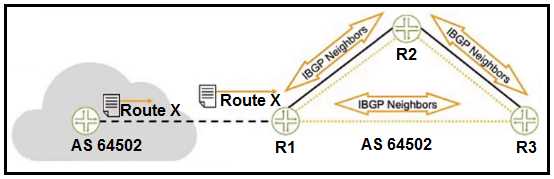
Referring to the exhibit, from which device(s) does R3 learn about Route X?
- A. both R2 and R1
- B. R1 only
- C. directly from the router in AS 64502
- D. R2 only
Answer:
D
Explanation:
R2 can not forward IBGP learned routes to another IBGP neighbor correct
R3 will learn about Route X from R2 only. R1 is in a separate AS and Route X is advertised to R2
through eBGP. R2 will then advertise the route to R3 using iBGP. R3 cannot learn routes directly from
another AS without having a direct eBGP session with that AS.
Reference::
BGP Route Propagation and Selection, Juniper Networks Documentation
Understanding iBGP and eBGP Route Distribution, Juniper Networks Documentation
Question 13
Which two statements are correct about the behavior of IS-IS metrics? (Choose two.)
- A. Wide metrics enable interfaces to advertise metrics larger than 63.
- B. By default, the metric of an interface is calculated based on the speed of the interface.
- C. Wide metrics enable an interface to advertise different metrics at Level 1 and Level 2.
- D. By default, all physical interfaces have a metric of 10.
Answer:
AC
Explanation:
Wide metrics in IS-IS allow for a larger metric value than what is available with narrow metrics,
which supports a maximum of 63. Wide metrics also enable an interface to advertise different
metrics for Level 1 and Level 2, allowing for more flexible routing policies and greater scalability in
large networks.
Reference::
IS-IS Wide Metrics, Juniper Networks Documentation
Configuring IS-IS Wide Metrics, Juniper Networks Documentation
Question 14
Click the Exhibit button.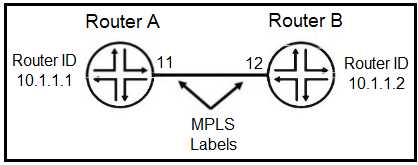
The routers shown in the exhibit are configured for segment routing.
In this scenario, what is the adjacency SID that Router B advertises to Router A?
- A. 11
- B. 10.1.1.2
- C. 10.1.1.1
- D. 12
Answer:
D
Explanation:
The diagram you provided shows two routers, Router A and Router B, with MPLS labels between
them. In the context of segment routing with MPLS, each router advertises a set of SIDs (Segment
Identifiers). These SIDs can be node SIDs, which are associated with the router itself, or adjacency
SIDs, which are associated with the links between routers.
Given the information from the exhibit:
Router A has a Router ID of 10.1.1.1 and is associated with the MPLS label 11.
Router B has a Router ID of 10.1.1.2 and is associated with the MPLS label 12.
The adjacency SID in segment routing is used to identify a specific adjacency between two routers. In
this case, the question is asking for the adjacency SID that Router B advertises to Router A. This
would be the label that Router B tells Router A to use to send packets directly to Router B over their
shared adjacency.
So, the adjacency SID that Router B advertises would be associated with the link that Router A would
use to send traffic to Router B, which is labeled with the number 12 in the exhibit.
Therefore, the answer to the question is:
D. 12
This is the label that packets would carry when being sent from Router A to Router B to identify the
specific adjacency between the two routers in the context of segment routing.
Question 15
Which two protocols are capable of distributing labels for segment routing? (Choose two.)
- A. RSVP
- B. LDP
- C. IS-IS
- D. OSPF
Answer:
CD
Explanation:
Segment routing labels can be distributed by link-state routing protocols such as IS-IS and OSPF,
which have been extended to support segment routing capabilities.
Reference::
Segment Routing Overview, Juniper Networks Documentation
Understanding Segment Routing with OSPF, Juniper Networks Documentation
Understanding Segment Routing with IS-IS, Juniper Networks Documentation