Juniper JN0-281 Exam Questions
Questions for the JN0-281 were updated on : Feb 18 ,2026
Page 1 out of 5. Viewing questions 1-15 out of 65
Question 1
What is the behavior of the default export policy for OSPF?
- A. Accept all routes.
- B. Reject all routes.
- C. Redistribute all routes.
- D. Forward all routes.
Answer:
B
Explanation:
In Junos, the default export policy for OSPF is to reject all routes from being exported.
Step-by-Step Breakdown:
Default Export Policy:
By default, OSPF in Junos does not export any routes to other routing protocols or neighbors. This is a
safety mechanism to prevent unintended route advertisements.
Custom Export Policies:
If you need to export routes, you must create a custom export policy that explicitly defines which
routes to advertise.
Example: You can create an export policy to redistribute static or connected routes into OSPF.
Juniper Reference:
OSPF Export Behavior: In Juniper devices, the default policy for OSPF is to reject route
advertisements unless explicitly configured otherwise through custom policies.
Question 2
You are troubleshooting a downed BGP session.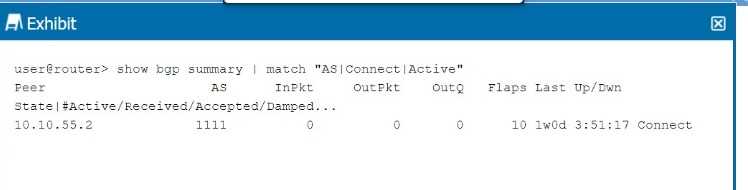
Referring to the exhibit, what is the cause of the problem?
- A. The UDP session between the peers has not been established.
- B. The local peer has sent an Open message but not received one from the remote peer.
- C. The TCP session between the peers has not been established.
- D. The local peer has sent an Update message but not received one from the remote peer.
Answer:
C
Explanation:
The BGP session in the exhibit shows the state as Connect, which indicates that the TCP session
between the BGP peers has not been fully established.
Step-by-Step Breakdown:
BGP State "Connect":
The Connect state is the second stage in the BGP finite state machine (FSM). At this stage, BGP is
trying to establish a TCP session with the peer, but the session has not yet been successfully
established.
A successful TCP three-way handshake (SYN, SYN-ACK, ACK) is required before BGP can progress to
the OpenSent state, where the peers exchange BGP Open messages.
Possible Causes:
A firewall blocking TCP port 179.
Incorrect IP addresses or network connectivity issues between the BGP peers.
Juniper Reference:
BGP Troubleshooting: In Junos, if a BGP session is stuck in the Connect state, the issue is likely due to
a failure in establishing the underlying TCP connection.
Question 3
When using spine and leaf fabric architectures, what is the role of each device? (Choose two.)
- A. Spine nodes are used for host connectivity.
- B. Spine nodes are used for transit to other leaf nodes.
- C. Leaf nodes are used for traffic to other leafs.
- D. Leaf nodes are used for host connectivity.
Answer:
B, D
Explanation:
In a spine-leaf fabric architecture, which is commonly used in data center designs, each device has a
distinct role to ensure efficient and scalable network traffic flow.
Step-by-Step Breakdown:
Spine Nodes:
The spine nodes form the backbone of the fabric and are responsible for transit traffic between leaf
nodes. They connect to every leaf switch and provide multiple paths for traffic between leaf nodes,
ensuring redundancy and load balancing.
Leaf Nodes:
The leaf nodes are used for host connectivity. These switches connect to servers, storage, or edge
routers. They also connect to the spine switches to reach other leaf switches.
Juniper Reference:
Spine-Leaf Architecture: In Juniper's IP fabric designs, spine switches handle inter-leaf
communication, while leaf switches manage host and endpoint connectivity.
Question 4
Exhibit: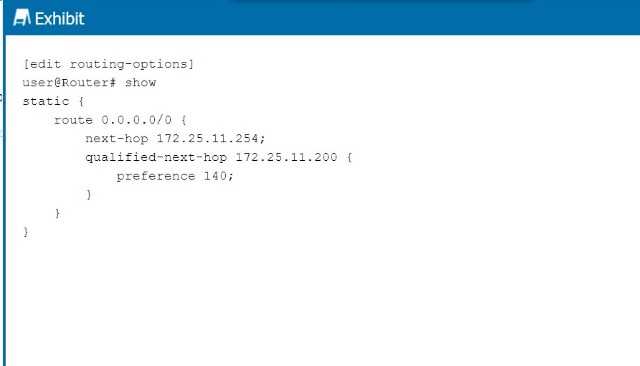
Referring to the exhibit, what is the route preference of the 172.25.11.254 next hop?
- A. 5
- B. 10
- C. 130
- D. 140
Answer:
A
Explanation:
In the exhibit, we see two next-hop addresses for the default static route (0.0.0.0/0):
The first next hop is 172.25.11.254, with no specified preference.
The second next hop is 172.25.11.200, with a specified preference of 140.
Step-by-Step Breakdown:
Default Static Route Preference:
If no preference is explicitly set for a next hop in Junos, it defaults to 5 for static routes.
Determining Preference:
In this case, the next hop 172.25.11.254 does not have an explicit preference defined, so it will use
the default value of 5. The second next hop has a preference of 140, which is higher, meaning it will
only be used if the primary next hop is unavailable.
Juniper Reference:
Static Route Preference: In Junos, the default preference for static routes is 5, and this value is
applied unless overridden by the preference parameter.
Question 5
Exhibit: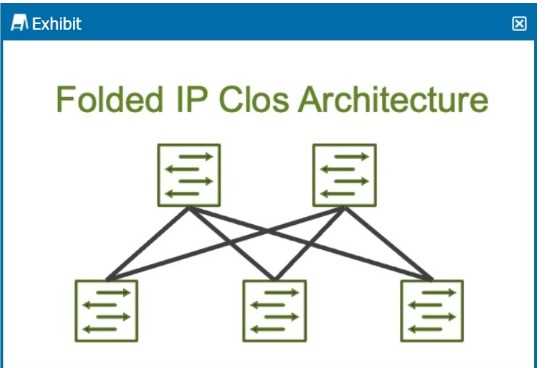
How many stages are shown in the exhibit?
- A. 2
- B. 5
- C. 6
- D. 3
Answer:
D
Explanation:
The exhibit shows a Folded IP Clos Architecture, which is also referred to as a 3-stage Clos network
design. This architecture typically consists of two layers of switches:
Spine Layer: The top row of switches.
Leaf Layer: The bottom row of switches.
Step-by-Step Breakdown:
Clos Architecture:
A 3-stage Clos network has two types of devices: spine and leaf. In this design, each leaf switch
connects to every spine switch, providing a high level of redundancy and load balancing.
Stage Explanation:
Stage 1: The first set of leaf switches.
Stage 2: The spine switches.
Stage 3: The second set of leaf switches.
The Folded Clos architecture shown here effectively "folds" the 3-stage design by combining the
ingress and egress leaf layers into one, reducing it to two visible layers, but still maintaining the
overall 3-stage architecture.
Juniper Reference:
IP Clos Architecture: The 3-stage Clos design is commonly used in modern data centers for high
availability, redundancy, and scalability.
Question 6
Which route is preferred by the Junos OS software routing tables?
- A. Static
- B. Aggregate
- C. Direct
- D. BGP
Answer:
C
Explanation:
In Junos OS, direct routes are the most preferred routes in the routing table, having the highest
priority.
Step-by-Step Breakdown:
Direct Routes:
Direct routes represent networks that are directly connected to the router's interfaces. Since these
routes are directly accessible, they are assigned the highest priority and always take precedence over
other types of routes.
Preference Values:
Direct routes have a preference of 0, which is the most preferred in Junos. Static routes, OSPF routes,
and BGP routes have higher preference values and will only be used if there are no direct routes to
the destination.
Juniper Reference:
Direct Route Preference: In Junos, direct routes are always preferred over other routes, ensuring that
the router forwards traffic through locally connected networks.
Question 7
Which two statements are correct about aggregate routes and generated routes? (Choose two.)
- A. An aggregate route does not have a forwarding next hop.
- B. An aggregate route has a forwarding next hop.
- C. A generated route has a forwarding next hop.
- D. A generated route does not have a forwarding next hop.
Answer:
A, C
Explanation:
Aggregate routes and generated routes are used to create summarized routes in Junos, but they
behave differently in terms of forwarding.
Step-by-Step Breakdown:
Aggregate Routes:
An aggregate route summarizes a set of more specific routes, but it does not have a direct forwarding
next hop. Instead, it points to the more specific routes for actual packet forwarding.
Generated Routes:
A generated route also summarizes specific routes, but it has a forwarding next hop that is
determined based on the availability of contributing routes. The generated route can be used to
directly forward traffic.
Juniper Reference:
Aggregate and Generated Routes: In Junos, aggregate routes rely on more specific routes for
forwarding, while generated routes can forward traffic directly based on their next-hop information.
Question 8
What are three correct layer names used in legacy hierarchical network design? (Choose three.)
- A. Access layer
- B. Modular layer
- C. Aggregation layer
- D. Core layer
- E. Function layer
Answer:
A, C, D
Explanation:
In legacy hierarchical network design, three key layers are used to create a scalable and structured
network:
Step-by-Step Breakdown:
Access Layer:
The access layer is where end devices, such as computers and IP phones, connect to the network. It
typically involves switches that provide connectivity for devices at the edge of the network.
Aggregation Layer (Distribution Layer):
The aggregation layer (also called the distribution layer) aggregates traffic from multiple access layer
devices and applies policies such as filtering and QoS. It also provides redundancy and load
balancing.
Core Layer:
The core layer provides high-speed connectivity between aggregation layer devices and facilitates
traffic within the data center or between different network segments.
Juniper Reference:
Legacy Hierarchical Design: Juniper networks often follow the traditional three-layer design (Access,
Aggregation, and Core) to ensure scalability and high performance.
Question 9
You are creating an IP fabric underlay and want to use OSPF as your routing protocol.
In this scenario, which statement is correct?
- A. All leaf devices must be configured in separate OSPF areas.
- B. All leaf and spine devices must be the same model to ensure the proper load-balancing behavior.
- C. Interface speeds should be the same throughout the fabric to ensure that all links are utilized.
- D. All spine devices must use the same router ID.
Answer:
C
Explanation:
When creating an IP fabric underlay using OSPF as the routing protocol, consistent interface speeds
are important to ensure optimal traffic distribution and utilization of all links.
Step-by-Step Breakdown:
OSPF and Interface Speeds:
OSPF calculates the cost of a link based on its bandwidth. The default cost calculation in OSPF is: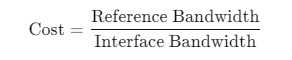
If interface speeds vary significantly, OSPF may choose paths with lower cost (higher bandwidth),
resulting in some links being underutilized.
Equal Utilization:
To ensure that all links are equally utilized in an IP fabric, it is recommended to maintain uniform
interface speeds across the fabric. This ensures balanced load sharing across all available paths.
Juniper Reference:
IP Fabric with OSPF: Juniper recommends consistent interface speeds to maintain even traffic
distribution and optimal link utilization in IP fabric underlay designs.
Question 10
What is the default route preference of a static route in the Junos OS?
- A. 0
- B. 10
- C. 1
- D. 5
Answer:
D
Explanation:
In Junos OS, the default route preference for a static route is 5. Route preference values are used to
determine which route should be installed in the routing table when multiple routes to the same
destination are available.
Step-by-Step Breakdown:
Static Route Preference:
A static route, by default, has a preference of 5, making it a highly preferred route. Lower preference
values are more preferred in Junos, meaning static routes take precedence over most dynamic
routing protocol routes, such as OSPF (preference 10) or BGP (preference 170).
Route Preference:
Route preference is a key factor in the Junos routing decision process. Routes with lower preference
values are preferred and installed in the forwarding table.
Juniper Reference:
Static Routes: In Junos, the default preference for static routes is 5, making them more preferred
than most dynamic routes.
Question 11
When evaluating BGP routes, what will be evaluated first?
- A. The local preference value
- B. The AS path
- C. The MED value
- D. The origin value
Answer:
A
Explanation:
In BGP (Border Gateway Protocol), when evaluating multiple routes to the same destination, the first
attribute that is considered is the local preference value. The local preference is a BGP attribute used
to influence outbound routing decisions within an Autonomous System (AS).
Step-by-Step Breakdown:
Local Preference:
The local preference attribute is used to determine which path is preferred for traffic leaving the AS.
The higher the local preference value, the more preferred the route.
BGP Path Selection:
The BGP path selection process evaluates the following attributes in this order:
Local Preference (higher is preferred)
AS Path (shorter is preferred)
Origin (IGP > EGP > incomplete)
MED (Multi-Exit Discriminator) (lower is preferred)
Juniper Reference:
BGP Path Selection: In Junos, the local preference attribute is the first to be evaluated when
determining the best path for outbound traffic.
Question 12
Exhibit: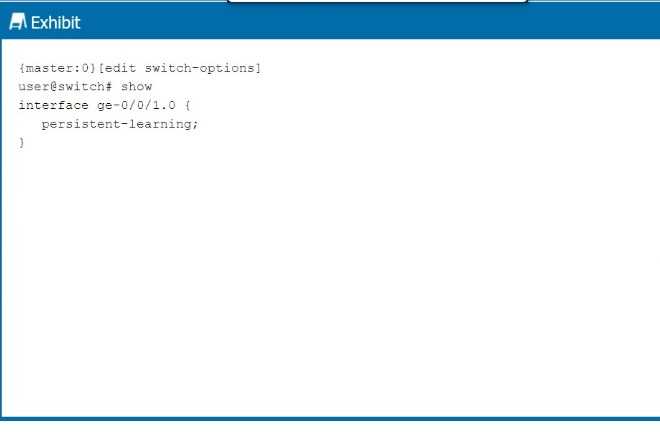
Referring to the exhibit, which behavior does this configuration enable on the ge-0/0/1.0 interface?
- A. This configuration enables a MAC address learned on the interface to be persistently retained in the Ethernet-switching table, even after a reboot.
- B. This configuration enables the device to place a MAC address that persistently causes network errors into a special protected VLAN.
- C. This configuration enables the device to shut down the interface when a particular MAC address persistently sends broadcast traffic.
- D. This configuration enables the interface to learn and remember MAC addresses, until the device is rebooted.
Answer:
A
Explanation:
The configuration in the exhibit shows the persistent-learning feature enabled on interface ge-
0/0/1.0.
Step-by-Step Breakdown:
Persistent Learning:
Persistent-learning ensures that the MAC addresses learned on the interface are retained in the
Ethernet-switching table, even after a device reboot. This prevents the need to re-learn MAC
addresses after the device restarts, improving stability and reducing downtime.
Use Case:
This feature is particularly useful in environments where the re-learning of MAC addresses could
cause temporary disruptions or delays in communication, such as in critical Layer 2 network
segments.
Command Example:
set switch-options interface ge-0/0/1.0 persistent-learning
Juniper Reference:
Persistent MAC Learning: In Junos, enabling persistent-learning ensures that learned MAC addresses
are not lost during reboots, contributing to smoother network operations in environments where
stability is crucial.
Question 13
Which state in the adjacency process do OSPF routers check the MTU size?
- A. Init
- B. Exchange
- C. Done
- D. ExStart
Answer:
B
Explanation:
In OSPF, routers exchange link-state information in different stages to establish full adjacency. The
MTU size is checked during the Exchange state.
Step-by-Step Breakdown:
OSPF Adjacency Process:
OSPF routers go through multiple stages when forming an adjacency: Down, Init, 2-Way, ExStart,
Exchange, Loading, and Full.
Exchange State:
During the Exchange state, OSPF routers exchange Database Description (DBD) packets to describe
their link-state databases. The MTU size is checked at this stage to ensure both routers can
successfully exchange these packets without fragmentation.
If there is an MTU mismatch, the routers may fail to proceed past the Exchange state.
Juniper Reference:
MTU Checking in OSPF: Junos uses the Exchange state to check for MTU mismatches, ensuring that
routers can properly exchange database information without packet fragmentation issues.
Question 14
What are two device roles in a five-member Virtual Chassis? (Choose two.)
- A. PFE
- B. Control-board
- C. Line card
- D. Routing-engine
Answer:
C, D
Explanation:
In a Virtual Chassis (VC) configuration, multiple Juniper switches are interconnected to form a single
logical device. Each member switch in the Virtual Chassis plays a specific role.
Step-by-Step Breakdown:
Line Card Role:
Member switches acting as line cards provide additional ports for traffic forwarding but do not
perform control or routing functions. These switches depend on the routing engine to handle
control-plane tasks.
Routing Engine Role:
A switch in the routing-engine role is responsible for control-plane operations such as routing
protocol management and control of the Virtual Chassis.
Virtual Chassis Roles:
Master Routing Engine: Handles control-plane functions and manages the entire Virtual Chassis.
Backup Routing Engine: Takes over if the master fails.
Line Card: Provides additional ports and handles data-plane operations.
Juniper Reference:
Virtual Chassis: In a five-member Virtual Chassis, multiple switches act as line cards, while one or
more switches are designated as the routing engines (master and backup).
Question 15
Which static routing parameter will silently drop the packet if it is set as the next hop?
- A. Reject
- B. Resolve
- C. Readvertise
- D. Discard
Answer:
D
Explanation:
When the discard option is configured as the next hop for a static route, it silently drops any packets
that match the route without sending any notification to the sender.
Step-by-Step Breakdown:
Discard Behavior:
If a route uses the discard next hop, the router drops the packet without generating any ICMP
message or error back to the sender. This is useful for creating null routes to prevent routing loops or
blackhole traffic intentionally.
Reject vs. Discard:
The reject next hop, in contrast, drops the packet but sends an ICMP Destination Unreachable
message back to the source.
Juniper Reference:
Static Route Behavior: In Junos, the discard option ensures packets matching a static route are
dropped silently, providing a way to discard traffic without alerting the source.