IIBA CBAP Exam Questions
Questions for the CBAP were updated on : Feb 18 ,2026
Page 1 out of 34. Viewing questions 1-15 out of 497
Question 1
While working on a major project to replace the billing mechanism at a bank, a major change in
scope is discussed. Which approach does the business analyst (BA) use to help determine the
formality of the assessment process to be followed to understand the impacts of the scope change?
- A. Governance
- B. Information management
- C. Stakeholder engagement
- D. Solution
Answer:
C
Explanation:
The BA should use the stakeholder engagement approach to help determine the formality of the
assessment process to be followed to understand the impacts of the scope change. Stakeholder
engagement is a technique that helps the BA identify, analyze, and communicate with the
stakeholders who are affected by or have influence on the project. By engaging the stakeholders, the
BA can understand their needs, expectations, interests, and concerns regarding the scope change,
and tailor the assessment process accordingly. The BA can also use stakeholder engagement to
obtain feedback, buy-in, and approval for the scope change, and manage any conflicts or issues that
may arise. Reference:
IIBA BABOK Guide
, Section 10.24, Stakeholder Engagement
Stakeholder Engagement: A Key Technique for Business Analysts
, BA Times
Stakeholder Engagement in Business Analysis
, Business Analyst Learnings
Question 2
Company A has been engaged to provided solution software to Company B as part of a combined
service offering to Company C.
The initiative requires a sub project for Companies A and B learn Company Cs statutory
requirements, a sub project for Company A to write custom functionality for the solution, and a sub
project for Company B to develop infrastructure and support for the solution as well as the main
project of implementation and cutover from Company Cs current data processing solution to the
service from Company B, How does the business analyst (BA) assign requirements to the various
solution components to ensure all objectives are met?
- A. Described Design Options
- B. Allocate Requirements
- C. Identify Improvement Opportunities
- D. Define Solution Approaches
Answer:
B
Explanation:
The BA should use the Allocate Requirements technique to assign requirements to the various
solution components to ensure all objectives are met. This technique involves distributing
stakeholder and solution requirements among solution components and releases in order to
maximize the possible business value given the options and alternatives generated by the design
team. The BA should consider the dependencies, constraints, priorities, and risks of each
requirement and component, and ensure that the allocation is traceable, verifiable, and consistent
with the project scope and objectives. Reference:
IIBA BABOK Guide
, Section 7.2, Allocate Requirements
Oh Where, Oh Where Does This Requirement Belong? (BABOK 7.2)
, Bridging the Gap
Requirements Allocation
, AcqNotes
Question 3
Refer to the exhibit.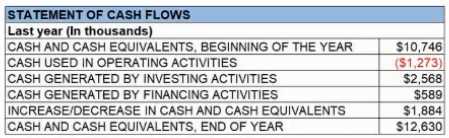
The table illustrate the statement of cash flower for a courier company for the last fiscal year:
Due to aggressive market competition the management of the company performed a strategy review
and based on their0-findings and the current market conditions, they came up with strategic and
tactical changes in order to keep a competitive market position.
In order to strength customer retention strategies through a new competitive advantage, the
company is considering implementing a live parcel tracking system. The added value will be that the
customers may determine the exact location on of the parcel whether it is in a warehouse, crossing
the ocean through an overseas the exact location of the parcel whether it is in a warehouse, crossing
the ocean through an overseas the ship, or travelling in a delivery truck at any time. The system
tracks the location of the parcel by tracking the vehicle in which it is contained. However, for a group
of old delivery trucks, it was noticed that the engine sound and vibration disturbed the tracking
signal and caused of management would like to sell these vehicles and replace them with newer
ones, the Chief Financial Officer (CFO) was strongly against that approach. The CFO argued that
instead of hanging tracking devices on the trucks body they can have the truck drivers manually send
the truck send the truck location from a hand-held mobile device every 20 minutes.
What could the business analyst (BA) do to gain consensus between the CFO and other
Management?
- A. Calculate the costs incurred by each option
- B. Recommend and present a completely new option
- C. Compare each option against an industry benchmark
- D. Estimate the potential value delivered by each option
Answer:
D
Explanation:
In order to gain consensus between the CFO and other management, the BA could estimate the
potential value delivered by each option and present the results to the stakeholders. This would
involve assessing the benefits, costs, and risks of each option, as well as the alignment with the
strategic objectives and customer needs. By estimating the value, the BA could help the stakeholders
understand the trade-offs and implications of each option, and facilitate a rational and informed
decision-making process. Reference:
IIBA BABOK Guide
, Section 9.4, Evaluate Solution Options
How to Estimate the Value of a Business Analysis Solution
, Bridging the Gap
Business Analysis Techniques: Estimating Value
, Business Analyst Learnings
Question 4
Refer to the exhibit.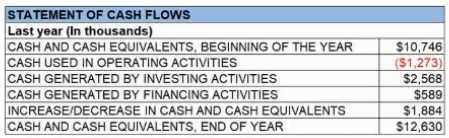
The table illustrate the statement of cash flower for a courier company for the last fiscal year:
Due to aggressive market competition the management of the company performed a strategy review
and based on their0-findings and the current market conditions, they came up with strategic and
tactical changes in order to keep a competitive market position.
In order to strength customer retention strategies through a new competitive advantage, the
company is considering implementing a live parcel tracking system. The added value will be that the
customers may determine the exact location on of the parcel whether it is in a warehouse, crossing
the ocean through an overseas the exact location of th parcel whether it is in a warehouse, crossing
the ocean through an overseas the ship, or travelling in a delivery truck at any time. The system
tracks the location of the parcel by tracking the vehicle in which it is contained. However, for a group
of old delivery trucks, it was noticed that the engine sound and vibration disturbed the tracking
signal and caused of management would like to sell these vehicles and replace them with newer
ones, the Chief Financial Officer (CFO) was strongly against that approach. The CFO argoad that
instead of hanging tracking devices on the trucks body they can have the truck drivers manually send
the truck send the truck location from a hand held mobile device every 20 minutes.
The CFO's resistance to replacing the older vehicles represents which type of cost?
- A. Maintenance
- B. Operating
- C. Opportunity
- D. Sunk
Answer:
C
Explanation:
The CFO’s resistance to replacing the older vehicles and suggesting that the truck drivers manually
send the truck location from a handheld mobile device every 20 minutes is an opportunity cost. An
opportunity cost is the value of the next best alternative that is foregone as a result of making a
decision. In this case, the opportunity cost of not replacing the older vehicles is the potential loss of
customer satisfaction, retention, and loyalty due to the less accurate and less convenient tracking
system. The CFO is choosing to save money on the upfront cost of buying new trucks, but at the
expense of losing the competitive advantage and long-term benefits of having a live parcel tracking
system. Reference:
IIBA BABOK Guide
, Section 10.23, Decision Analysis
Opportunity Cost: Definition, Real-World Examples, How to Calculate
, The Balance
What is Opportunity Cost and How to Calculate It
, Investopedia
Question 5
An insurance company wants to implement a business intelligence solution to consolidate data from
various different internal system to provide a better understanding of their customer base.
A business analysis (BA) is engaged to put together a tender (bid) to be sent to various business
intelligence providers and implementation partners. Among other information the business analysis
requests the following:
* Licensing costs for year 0 based on needing 1 Central processing Unit (CPU) license
* Licensing costs for specific user types such as Report Creators Online Analytical Process (OLAO) user
and Power users
* Predicted licensing costs for renewing in Years 1 and 2
* Full implementation costs
After reviewing the received vendor responses the project team shortlists the candidates to 3 and
the BA structures the received information as follows: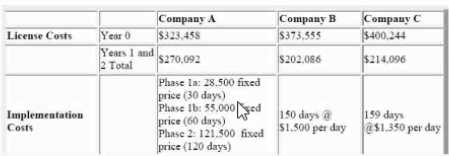
The Insurance company has a maximum bucket of $310,000 for the entire to implementation and
operation over the first three years. Which vendor or vendors meet that criterion?
- A. Both companies B and C
- B. Company B
- C. Company A
- D. Both companies A and C
Answer:
B
Explanation:
Based on the table in the image, the total cost for each company over the three years can be
calculated by adding the Year 0 license costs, Years 1 and 2 total license costs, and implementation
costs. For Company A, the total cost is $323,458 (Year 0) + $270,092 (Years 1 and 2) + $28,500 (Phase
Ia) + $55,000 (Phase Ib) + $121,500 (Phase 2) = $798,550. For Company B, it’s $373,555 (Year 0) +
$202,056 (Years 1 and 2) + ($1.500 150 days of implementation)= $578611 which is less than the
insurance company’s maximum budget of $310000. For Company C it’s =
($400244+$214096+($31.50159))= $695439 which exceeds the budget. Reference: The answer is
derived from a direct calculation based on the provided information in the image and does not
reference specific CBAP learning documents or resources.
Question 6
I . A health insurance provider undertakes enhancements to its mobile application platform and
finalizes the following capabilities as part of the scope of the next release:
L Ability to integrate online maps and global positioning system (GPS) technology with the mobile
application in real time to display location of service providers in the subscriber’s that participate in
the subscriber’s plan network.
Ability for the subscriber to lookup the service providers by specifying either a postal code on a
search area radius in miles.
III . Ability for the subscriber to initial the download of fee information for one more service
providers in a single request.
Through requirements workshops the business analyst elicits the following detailed business
requirements:
1. The company's mobile application platform must support real time integration with the following
third-party systems:
A . GPS System
B . Postal Code Validation
2. The service providers available for selection must participate in the subscriber’s medical plan
network as of the current system date.
3. The map display shall highlight the boundary of the search area with a dotted yellow line.
4. The extent and shape of he searches area shall be determined based on one of the following user
choices:
A postal code-Subscriber location acquired from GPS shall be used to determine and
populate........................
Which of the following is the appropriate technique to define communication flows between the
Postal Code validation system with other systems?
- A. Process Analysis
- B. Capability Analysis
- C. Decision Analysis
- D. Interface Analysis
Answer:
D
Explanation:
Interface analysis is a technique that helps the business analyst identify and specify the interactions
and information exchanges between different systems, components, or actors. Interface analysis can
help define the communication flows between the Postal Code validation system and other systems,
such as the GPS system, the mobile application platform, and the service provider database.
Interface analysis can also help specify the interface requirements, such as the format, frequency,
and protocol of the data exchange, and the interface design, such as the layout, navigation, and
functionality of the user interface. Reference:
IIBA BABOK Guide
, Section 10.20, Interface Analysis
Interface Analysis
, Business Analyst Learnings
Interface Analysis: A Key Technique for Business Analysts
, BA Times
Question 7
A large insurance company wants to buy a new claims processing system or upgrade one of its two
existing system. Each year the claims department is given a $3.5 million budget to spend. Time is of
the essence since there are tome regulatory charges that will be coming the following year that will
require several features that currently neither one of the two claims System currently support.
There are eight stakeholders involved in this initiative. There are local to where the claim system is
managed, while five are located across the country. The business analyst (BA) struggled to get all
stakeholders to agree on the desired features but ultimately got agreement on ten identified key
features for the new claims system. The BA was able to build a current state and future state process
model which included all ten key features.
System a processes 75% of the company's claims. It is 5 years old and the claim processors love it
because it is easy to use. However, it must go offline for two hours each day. The code is very module
so it does have flexibility to be modified. To upgrade system A to have all ten features it would cost
$5 million. System A would be at capacity if it were to process all of the company's claims.
System B process 25% of the company's claims. It is an older mainframe system, but rarely goes
offline. It could easily handle double the number of claims that system A processes. However, it has a
lot of legacy code and would cost $6 million to upgrade.
Both systems have some of the desired key features. But neither system has all ten. The cost to buy a
new system would be $7 million.
Below is the estimated cost for each feature in priority order.
During elicitation the BA must understand the non-functional requirements. What nonfunctional
requirement does System B support over System A?
- A. Usability
- B. Compatibility
- C. Scalability
- D. Compliance
Answer:
C
Explanation:
Scalability is a non-functional requirement that refers to the ability of a system to handle increasing
workloads or demands without compromising its performance or functionality. System B supports
scalability over System A, as it can process double the number of claims that System A can, and it
rarely goes offline. System A, on the other hand, would be at capacity if it were to process all of the
company’s claims, and it must go offline for two hours each day. Reference: The answer can be
verified from the Business Analysis Professional (CBAP) learning documents or resources, such as:
IIBA BABOK Guide
, Section 4.2.3, Non-Functional Requirements
Non-Functional Requirements: Definition, Types, and Examples
, ReQtest
Non-Functional Requirements: Scalability
, Software Engineering Stack Exchange
Question 8
A large insurance company wants to buy a new claims processing system or upgrade one of its two
existing system. Each year the claims department is given a $3.5 million budget to spend. Time is of
the essence since there are tome regulatory charges that will be coming the following year that will
require several features that currently neither one of the two claims System currently support.
There are eight stakeholders involved in this initiative. There are local to where the claim system are
managed, while five are located across the country. The business analyst (BA) struggled to get all
stakeholders to agree on the desired features but ultimately got agreement on ten identified key
features for the new claims system. The BA was able to build a current state and future state process
model which included all ten key features.
System a process 75% of the company's claims. It is 5 years old and the claim processors love it
because it is easy to use. However, it must go offline for two hours each day. The code is very module
so it does have flexibility to be modified. To upgrade system A to have all ten features it would cost
$5 million. System A would be at capacity if it were to process all of the company's claims.
System B process 25% of the company's claims. It is an older mainframe system, but rarely goes
offline. It could easily handle double the number of claims that system A processes. However, it has a
lot of legacy code and would cost $6 million to upgrade.
Both systems have some of the desired key features. But neither system has all ten. The cost to buy a
new system would be $7 million.
Below is the estimated cost for each feature in priority order.
If System A is unanimously selected to be the system for upgrade but the technical lead says that
System A will have to be taken offline for 3 months, what kind of strategy should the project team
develop while system A is offline?
- A. Organizational
- B. Stakeholder
- C. Change
- D. Competitive
Answer:
C
Explanation:
A change strategy is a plan that outlines how the project team will manage the transition from the
current state to the future state of the system, and how they will address the impacts and risks of the
change on the organization and the stakeholders. A change strategy is needed when system A is
offline for 3 months, as this will affect the claims processing operations and the user experience. A
change strategy should include the following elements:
Change vision and objectives: This defines the purpose and scope of the change, and the expected
outcomes and benefits of the system upgrade.
Change readiness assessment: This evaluates the current level of awareness, willingness, and ability
of the organization and the stakeholders to adopt the change, and identifies any gaps or barriers that
need to be addressed.
Change impact analysis: This identifies and analyzes the potential effects of the change on the
business processes, roles and responsibilities, policies and procedures, systems and tools, and
culture and behavior of the organization and the stakeholders.
Change communication plan: This specifies the key messages, channels, methods, and frequency of
communication with the organization and the stakeholders, and how to solicit and incorporate
feedback and input.
Change training plan: This defines the learning objectives, content, delivery modes, and evaluation
methods of the training programs that will help the organization and the stakeholders acquire the
necessary knowledge and skills to use the upgraded system.
Change management roles and responsibilities: This clarifies the roles and expectations of the
project team, the sponsors, the champions, the change agents, and the end users in the change
process, and how they will collaborate and coordinate with each other.
Change monitoring and evaluation plan: This establishes the metrics, indicators, and tools that will
measure the progress and performance of the change process, and how to report and act on the
results.
Reference:
IIBA BABOK Guide
, Section 5.6, Define Change Strategy
Change Management Strategy: A Guide with Best Practices
, Smartsheet
How to Develop a Change Management Strategy
, Indeed
Question 9
A large insurance company wants to buy a new claims processing system or upgrade one of its two
existing system. Each year the claims department is given a $3.5 million budget to spend. Time is of
the essence since there are tome regulatory charges that will be coming the following year that will
require several features that currently neither one of the two claims System currently support.
There are eight stakeholders involved in this initiative. There are local to where the claim system is
managed, while five are located across the country. The business analyst (BA) struggled to get all
stakeholders to agree on the desired features but ultimately got agreement on ten identified key
features for the new claims system. The BA was able to build a current state and future state process
model which included all ten key features.
System a process 75% of the company's claims. It is 5 years old and the claim processors love it
because it is easy to use. However, it must go offline for two hours each day. The code is very module
so it does have flexibility to be modified. To upgrade system A to have all ten features it would cost
$5 million. System A would be at capacity if it were to process all of the company's claims.
System B process 25% of the company's claims. It is an older mainframe system, but rarely goes
offline. It could easily handle double the number of claims that system A processes. However, it has a
lot of legacy code and would cost $6 million to upgrade.
Both systems have some of the desired key features. But neither system has all ten. The cost to buy a
new system would be $7 million.
Below is the estimated cost for each feature in priority order.
If the budget for the initiative was firm, what is a feasible solution to make sure the project stays
within budget?
- A. Buy the new system with only the first 8 features.
- B. Upgrade system A with the first 8 features
- C. Upgrade system B with the first B features
- D. Buy the new system with only the first 5 features
Answer:
B
Explanation:
Based on the table in the image, the total cost of upgrading system A with the first 8 features is $3.5
million, which is equal to the budget for the initiative. This option would also allow the company to
retain the system that is preferred by the claim processors and has more flexibility to be modified.
The other options would either exceed the budget or compromise the functionality and usability of
the system. Therefore, upgrading system A with the first 8 features is a feasible solution to make sure
the project stays within budget. Reference:
IIBA BABOK Guide
, Section 10.23, Decision Analysis
Cost Benefit Analysis: An Expert Guide
, Smartsheet
How to Choose the Right Software Vendor
, CIO
Question 10
Refer to the exhibit.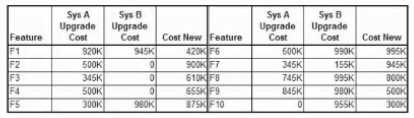
What kind of analysis must the BA do to determine if one of the systems is better suited to be
modified and upgraded?
- A. Risk Analysis
- B. Stakeholder Analysis
- C. Process Analysis
- D. Decision Analysis
Answer:
D
Explanation:
Decision analysis is a technique that helps the BA evaluate and compare different alternatives based
on their costs, benefits, and risks, and select the best option that meets the objectives and criteria. In
this case, the BA needs to determine if one of the systems (Sys A or Sys B) is better suited to be
modified and upgraded, based on the upgrade cost and cost new of each feature. The BA can use the
table in the image to calculate the total cost of upgrading or creating new features for each system,
and compare them with the expected value and return on investment of each system. The BA can
also consider other factors, such as the feasibility, compatibility, reliability, and maintainability of
each system, and the preferences and expectations of the stakeholders. By using decision analysis,
the BA can make an informed and rational choice that maximizes the value and minimizes the risk of
the solution. Reference:
IIBA BABOK Guide
, Section 10.23, Decision Analysis
Decision Analysis for the Professional
, SmartOrg
Decision Analysis: Making Justifiable, Defensible Decisions
, MindTools
Question 11
Several commercial-off-the-shelf (COTS) software packages exist that would enable the business
analyst (BA) to meet the needs of the business. For the potential deign options, the Ba included one
of the COTS packages as a solution approach What kind of solution approach is this?
- A. Outsource
- B. Exploit
- C. Create
- D. Purchase
Answer:
D
Explanation:
A purchase solution approach is one that involves acquiring a COTS software package from an
external vendor or provider, rather than developing a custom solution in-house. A purchase solution
approach can offer several benefits, such as faster delivery, lower cost, higher quality, and reduced
risk. However, a purchase solution approach also has some drawbacks, such as limited
customization, dependency on the vendor, compatibility issues, and licensing fees. A BA should
evaluate the pros and cons of a purchase solution approach against the business needs and
requirements, and compare it with other possible solution approaches, such as outsource, exploit, or
create. Reference:
Evaluating Candidate COTS Packages
, ArgonDigital
Seven Insights: Agile and Custom Off The Shelf (COTS) packaged software
, Kenny & Company
COTS Software Procurement Methodology
, IGI Global
Question 12
A business analyst (BA) is preparing a governance approach. The BA is trying to define the approval
process. Which factors should the BA consider?
- A. The organizational culture and type of information being approved
- B. The associated risks of foregoing or delaying an approval
- C. The formality and rigor of the prioritization process
- D. The solution performance measures
Answer:
A
Explanation:
The organizational culture and type of information being approved are two factors that the BA
should consider when defining the approval process. The organizational culture reflects the values,
beliefs, and behaviors that guide the decision-making and actions of the stakeholders in the
organization. The type of information being approved refers to the nature, scope, and impact of the
information that requires approval from the relevant authorities. Both factors can influence the level
of authority, responsibility, and accountability that are involved in the approval process, as well as
the criteria, methods, and tools that are used to facilitate the approval process. The BA should align
the approval process with the organizational culture and the type of information being approved to
ensure that the process is effective, efficient, and consistent. Reference:
Approval Process: Key Governance Procedure
, Business Group on Health
Developing an effective governance operating model
, Deloitte
What is a Governance Process?
, WalkMe
Question 13
A business analyst (BA) has defined a business analysis approach and presented the documents to
the sponsors, the senior executives, the domain experts, the project manager and the head of
technology, to obtain agreement from all. At this juncture, the prefect manager objected to some of
the estimates determined m the budget and refused to agree with the estimates. Which guideline or
tool, if followed by the B
- A. Requirements Classification Schema
- B. Stakeholder Engagement Approach
- C. Risk Analysis and Management
- D. Business Analysis Performance Assessment
Answer:
B
Explanation:
A stakeholder engagement approach is a plan that describes how the BA will interact with the
stakeholders, identify their needs and expectations, and address their concerns and issues. A
stakeholder engagement approach can help the BA avoid disagreements and conflicts by ensuring
that the stakeholders are involved and informed throughout the business analysis process, and that
their feedback and input are considered and incorporated. A stakeholder engagement approach can
also help the BA build trust and rapport with the stakeholders, and manage their expectations and
influence levels. By following a stakeholder engagement approach, the BA can ensure that the
business analysis approach and the budget estimates are aligned with the stakeholder needs and
agreed upon by all the relevant parties. Reference:
IIBA BABOK Guide
, Section 3.2, Plan Stakeholder Engagement
Five-Step Approach to Stakeholder Engagement
, BSR
5 steps to creating a stakeholder engagement plan (with template)
, Asana
Question 14
Before the start of a large, cross functional change effort, the team of Business analysts (BAs)
assigned decided they need something to help them ensure requirements collectively support one
another and do not conflict. What option would provide the consistency they are looking for?
- A. Process modeling
- B. Functional decomposition
- C. plate Architecture
- D. Checklist
Answer:
C
Explanation:
Plate architecture is a structural system consisting of plates, which are planar, two-dimensional
components that only transfer forces in the direction of their level. Plate architecture can help the
BAs ensure that the requirements collectively support one another and do not conflict, as it provides
a clear and consistent representation of the relationships and dependencies among the
requirements.
Plate architecture can also help the BAs identify and resolve any gaps, overlaps, or
inconsistencies in the requirements, as well as facilitate the communication and verification of the
requirements with the stakeholders 12
. Reference:
Plate (structure)
, Wikipedia
Top Architectural Plates: A Comprehensive Guide 2023
, AMTHY
Question 15
An automobile manufacturer is undertaking a project intended to modify or replace the company's
current timekeeping system. Negative employee reaction to change follows as word of the proposed
solution spreads throughout the company. What could a business analyst (BA) do to prevent or
reduce employee discontent?
- A. Record negative employee reaction as a project risk
- B. Propose cultural changes for the organization
- C. Report potential sources of dissent to management
- D. Relay upper management support to stakeholders
Answer:
D
Explanation:
Relaying upper management support to stakeholders is a way to reduce employee discontent and
resistance to change. This can help the employees feel more confident and secure about the change
initiative, as they perceive that the leaders are committed and supportive of the change. It can also
help the employees understand the vision and goals of the change, and how it aligns with the
organizational strategy and values. By communicating the benefits and rationale of the change, and
addressing the concerns and fears of the employees, the BA can foster a positive and collaborative
attitude towards the change among the stakeholders. Reference:
Emotional Reactions to Change in the Workplace
, CMI
Reactions to Change in an Organization
, Wonder
IIBA BABOK Guide
, Section 5.5, Assess Organizational Readiness