Huawei H12-351-V1-0 Exam Questions
Questions for the H12-351-V1-0 were updated on : Feb 18 ,2026
Page 1 out of 4. Viewing questions 1-15 out of 60
Question 1
Which of the following configurations may cause ST As to experience a slow Internet connection?
(Select All that Apply)
- A. QoS CAR is configured in the traffic profile.
- B. Radio 1 of APs is disabled.
- C. TKIP encryption is configured, causing a low link setup rate.
- D. Rate limiting is configured in the SSID profile.
Answer:
ACD
Explanation:
B is false because disabling radio 1 of APs does not affect the Internet connection speed of STAs that
use radio 2.
Reference:
https://support.huawei.com/enterprise/en/doc/EDOC1100058940/8a8f1c9b/troubleshooting-slow-
internet-connection
Question 2
After the HTTP domain name is entered in a browser, the user Is not redirected to the Portal URL.
Which of the followings is the possible cause for this failure? (Select All that Apply)
- A. The DNS server IP address is not added to the authentication-free rule.
- B. The URL template is incorrectly configured.
- C. HTTPS redirection is disabled.
- D. The web server is incorrectly configured.
Answer:
ABD
Explanation:
C is false because HTTPS redirection is not required for Portal authentication to work properly.
Reference:
https://support.huawei.com/enterprise/en/doc/EDOC1100058940/8a8f1c9b/troubleshooting-
portal-authentication-failures
Question 3
DRAG DROP
Drag the reasons for AP onboarding failures on the left to the corresponding troubleshooting
operations on the right.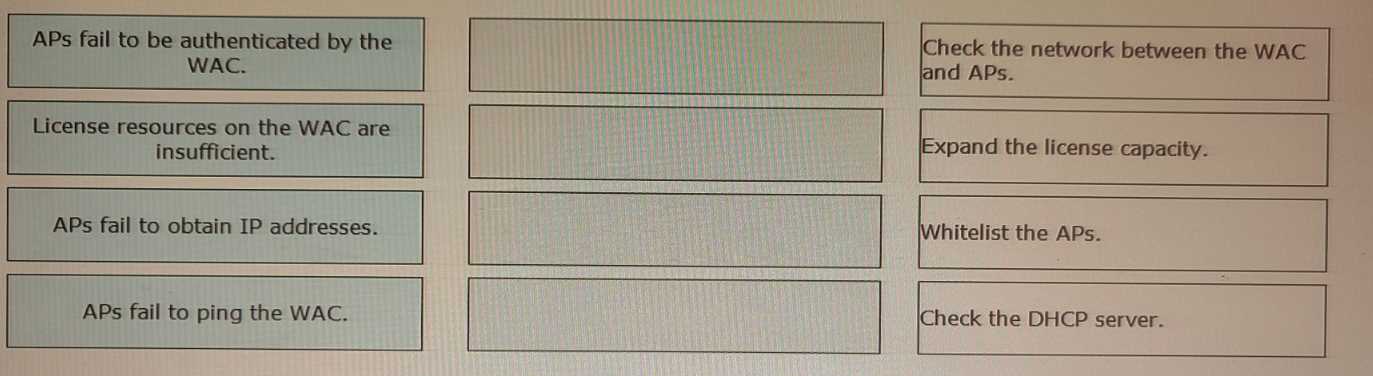
Answer:
None
Explanation:
According to the Huawei documents and resources, the troubleshooting operations for the AP
onboarding failures are as follows:
APS fail to be authenticated by the WAC: Whitelist the APS. The WAC can authenticate APs based on
their MAC addresses or SNs. If an AP is not whitelisted on the WAC, it cannot be authenticated and
onboarded.
License resources on the WAC are insufficient: Expand the license capacity. The WAC can manage a
limited number of APs based on its license. If the license resources are insufficient, some APs cannot
be onboarded.
APS fail to obtain IP addresses: Check the DHCP server. The APs need to obtain IP addresses from a
DHCP server before they can communicate with the WAC. If the DHCP server is not configured or
reachable, the APs cannot obtain IP addresses and onboard.
APS fail to ping the WAC: Check the network between the WAC and APS. The APs need to ping the
WAC to discover its IP address and establish a CAPWAP tunnel. If there is a network problem
between the WAC and APs, such as incorrect VLAN configuration or firewall blocking, the APs cannot
ping the WAC and onboard.
Therefore, APS fail to be authenticated by the WAC - c, License resources on the WAC are insufficient
- b, APS fail to obtain IP addresses - d, APS fail to ping the WAC - a is the correct answer. Reference: :
https://support.huawei.com/enterprise/en/doc/EDOC1100158948/9a0d5c37/ap-onboarding-
failures
Question 4
Which of the following statements about WLAN roaming and signal strength Is false?
- A. Smart roaming can be enabled on the WAC to help ST As roam and associate with APs with better signals.
- B. Generally, a STA roams when it detects that the signal strength is less than -75 dBm.
- C. STAs can roam between WACs in dual-link HSB mode.
- D. In most cases, the signal strength of a STA should range from -45 dBm to -65 dBm.
Answer:
B
Explanation:
B is false because generally, a STA roams when it detects that the signal strength is less than -70 dBm
or -65 dBm, not -75 dBm.
Reference:
https://support.huawei.com/enterprise/en/doc/EDOC1100058940/8a8f1c9b/wlan-
roaming-and-signal-strength
Question 5
When calculating the number of APs, you can divide the total required bandwidth by the maximum
bandwidth of a single AP.
- A. True
- B. False
Answer:
B
Explanation:
When calculating the number of APs, you cannot simply divide the total required bandwidth by the
maximum bandwidth of a single AP. You also need to consider other factors such as signal coverage
area, user density, interference level, and application type.
Reference: https://support.huawei.com/enterprise/en/doc/EDOC1100058940/8a8f1c9b/calculation-
of-the-number-of-aps
Question 6
Which of the following statements are true about the WLAN site survey In different typical
scenarios? (Select All that Apply)
- A. In a classroom scenario. If the walls are made of reinforced concrete, the signal attenuation Is high. In this case, you are advised to test the attenuation during the site survey. Additionally, pay attention to the locations of ELV rooms in the teaching building.
- B. In an office scenario, the load-bearing columns and partitions affect the signal coverage. If an integrated ceiling is used, deploy APs near maintenance entrances. If a metal ceiling is used, mount APs on the ceiling or wall.
- C. In a ward-round scenario, high requirements are posed on the coverage field strength, roaming effect, and bandwidth. Determine the interference of medical equipment and the areas where Wi-Fi signals are not allowed.
- D. In a stadium scenario, the onsite environment is complex and cabling is difficult. Therefore, confirm with the property management company about ELV rooms and cabling. If the transmission distance is too long, consider deploying more switches. During the survey, focus on the interference between APs and AP mounting modes.
Answer:
ABCD
Explanation:
Only: All statements are true about the WLAN site survey in different typical scenarios.
Reference: https://support.huawei.com/enterprise/en/doc/EDOC1100058940/8a8f1c9b/wlan-site-
survey
Question 7
In the early phase of a project, after the project requirements are clarified, the project owner should
Checklist to describe the customer's requirements. (Capitalize the first letter of each word.)
Answer:
Customer
Requirement
Specification
Explanation:
Customer Requirement Specification (CRS) is a document that needs to be output after the project
requirements are clarified. The CRS describes the customer’s requirements in detail and serves as the
basis for subsequent project design and delivery.
Reference: https://support.huawei.com/enterprise/en/doc/EDOC1100058940/8a8f1c9b/crs
Question 8
During a project lifecycle, the______ document needs to be output after the high level design be
output after the low level design is complete. (Enter the acronyms in capital letters.)
Answer:
ATP
Explanation:
ATP stands for Acceptance Test Plan, which is a document that needs to be output after the low level
design is complete. The ATP describes the acceptance criteria and test cases for the project.
Reference: https://support.huawei.com/enterprise/en/doc/EDOC1100058940/8a8f1c9b/atp
Question 9
Which of the following items is not involved in the HLD phase?
- A. Capacity planning
- B. Network design
- C. AP position planning
- D. Deployment planning
Answer:
C
Explanation:
According to the Huawei documents and resources, the HLD phase is the high-level design phase of a
WLAN project. It involves the following items:
Capacity planning: Determines the number and types of devices required for the WLAN network
based on the customer’s requirements and network scale.
Network design: Designs the network topology, IP addressing scheme, VLAN division, security
policies, and other network parameters for the WLAN network.
Deployment planning: Plans the deployment sequence, schedule, resources, and risks for the WLAN
project.
AP position planning is not involved in the HLD phase. It is part of the LLD phase, which is the low-
level design phase of a WLAN project. It involves the detailed design of AP positions, antenna types,
channel allocation, power adjustment, and other wireless parameters for the WLAN network.
Therefore,
C
is
the
correct
answer.
Reference:
:
https://support.huawei.com/enterprise/en/doc/EDOC1100158948/9a0d5c37/wlan-project-design
Question 10
iMaster NCE-Campuslnsight comprehensively analyzes WLAN client access, displays success rates
and time consumption of association, --------, and DHCP. It also provides issue analysis and
optimization suggestions. (Enter lowercase letters.)
Answer:
authentication
Explanation:
iMaster NCE-CampusInsight comprehensively analyzes WLAN client access, displays success rates
and time consumption of association, authentication, and DHCP. It also provides issue analysis and
optimization suggestions.
Reference:
https://support.huawei.com/enterprise/en/doc/EDOC1100058940/8a8f1c9b/client-
access-analysis
Question 11
Which of the following tools are commonly used for WLAN network planning, acceptance, or health
evaluation? (Select All that Apply)
- A. WLAN Planner
- B. iMaster NCE-Campuslnsight
- C. eDesk
- D. CloudCampus APP
Answer:
ABD
Explanation:
C is not a tool commonly used for WLAN network planning, acceptance, or health evaluation. eDesk
is a tool for remote fault diagnosis and rectification on WLAN networks.
Reference:
https://support.huawei.com/enterprise/en/doc/EDOC1100058940/8a8f1c9b/wlan-
planner https://support.huawei.com/enterprise/en/doc/EDOC1100058940/8a8f1c9b/imaster-nce-
campusinsight
https://support.huawei.com/enterprise/en/doc/EDOC1100058940/8a8f1c9b/cloudcampus-app
Question 12
To which of the following scenarios is radio calibration applicable?
- A. Enterprise office scenario
- B. Rail transportation scenario
- C. High-density scenario
- D. WDS or mesh backhaul scenario
Answer:
C
Explanation:
Radio calibration is applicable to high-density scenarios where a large number of users access the
network simultaneously and require high bandwidth, such as stadiums, exhibition halls, and
conference centers. Radio calibration can improve user experience by increasing the frequency
bandwidth for high-load APs.
Reference:
https://support.huawei.com/enterprise/en/doc/EDOC1100058940/8a8f1c9b/radio-
calibration
Question 13
Master NCE-Campuslnsight can comprehensively record and analyze Interference. Which of the
following parameters are recorded? (Select All that Apply)
- A. Recommended channels
- B. Interference fulfillment rate
- C. Interference strength
- D. Number of interference SSIDs
- E. Air interface congestion fulfillment rate
Answer:
ACD
Explanation:
B and E are not parameters recorded by iMaster NCE-CampusInsight for interference analysis. The
other options are parameters recorded by iMaster NCE-CampusInsight to comprehensively record
and analyze interference.
Reference:
https://support.huawei.com/enterprise/en/doc/EDOC1100058940/8a8f1c9b/interference-analysis
Question 14
iMaster NCE-Campuslnsight provides Intelligent radio calibration for high-load APs to increase the
frequency bandwidth. This function applies to both 5 GHz and 2.4 GHz frequency bands.
- A. True
- B. False
Answer:
B
Explanation:
iMaster NCE-CampusInsight provides intelligent radio calibration for high-load APs to increase the
frequency bandwidth. However, this function applies only to the 5 GHz frequency band, not to the
2.4 GHz frequency band.
Reference: https://support.huawei.com/enterprise/en/doc/EDOC1100058940/8a8f1c9b/intelligent-
radio-calibration
Question 15
Which of the following may be the reason why no data Is displayed on the telemetry management
page of IMaster NCE-CampusInsight? (Select All that Apply)
- A. The network connecting devices and iMaster NCE-Campuslnsight Is faulty.
- B. Telemetry data reporting is not configured on devices according to the configuration guide.
- C. No license file is imported.
- D. Devices are not added to iMaster NCE-Campuslnsight.
- E. The UTC time of devices is inconsistent with that of iMaster NCE-Campuslnsight.
Answer:
ABD
Explanation:
C is false because the license file only affects the number of devices that can be managed by iMaster
NCE-CampusInsight, not the data display.
E is false because the UTC time of devices does not need to be consistent with that of iMaster NCE-
CampusInsight.
Reference:
https://support.huawei.com/enterprise/en/doc/EDOC1100058940/8a8f1c9b/data-
display