HP HPE6-A85 Exam Questions
Questions for the HPE6-A85 were updated on : Feb 18 ,2026
Page 1 out of 7. Viewing questions 1-15 out of 102
Question 1
DRAG DROP
Match the most cost-effective option for cabling each requirement. (All lengths indicate total cable
length including patch cable(s), service loops, etc. where used.)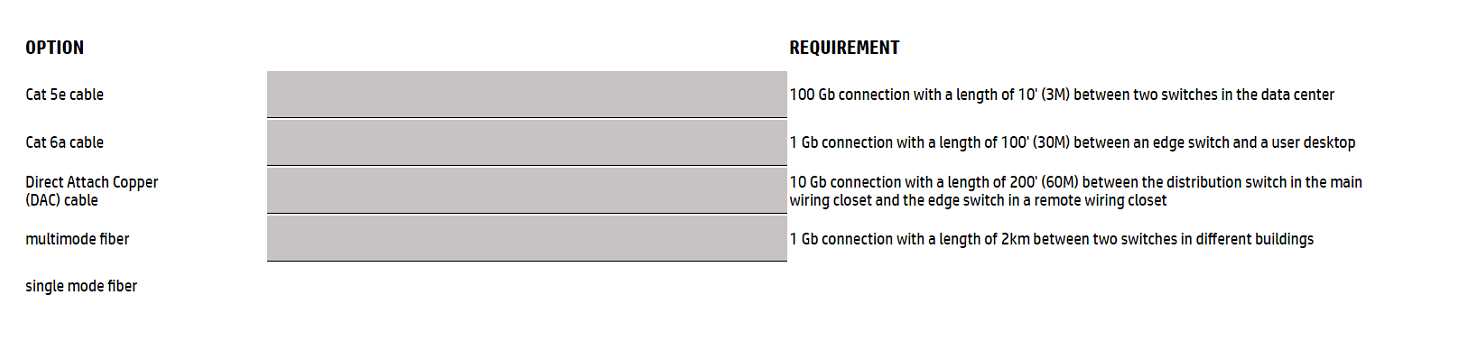
Answer:
None
Explanation:
Single mode
Cat 6a cable
Direct attach copper
Multimode fiber
Cat 5e cable
Question 2
What is used by network devices to send error and operational information related to IP
communications?
- A. Frame Check Sequence (FCS)
- B. User Datagram Protocol (UDP)
- C. Cyclic Redundancy Check (CRC)
- D. Internet Control Message Protocol (ICMP)
Answer:
D
Explanation:
ICMP (Internet Control Message Protocol) is used by network devices to send error and operational
information related to IP communications. It is used to send messages like "destination unreachable"
or "time exceeded" when there are issues in IP communication
Question 3
You have physical access to an Aruba CX-Switch with unknown/lost credentials. What are the
possible steps to rebuild the credentials? (Select two.)
- A. Connect the switch via the console. Then, power cycle the switch.
- B. Press and hold the clear button. Then, power-cycle the switch.
- C. Press and hold the clear button. Then, press the reset button for 2 seconds and release both buttons.
- D. Call Aruba support for a one-time password.
- E. Use boot profile 0.
Answer:
BE
Explanation:
To regain access to an Aruba CX switch when credentials are unknown or lost, one can press and hold
the clear button, then power cycle the switch to reset the password. Additionally, using the boot
profile 0 at the boot loader menu can be used to bypass the current startup configuration, which may
include the unknown credentials.
Question 4
What will perform a hard reset of an Aruba CX switch?
- A. Press the reset button and hold the clear button while releasing the reset button for 5 seconds.
- B. Press and hold the reset button for 5 seconds, then release.
- C. Press the reset button and the clear button simultaneously.
- D. Press the reset button three times.
Answer:
B
Explanation:
Performing a hard reset on an Aruba CX switch typically involves pressing and holding the reset
button for a specified amount of time, such as 5 seconds, and then releasing it. This action will
initiate a reboot of the switch and return it to factory default settings, including the credentials.
Question 5
A hacker has altered a user's 3-Way Handshake in order to gain access to their session.
Which security mechanism would intelligently deny this traffic?
- A. Out-of-band management (00BM)
- B. Stateless firewall
- C. Access Control List (ACL)
- D. Stateful firewall
Answer:
D
Explanation:
A stateful firewall would intelligently deny traffic from a hacker attempting to alter a user's 3-Way
Handshake to gain access to their session. Stateful firewalls keep track of the state of active
connections and can recognize if an incoming packet is part of an established session. This allows
them to detect and block unauthorized access attempts that do not match the known state of a
connection.
Question 6
What is a common use of LLDP for wireless access points?
- A. testing the quality of the physical link between the access point and the switch
- B. discovery of rogue access points
- C. exchange of RF channel information with nearby access points
- D. negotiation of PoE power level to be provided to the access point
Answer:
D
Explanation:
LLDP (Link Layer Discovery Protocol) is commonly used by network devices, including wireless access
points, to negotiate PoE (Power over Ethernet) power levels with the switch they are connected to.
This allows the access point to communicate its power requirements to ensure it receives the
necessary power for optimal operation.
Question 7
A network technician at a branch office is connecting VolP phones to a newly configured AOS-CX
switch. Users are complaining that voice quality is not as good as at the corporate office. Further
investigation
shows the local-priority value at the branch office is 1 while at the corporate office is 5.
What describes the issue regarding the default QoS behavior on the AOS-CX switch?
- A. The QoS trust is set to DSCP by default, and the VolP phone's local-priority value is mapped to 1.
- B. The QoS trust is set to CoS by default, and the VolP phone's local-priority value is mapped to 1.
- C. The QoS trust is set to none by default, and each VolP phone's local priority is configured for CoS map entry 1.
- D. The QoS trust is set to none by default, and each VolP phone's local priority is configured for CoS map entry 0.
Answer:
C
Explanation:
In an AOS-CX switch, if the QoS trust mode is not configured, it is set to none by default. The VoIP
phones will mark their traffic with a local-priority value, which, if the QoS trust mode is none, will
correspond to CoS map entry 1 by default. The local-priority value of 1 at the branch office likely
indicates that the traffic is not being prioritized correctly compared to the corporate office, where a
local-priority of 5 suggests a higher level of prioritization for voice traffic.
Question 8
What change does a client make when it roams from one access point to another in a WLAN?
- A. It changes the destination MAC address on its 802.11 frames.
- B. It changes the SSID to match the SSID on the new access point.
- C. It changes its default gateway to the IP of the new access point.
- D. It changes its association with the new wireless controller's SSID.
Answer:
A
Explanation:
When a client roams from one access point to another, it must change the destination MAC address
on its 802.11 frames to match the new access point to which it is associated. The SSID does not
change since it is typically consistent across an entire WLAN, and the default gateway remains the
same as long as the client stays within the same IP subnet. The association to a new access point
involves updating the destination MAC address in the frames that the client sends.
Question 9
Which three channels can be used simultaneously in a 2.4GHz WLAN environment while avoiding
any co-channel interference?
- A. 1,6, 11
- B. 1,5, 10
- C. 3,6, 9
- D. 2,7, 11
Answer:
A
Explanation:
In a 2.4GHz WLAN environment, channels 1, 6, and 11 are recommended for use simultaneously to
avoid co-channel interference because these channels do not overlap with each other. Each of these
channels is separated by enough frequency space to ensure that the signals do not interfere, which is
not the case with other channel combinations.
Question 10
Which type of device type and group persona is required to manage a Microbranch environment?
- A. ArubaOS 10 AP Group Persona
- B. ArubaOS 10 Branch Gateway Group Persona
- C. ArubaOS 8 AP Group Persona
- D. ArubaOS 8 Branch Gateway Group Persona
Answer:
B
Explanation:
In the context of Aruba networks, a Microbranch environment is managed using a group persona
that aligns with the functionality required. ArubaOS 10 Branch Gateway Group Persona would be the
correct device type and group persona for managing a Microbranch environment, as it would provide
the necessary features and controls for branch networking requirements.
Question 11
Which Protocol Data Unit (PDU) represents the network layer PDU?
- A. PDU3 - Packet
- B. PDU4 - Segment
- C. PDU1 - Signal
- D. PDU2 - Frame
Answer:
A
Explanation:
In the context of the OSI model, the network layer is responsible for packet forwarding including
routing through intermediate routers. Hence, the network layer PDU is known as a packet.
Question 12
You are working with a pair of 6300M switches in a VSF stack. The switch has 48 SmartRate 5G ports,
2 SFP28 ports, and 2 SFP56 ports. Both SFP56 ports are used for stacking.
You need to provide an LACP connection to another identical stack with the maximum available
bandwidth possible. What should you configure?
- A. a 16-member LAG using 2 SFP28 ports and 6 SR5 ports on each switch
- B. an eight-member LAG using 4 SR5 ports on each switch
- C. an eight-member LAG using 2 SFP28 ports and 2 SR5 ports on each switch
- D. a four-member LAG using 2 SFP28 ports on each switch
Answer:
A
Explanation:
To provide an LACP connection with the maximum available bandwidth, one should configure a link
aggregation group (LAG) using all available ports that can be used for data transfer. Since the SFP56
ports are used for stacking, the next best option is to use the 2 SFP28 ports and as many SmartRate
5G (SR5) ports as possible on each switch, which would allow for a 16-member LAG, with 2 SFP28
and 6 SR5 ports on each switch contributing to the LAG.
Question 13
What is indicated by a flashing amber global status indicator LED on an Aruba CX6200M?
- A. The switch has a recoverable fault.
- B. Self-test is in progress.
- C. The firmware image is corrupt.
- D. The switch is booting the firmware image.
Answer:
A
Explanation:
A flashing amber global status indicator LED on an Aruba CX6200M switch typically indicates that the
switch has encountered a fault, but it is recoverable. This LED behavior serves as an alert to the
network administrator that an issue needs to be addressed, but it does not necessarily mean that the
switch is inoperable.
Question 14
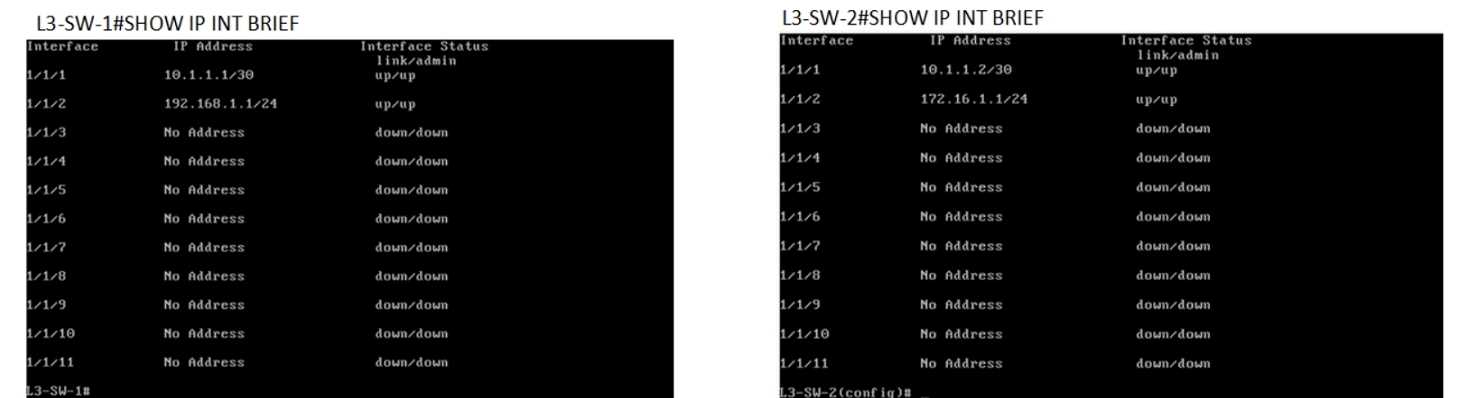
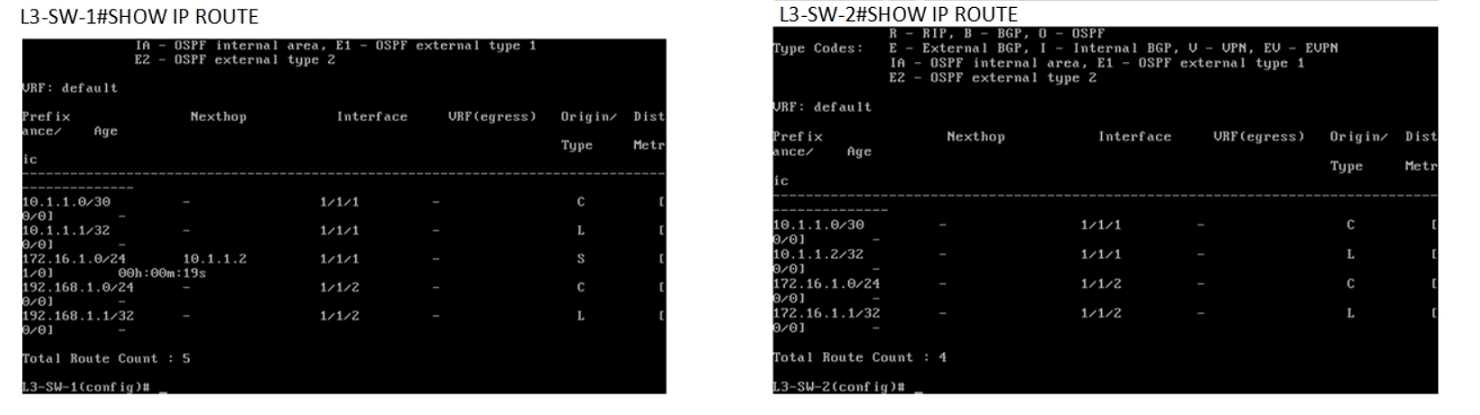
You have been asked to troubleshoot failed connectivity between a local subnet in the HQ Office and
a remote subnet in the Branch Office. PC1 is unable to ping PC2.
Use the provided topology and show command output to identify the reason for the failure: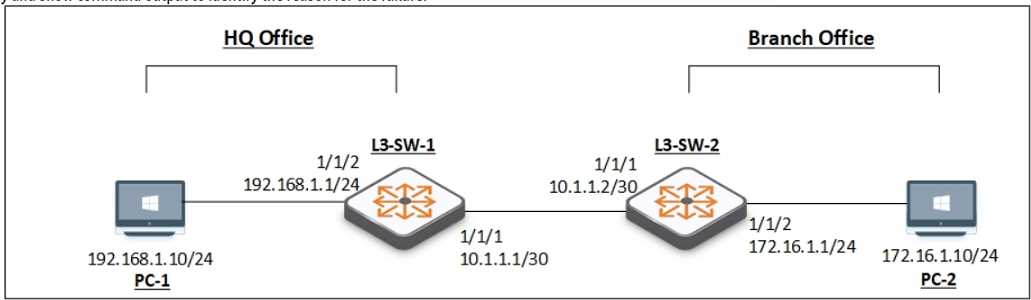
- A. On Branch Office - L3-SW-2- There is no Layer 3 SVI configured in the correct subnet.
- B. On HQ Office L3-SW-1 - There is no route to the Branch Office.
- C. On HQ Office L3-SW-1 - The switch does not have a static default route to the internet.
- D. On Branch Office L3-SW-2- The switch does not have a static route to the HQ Office Local Subnet.
Answer:
D
Explanation:
Using the provided topology and show command output, it can be determined that L3-SW-2 in the
Branch Office does not have a route to reach the subnet where PC1 resides (192.168.1.0/24 in the
HQ Office). L3-SW-1 in the HQ Office has a route to the Branch Office subnet (172.16.1.0/24), but
without the reciprocal route on L3-SW-2, traffic from the Branch Office will not be able to reach the
HQ Office subnet, hence PC1 cannot ping PC2.
Question 15
DRAG DROP
Match the Open Systems Interconnection (OSI) layer with its comparable member of the TCP/IP
stack. (Options may be used more than once.)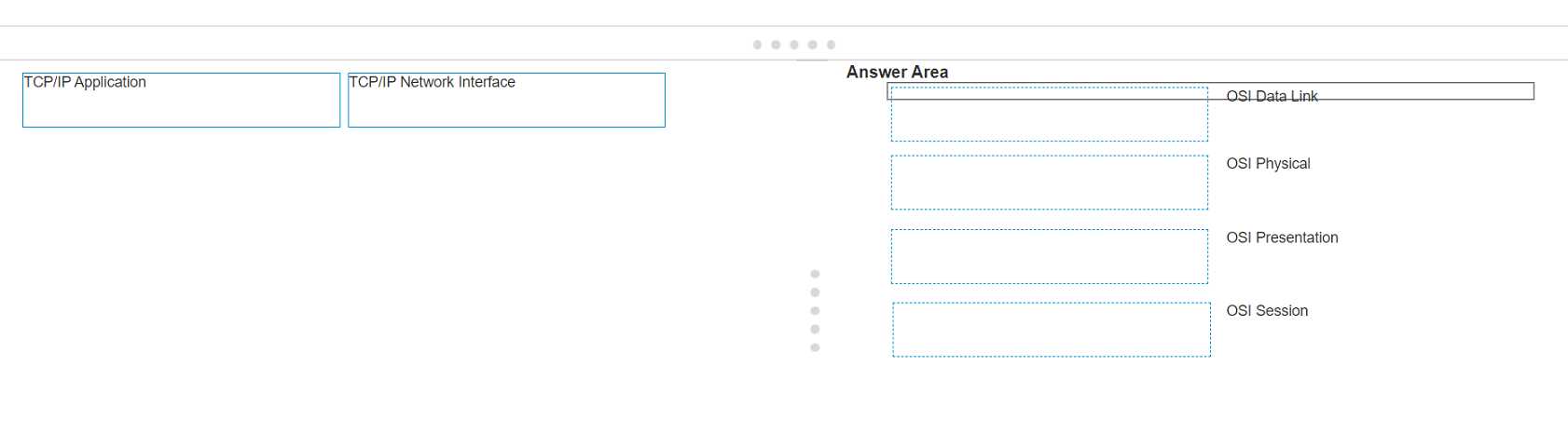
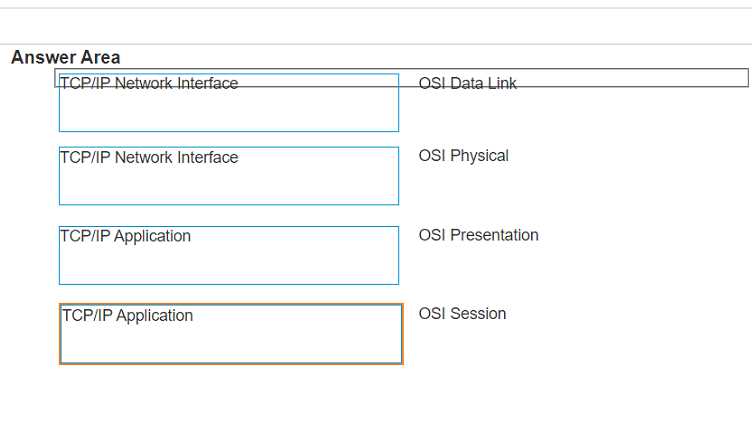
Answer:
None
Explanation: