HP HPE6-A72 Exam Questions
Questions for the HPE6-A72 were updated on : Feb 18 ,2026
Page 1 out of 8. Viewing questions 1-15 out of 106
Question 1
What command will save your configuration on an Aruba AOS-CX switch so that your changes
automatically load on next reboot?
- A. copy running-config checkpoint startup-config
- B. copy startup-config running-config
- C. copy running-config initial-checkpoint
- D. copy running-config default
Answer:
A
Question 2
DRAG DROP
Match each description to the correct management tool tor AOS-CX.
Answer:
None
Explanation: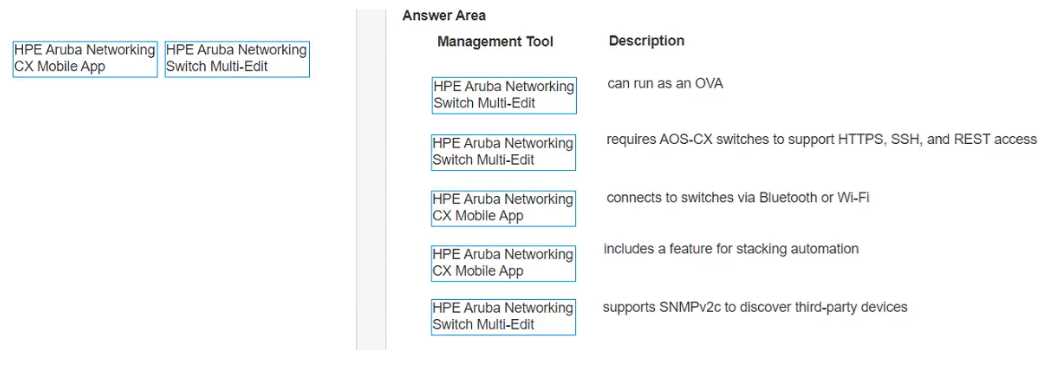
Question 3
What are two key features unique to AOS-CX that support root cause analytics and recovery in a
wired network? (Select two.)
- A. REST APIs
- B. Network Analytics Engine
- C. Multi-Protocol Border Gateway Protocol (MP-BGP)
- D. Redundant management modules
- E. Checkpoints
Answer:
B, E
Question 4
Refer to the exhibit.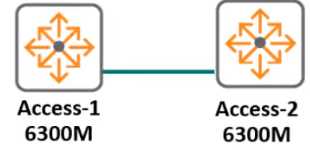
You are in the process of configuring VSF between Access-1 and Access-2. Access-1 has been
configured as the VSF Master. What is a valid configuration for Access-2 to join the VSF stack?
- A. Access-2# configure Access-2(config)# vsf member 1 Access-2(config)# vsf renumber-to 2 Access-2(vsf-member-1)# link 2 2/1/28 Access-2(vsf-member-1)# exit This will save the VSF configuration and reboot the switch. Do you want to continue (y/n)? y
- B. Access-2# configure Access-2(config)# vsf member 1 Access-2(vsf-member-1)# link 1 1/1/28 Access-2(vsf-member-1)# exit Access-2(config)# vsf renumber-to 2 This will save the VSF configuration and reboot the switch. Do you want to continue (y/n)? y
- C. Access-2# configure Access-2(config)# vsf member 2 Access-2(vsf-member-1)# link 1 1/1/28 Access-2(vsf-member-1)# exit This will save the VSF configuration and reboot the switch. Do you want to continue (y/n)? y
- D. Access-2# configure Access-2(config># vsf member 2 Access-2(vsf-member-1)# link 2 1/1/28 Access-2(vsf-member-1)# exit This will save the VSF configuration and reboot the switch. Do you want to continue (y/n)? y
Answer:
C
Question 5
Refer to the exhibit.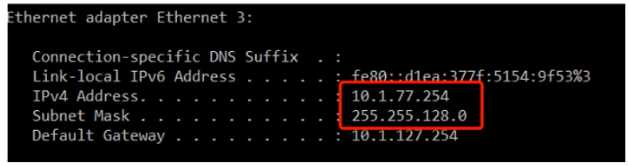
What subnet does the IP address above belong to?
- A. 10.177.0/17
- B. 10.1.77.0/25
- C. 10.1.0.0 255.255.0.0
- D. 10.1.0.0/17
Answer:
A
Question 6
Which two statements are true about the state of a new HPE Aruba Networking CX 6300 Series
switch on factory defaults? (Select two.)
- A. The CX 6300M has support for IP addressing applied to switched virtual interfaces (SVIs) but not on routed ports.
- B. LLDP is not enabled but is supported on all AOS-CX switches.
- C. The CX 6300M up-link ports only support routed mode. All other ports only support access mode.
- D. For the CX 6300M switch, all up-link ports and switchports are configured as access mode.
- E. LLDP is enabled on up-link ports and switchports for the CX 6300M.
Answer:
D, E
Question 7
Refer to the exhibit.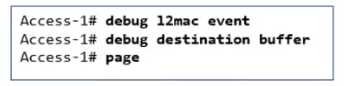
What does the command page result in?
- A. Starts an automatic page scrolling effect that pauses for a few seconds every 30 rows.
- B. Enables a terminal notification when a new debug event occurs for L2MAC events.
- C. Shows a new terminal window opening to allow typing while debugging occurs.
- D. Results in a page break to disable the default continuous scrolling In the console.
Answer:
B
Question 8
What does link aggregation provide? (Select two.)
- A. improved bandwidth between switches
- B. faster convergence than spanning-tree
- C. support for up to 2 active ports to be bundled together
- D. disables spanning-tree between switches
- E. no load balancing
Answer:
A, B
Question 9
Which two options are considered Layer 2 protocols? (Select two.)
- A. STP
- B. 802.11af
- C. RIP
- D. 802.1Q
- E. IPSec
Answer:
A, D
Question 10
Which command will save your configuration on an AOS-CX switch so that your changes
automatically load on next reboot?
- A. copy running-config checkpoint startup-config
- B. copy startup-config running-config
- C. copy running-config default
- D. copy running-config initial-checkpoint
Answer:
A
Question 11
Which option correctly describes a two-tier network design?
- A. designed to avoid routing entirely and to have Layer 2 remain across Core, Distribution, and Access layers
- B. divides the Core into two layers (Core and Aggregation) with the Access Layer only handling PoE and Access Control
- C. includes a Distribution Layer to provide Layer 3 features between a routed Core and a Layer 2 Access edge
- D. divides the network into two layers (Access and Core) with the option of routing to the Access Layer
Answer:
C
Explanation:
In a two-tier network architecture, the collapsed core layer typically combines the core and
distribution layers of a three-tier architecture into a single layer. The main function of the collapsed
core layer is to provide high-speed switching and routing of traffic between the distribution layer
switches and the access layer switches.
Question 12
Refer to the exhibits.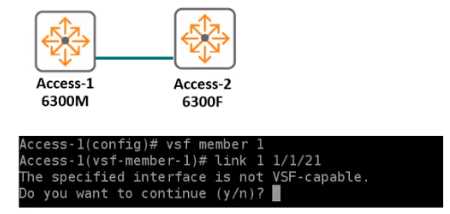
The AOS-CX 6300M switch is attempting to configure VSF with a peer CX 6300F switch. What is one
reason you are receiving the above error when attempting to configure VSF on the AOS-CX 6300M
switch?
- A. AOS-CX VSF links can only be applied to uplink ports with 10G, 25G. and 50G speeds.
- B. VSF Is not possible between CX 6300M and CX 6300F AOS-CX switches.
- C. Link 1 cannot be used if the attached CX 6300F VSF member 2 has already assigned link 1
- D. The port1/1/21 has been shutdown
Answer:
C
Question 13
Refer to the exhibit.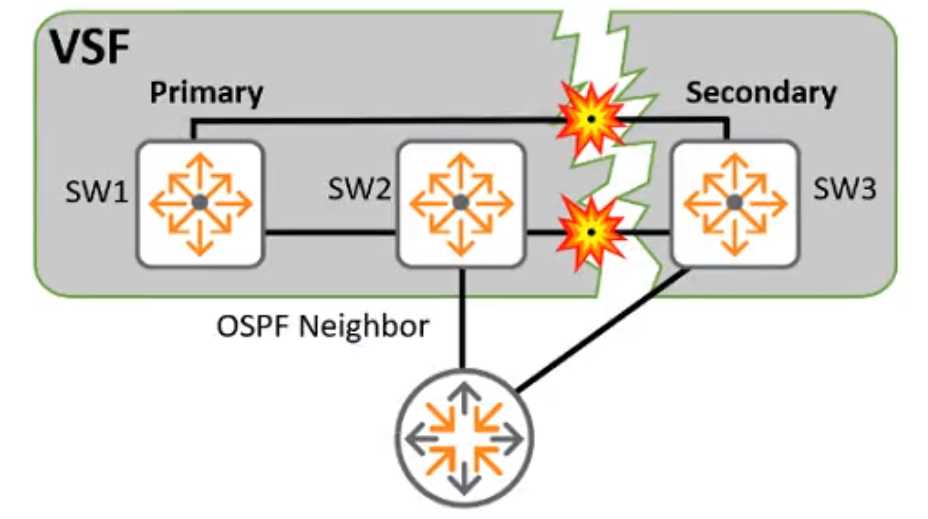
All switches shown are CX 6300M. The links connecting SW3 to both SW1 and SW2 are broken. Multi-
Active Detection has not been enabled. What are two results? (Select two.)
- A. A re-election will occur upon repairing the disabled links between SW2 and SW3. The switch with the highest priority will reclaim the Master role with the lowest bridge mac-address acting the tie- breaker
- B. The OSPF adjacency between the OSPF neighbor and the VSF stack switches SW2 and SW3 will remain up. Packets destined for SW3 that are received on SW2 are discarded.
- C. The stack will split with SW1 remaining an active VSF Master and SW3 becoming another active VSF Master. Switch 2 will remain a VSF member switch.
- D. Only the OSPF adjacency between SW3 and the OSPF neighbor will fail. All routed traffic will be redirected to SW2 instead.
- E. The stack will split resulting in SW1 remaining an active VSF Master and SW3 disabling all ports. SW2 will automatically take the VSF Standby role.
Answer:
C, E
Explanation:
In a multi-VRF environment, while performing mutual route leaking on the VRRP peers with BGP
neighborship established in between and towards the upstream network, the switch installs both
routes as ECMP instead of preferring the leaked route.
What happens if a VSF link fails?
If the stack topology is a ring, it will degenerate to a chain when a VSF link in the stack fails.
If the topology is a chain, a VSF link failure will result in a stack being split into two independent stack
fragments.
When a stack splits and the master and standby of the stack become part of two different fragments,
the standby takes up the master role for its fragment. Network disruption can result because the two
fragments are simultaneously active. Aruba highly recommends enabling VSF split-detection to
gracefully handle split brain scenarios.
If a stack splits and the master and standby are in the same fragment with the other members on a
different fragment, the members-only fragment will:
Reboot.
Come back up.
Wait for communication from the stack master.
What is VSF split-detect?
When a stack splits, the split-detect feature provides a mechanism for the fragments to discover each
other.
Once the two stack fragments are discovered, the fragment that has the primary member becomes
the active fragment and keeps its front plane (non-VSF) interfaces up and running. The other
fragment becomes inactive and all non-VSF interfaces on the inactive fragment are brought down to
avoid network disruption.
How do I configure split-detect?
VSF supports split-detection through the management interface.
Connect the management interfaces of the primary and secondary members to the same
management VLAN/network or connect them directly to one another. The CLI command to enable
split detection is vsf split-detect mgmt.
Question 14
DRAG DROP
Match each network protocol to the current default listening port and transport protocol. Not all
answer will be used.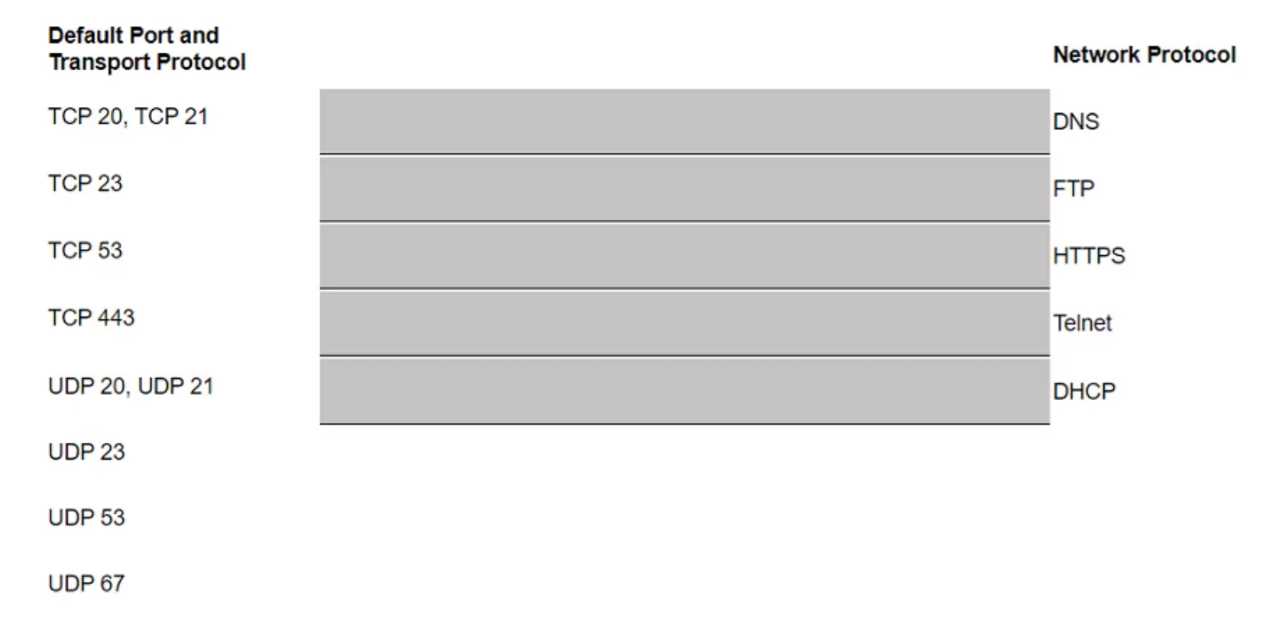
Answer:
None
Explanation: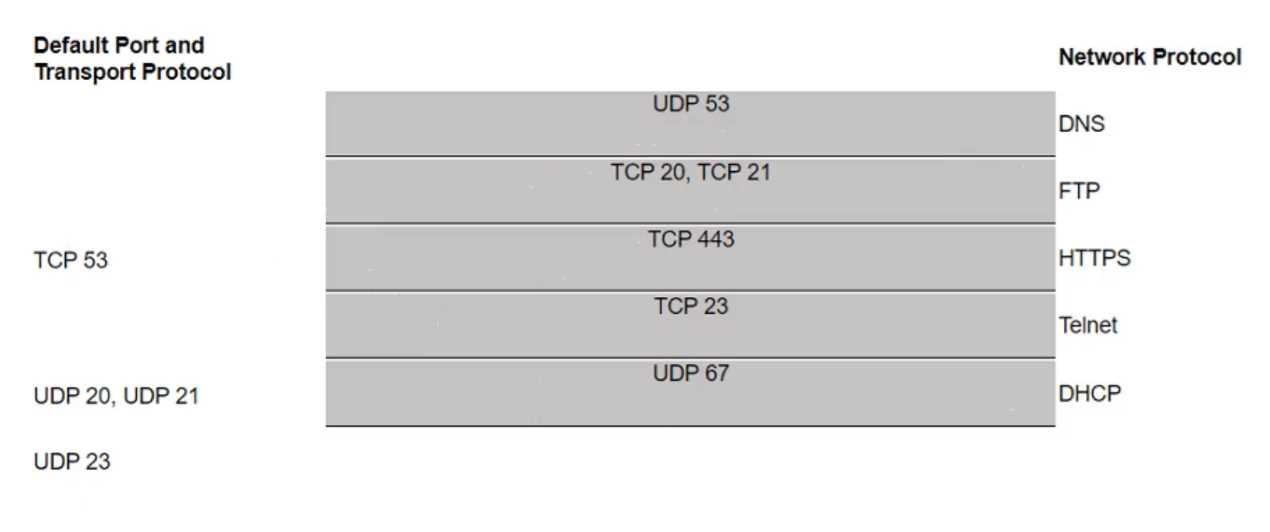
Question 15
HOTSPOT
Review the exhibit.
Which ports should be configured as access ports? Click in the green box to make your selection.
(Select two.)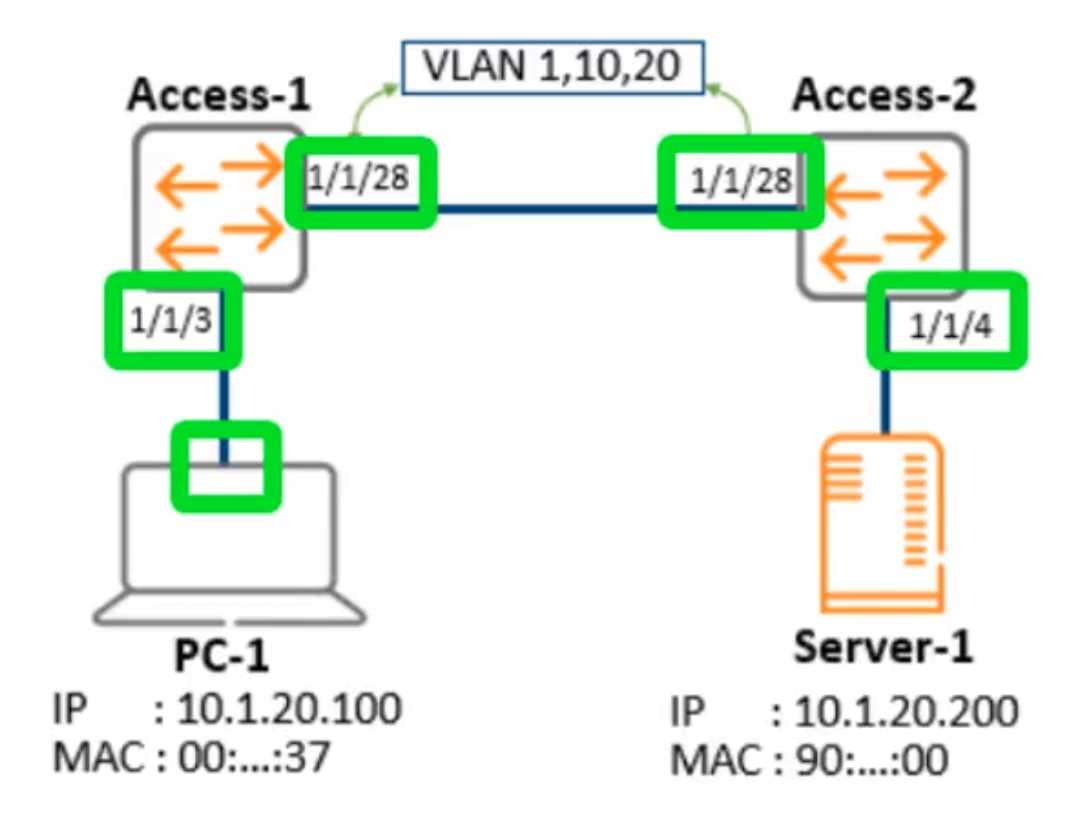
Answer:
None
Explanation: