HP HPE6-A69 Exam Questions
Questions for the HPE6-A69 were updated on : Feb 18 ,2026
Page 1 out of 4. Viewing questions 1-15 out of 60
Question 1
The customer is already using Aruba Gateway and third-party L2 switches New ArubaOS CX 6300
switches have been deployed for R&D. which have a requirement for user profiling and tunneled
traffic between ArubaOS CX 6300 and Aruba Gateway
What is required for this configuration to apply QoS user-based rules for the R&D client traffic?
- A. Apply a QoS rule to the ArubaCX 6300 client port, lo classify traffic before it is tunneled.
- B. Apply a port-access policy with QoS defined in the user role on the ArubaOS CX6300 switch
- C. Manually prioritize IP protocol 47 traffic on the third-party switches to prioritize the tunneled traffic
- D. Create a QoS policy for the UBT-client-VLAN traffic on the third-party switch.
Answer:
A
Question 2
What are the requirements for managing a switch using Aruba NetEdit? (Select two)
- A. REST access-mode must be set to read-write.
- B. HTTPS service must be restricted to the management VRF
- C. The switch user account mat NetEdit uses should have a password.
- D. Telnet must be disabled on the switch
Answer:
A, D
Question 3
ArubaOS-CX 8325 VSX configuration has a Tailed ISL link between the switches with keepalive status
established. While troubleshooting the condition, what is the expected behavior of the VSX traffic
flow in the current condition?
- A. vsx tables are n sync
- B. VSX tables are out of sync
- C. VSX nodes Keep forwarding traffic over its interfaces
- D. VSX protection state is OK
- E. VSX peer is seen as down
Answer:
C
Question 4
The rate-limiting QoS feature can be implemented on all ArubaOS-CX platforms However, some
features are platform dependent. Which statements are true'' (Select two.)
- A. Unknown unicast rate limiting is supported on all ArubaOS-CX platforms
- B. ICMP-Rate limiting is supported on all ArubaOS-CX platforms.
- C. Broadcast-rate limiting is supported on all ArubaOS-CX platforms
- D. Multicast and broadcast rate limits cannot be applied at the same time on the same Interface
Answer:
B, D
Question 5
Which statements are true with regards to Strict Priority scheduling? (Select two.)
- A. Strict Priority scheduling protects against starvation of low priority queues.
- B. Under strict Priority, the port will never forward a packet in a tower priority queue if a higher priority queue includes even one packet.
- C. Strict Priority must be used with egress queue shaping to prevent starvation.
- D. Strict Priority works best when the network uses the higher priority queues for the majority of applications
Answer:
B, C
Question 6
Refer to the exhibit.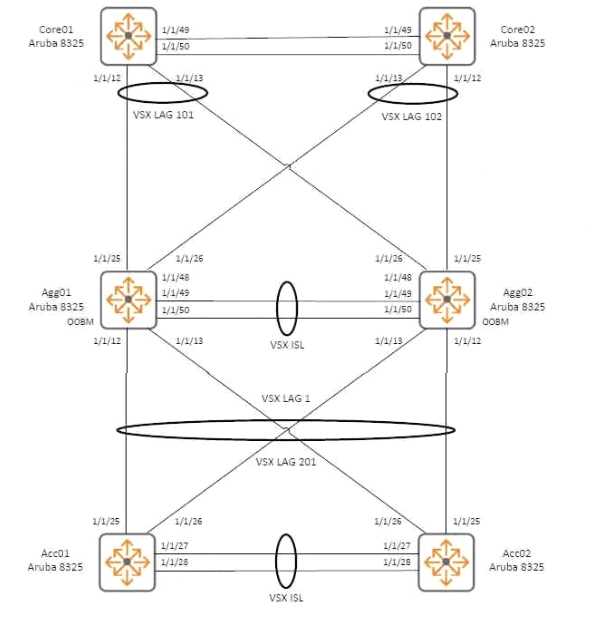
You want to protect the aggregation layer if the VSXISL falls. Where should you place a VSX keepalive
link?
- A. On VSX LAG 1
- B. On a dedicated link created using port 1'1/48 of each aggregation switch
- C. On the OOBM ports of both aggregation switches
- D. On VSX LAG 101
Answer:
C
Question 7
A customer is migrating from a Cisco VSS system to an ArubaOS-CX VSX cluster in order to provide
default gateway functionality, the local network administrator creates VLAN interfaces The network
administrator then migrates successfully from Cisco to Aruba
The next day a manager asks if the solution is redundant. The network administrator realizes that
there is no redundancy on the default gateway functionality
What is the preferred solution with the least amount of configuration and disturbance?
- A. Remove the IP address on every VLAN interface, and replace it with another one in the same subnet Configure active gateway IP with the default gateway address on every VLAN interface on Doth switches
- B. For every VLAN Interface, configure a VRRP IP address with the same IP address as already present in the first VSX node. Configure this on both switches.
- C. Remove the IP address on every VLAN interface, and replace it with another one in the same subnet Configure VRRP with the default gateway address as virtual IP-address per VLAN.
- D. For every VLAN interface, configure an active gateway IP with the same IP address as already present in the first VSX node Configure this on both switches
Answer:
C
Question 8
Which functionalities of ClearPass can be added in a wired network that implements dynamic
segmentation? (Select two.)
- A. Profiling
- B. Fingerprinting
- C. Downloadable user Roles
- D. Multi Factor Authentication
- E. Dynamic VLANs
Answer:
D, E
Question 9
Refer to the exhibit.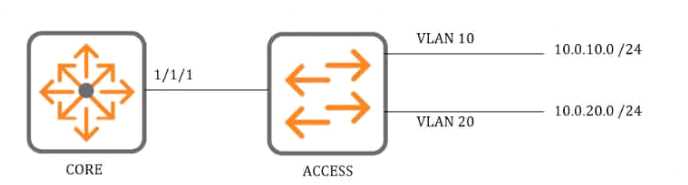
• For all traffic within VLAN 10. a remark action or DSCP value EF must be set
• For all traffic exiting VLAN 10, a remark action of DSCP value AF41 must be set
Which is the correct configuration?
A)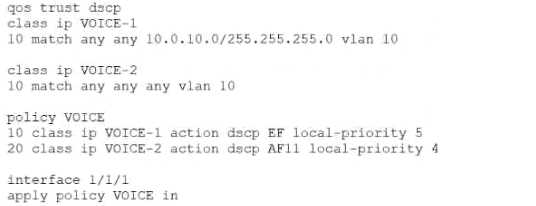
B)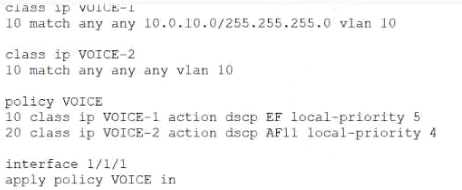
C)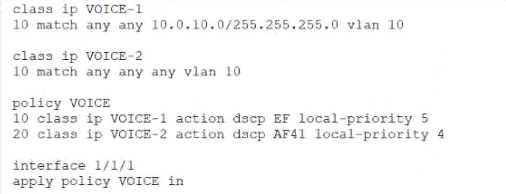
D)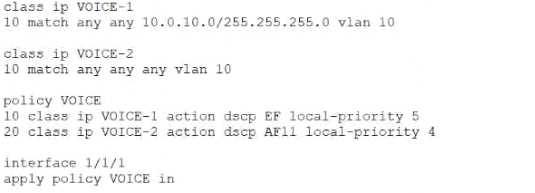
- A. Option A
- B. Option B
- C. Option C
- D. Option D
Answer:
A
Question 10
The customer is currently planning the migration of their current switches from the existing Aruba
5400R to ArubaOS-CX 6400. Which statements are correct about the mitigation of rogue DHCP
servers with the selected product? (Select two )
- A. With Aruba CX 6400 configure dhcp-snooping for the selected VLANs with authorized servers
- B. DHCP snooping can be enabled on ArubaOS-CX switches, once it's disabled on ArubaOS switches for same VLANs
- C. DHCP snooping is supported on both IPv4 and IPv6
- D. DHCP snooping needs to be enabled per VRF basis on Aruba CX 6400
Answer:
A, B
Question 11
How Is voice Traffic prioritized correctly on ArubaOS-CX switches?
- A. By placing it in the strict priority queue
- B. By defining voice VLANs inside VLAN context
- C. By attaching the QoS settings directly to device profiles
- D. By implementing TOS-profiles
Answer:
D
Question 12
You are working with a customer whos has a paw of Aruba 8325 switches configured for Multi-
Chassis Link Aggregation The customer is complaining that users are experiencing intermittent
packet drops. Which action should be taken to quickly aid you in identifying the cause?
- A. Enable debug of vri with "console" set as the destination
- B. Setup a mirror session to generate a Tshark file.
- C. Setup a mirror session to niter packets for TCPDUMP analysis
- D. Check the configured VLANs using "show vsx config-consistency"
Answer:
D
Question 13
A customer wants to verify the proposed configuration snippets to create a point-to-point link
between Aruba Switch and a third-party switch.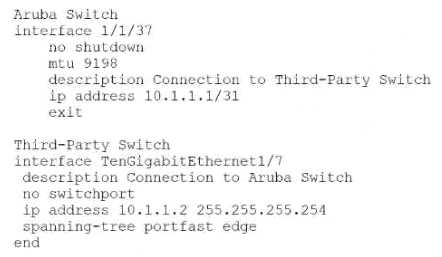
Will this configuration work with static routing?
- A. No, the configuration will not work, because the Aruba Switch has an MTU mismatch which will prevent IP communication.
- B. No. the configuration will not work, because the Aruba Switch does not have a locally reachable IP address from the third-party switch.
- C. No. the configuration will not work because the Aruba Switch does not have the "routing" command on it
- D. yes, the configuration should work fine and has no issues
Answer:
C
Question 14
(Scenarios may contain multiple errors which may or may not Impact the solution)
Refer to the exhibit.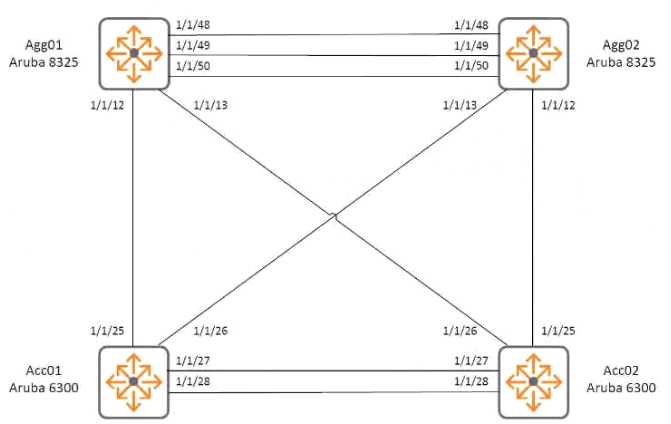
An engineer has attempted to configure two pairs of switches in the referenced configuration, it is
required to implement Multi-Chassis Link Aggregation for each pair of switches
The ports of the Aruba 8325 switches used for Agg01 and Agg02 are populated as follows:
There is an error message staling "incompatible interface." Which interfaces are the cause of the
error? (Select two.)
- A. 1/1/12 10GBaseT SFP*+ 30m Cat6A Transceiver
- B. 1/1/49 40G QSFP+ 15m Active Optical Cable
- C. 1/1/13 10GBaseT SFP+ 30m Cat6A Transceiver
- D. 1/1/48 iGBaseT 100m Cat5e Transceiver
- E. 1/1/50 40G QSFP+ 15m Active Optical Cable
Answer:
B, E
Question 15
Refer to the exhibit.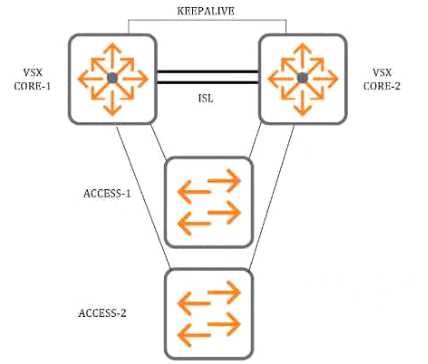
A customer has implemented this ArubaOS-CX solution. NetEdit is not present. After a while, the
secondary node of the VSX-cluster fails. What is the correct procedure to replace the failed node as
quickly as possible?
- A. Replace the failed unit, boot up the new node without connecting cables, upgrade firmware and configure as secondary vsx node connect iSl and wart for VSX to synchronize After successful recovery, reconnect the remaining cables.
- B. Replace the failed unit, boot up the new node without connecting cables, upgrade firmware, and restore and save config Shutdown all ports, reconnect the correct cables, and enable all ports
- C. Replace the failed unit, connect the correct cables, boot up the new node in recovery mode, upgrade firmware and restore, and save config Then, reboot and wait for VSX to synchronize.
- D. Replace the failed unit, connect the correct cables, boot up the new node and wait for VSX to synchronize configuration and firmware.
Answer:
A