databricks DATABRICKS MACHINE LEARNING ASSOCIATE Exam Questions
Questions for the DATABRICKS MACHINE LEARNING ASSOCIATE were updated on : Feb 18 ,2026
Page 1 out of 5. Viewing questions 1-15 out of 74
Question 1
Which of the following machine learning algorithms typically uses bagging?
- A. IGradient boosted trees
- B. K-means
- C. Random forest
- D. Decision tree
Answer:
C
Explanation:
Random Forest is a machine learning algorithm that typically uses bagging (Bootstrap Aggregating).
Bagging is a technique that involves training multiple base models (such as decision trees) on
different subsets of the data and then combining their predictions to improve overall model
performance. Each subset is created by randomly sampling with replacement from the original
dataset. The Random Forest algorithm builds multiple decision trees and merges them to get a more
accurate and stable prediction.
Reference:
Databricks documentation on Random Forest: Random Forest in Spark ML
Question 2
The implementation of linear regression in Spark ML first attempts to solve the linear regression
problem using matrix decomposition, but this method does not scale well to large datasets with a
large number of variables.
Which of the following approaches does Spark ML use to distribute the training of a linear regression
model for large data?
- A. Logistic regression
- B. Singular value decomposition
- C. Iterative optimization
- D. Least-squares method
Answer:
C
Explanation:
For large datasets, Spark ML uses iterative optimization methods to distribute the training of a linear
regression model. Specifically, Spark MLlib employs techniques like Stochastic Gradient Descent
(SGD) and Limited-memory Broyden–Fletcher–Goldfarb–Shanno (L-BFGS) optimization to iteratively
update the model parameters. These methods are well-suited for distributed computing
environments because they can handle large-scale data efficiently by processing mini-batches of data
and updating the model incrementally.
Reference:
Databricks documentation on linear regression: Linear Regression in Spark ML
Question 3
A data scientist has produced three new models for a single machine learning problem. In the past,
the solution used just one model. All four models have nearly the same prediction latency, but a
machine learning engineer suggests that the new solution will be less time efficient during inference.
In which situation will the machine learning engineer be correct?
- A. When the new solution requires if-else logic determining which model to use to compute each prediction
- B. When the new solution's models have an average latency that is larger than the size of the original model
- C. When the new solution requires the use of fewer feature variables than the original model
- D. When the new solution requires that each model computes a prediction for every record
- E. When the new solution's models have an average size that is larger than the size of the original model
Answer:
D
Explanation:
If the new solution requires that each of the three models computes a prediction for every record,
the time efficiency during inference will be reduced. This is because the inference process now
involves running multiple models instead of a single model, thereby increasing the overall
computation time for each record.
In scenarios where inference must be done by multiple models for each record, the latency
accumulates, making the process less time efficient compared to using a single model.
Reference:
Model Ensemble Techniques
Question 4
A data scientist has developed a machine learning pipeline with a static input data set using Spark
ML, but the pipeline is taking too long to process. They increase the number of workers in the cluster
to get the pipeline to run more efficiently. They notice that the number of rows in the training set
after reconfiguring the cluster is different from the number of rows in the training set prior to
reconfiguring the cluster.
Which of the following approaches will guarantee a reproducible training and test set for each
model?
- A. Manually configure the cluster
- B. Write out the split data sets to persistent storage
- C. Set a speed in the data splitting operation
- D. Manually partition the input data
Answer:
B
Explanation:
To ensure reproducible training and test sets, writing the split data sets to persistent storage is a
reliable approach. This allows you to consistently load the same training and test data for each model
run, regardless of cluster reconfiguration or other changes in the environment.
Correct approach:
Split the data.
Write the split data to persistent storage (e.g., HDFS, S3).
Load the data from storage for each model training session.
train_df, test_df = spark_df.randomSplit([0.8, 0.2], seed=42)
train_df.write.parquet("path/to/train_df.parquet") test_df.write.parquet("path/to/test_df.parquet")
# Later, load the data train_df = spark.read.parquet("path/to/train_df.parquet") test_df =
spark.read.parquet("path/to/test_df.parquet")
Reference:
Spark DataFrameWriter Documentation
Question 5
A data scientist is developing a single-node machine learning model. They have a large number of
model configurations to test as a part of their experiment. As a result, the model tuning process
takes too long to complete. Which of the following approaches can be used to speed up the model
tuning process?
- A. Implement MLflow Experiment Tracking
- B. Scale up with Spark ML
- C. Enable autoscaling clusters
- D. Parallelize with Hyperopt
Answer:
D
Explanation:
To speed up the model tuning process when dealing with a large number of model configurations,
parallelizing the hyperparameter search using Hyperopt is an effective approach. Hyperopt provides
tools like SparkTrials which can run hyperparameter optimization in parallel across a Spark cluster.
Example:
from hyperopt import fmin, tpe, hp, SparkTrials search_space = { 'x': hp.uniform('x', 0, 1), 'y':
hp.uniform('y', 0, 1) } def objective(params): return params['x'] ** 2 + params['y'] ** 2 spark_trials =
SparkTrials(parallelism=4) best = fmin(fn=objective, space=search_space, algo=tpe.suggest,
max_evals=100, trials=spark_trials)
Reference:
Hyperopt Documentation
Question 6
A machine learning engineer is trying to scale a machine learning pipeline by distributing its single-
node model tuning process. After broadcasting the entire training data onto each core, each core in
the cluster can train one model at a time. Because the tuning process is still running slowly, the
engineer wants to increase the level of parallelism from 4 cores to 8 cores to speed up the tuning
process. Unfortunately, the total memory in the cluster cannot be increased.
In which of the following scenarios will increasing the level of parallelism from 4 to 8 speed up the
tuning process?
- A. When the tuning process in randomized
- B. When the entire data can fit on each core
- C. When the model is unable to be parallelized
- D. When the data is particularly long in shape
- E. When the data is particularly wide in shape
Answer:
B
Explanation:
Increasing the level of parallelism from 4 to 8 cores can speed up the tuning process if each core can
handle the entire dataset. This ensures that each core can independently work on training a model
without running into memory constraints. If the entire dataset fits into the memory of each core,
adding more cores will allow more models to be trained in parallel, thus speeding up the process.
Reference:
Parallel Computing Concepts
Question 7
A machine learning engineer wants to parallelize the inference of group-specific models using the
Pandas Function API. They have developed the apply_model function that will look up and load the
correct model for each group, and they want to apply it to each group of DataFrame df.
They have written the following incomplete code block:
Which piece of code can be used to fill in the above blank to complete the task?
- A. applyInPandas
- B. groupedApplyInPandas
- C. mapInPandas
- D. predict
Answer:
A
Explanation:
To parallelize the inference of group-specific models using the Pandas Function API in PySpark, you
can use the applyInPandas function. This function allows you to apply a Python function on each
group of a DataFrame and return a DataFrame, leveraging the power of pandas UDFs (user-defined
functions) for better performance.
prediction_df = ( df.groupby("device_id") .applyInPandas(apply_model,
schema=apply_return_schema) )
In this code:
groupby("device_id"): Groups the DataFrame by the "device_id" column.
applyInPandas(apply_model, schema=apply_return_schema): Applies the apply_model function to
each group and specifies the schema of the return DataFrame.
Reference:
PySpark Pandas UDFs Documentation
Question 8
A data scientist has been given an incomplete notebook from the data engineering team. The
notebook uses a Spark DataFrame spark_df on which the data scientist needs to perform further
feature engineering. Unfortunately, the data scientist has not yet learned the PySpark DataFrame
API.
Which of the following blocks of code can the data scientist run to be able to use the pandas API on
Spark?
- A. import pyspark.pandas as ps df = ps.DataFrame(spark_df)
- B. import pyspark.pandas as ps df = ps.to_pandas(spark_df)
- C. spark_df.to_pandas()
- D. import pandas as pd df = pd.DataFrame(spark_df)
Answer:
A
Explanation:
To use the pandas API on Spark, the data scientist can run the following code block:
import pyspark.pandas as ps df = ps.DataFrame(spark_df)
This code imports the pandas API on Spark and converts the Spark DataFrame spark_df into a
pandas-on-Spark DataFrame, allowing the data scientist to use familiar pandas functions for further
feature engineering.
Reference:
Databricks documentation on pandas API on Spark: pandas API on Spark
Question 9
A data scientist is using the following code block to tune hyperparameters for a machine learning
model: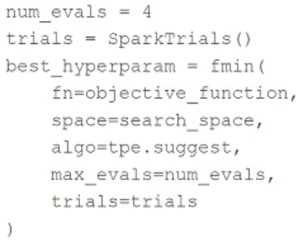
Which change can they make the above code block to improve the likelihood of a more accurate
model?
- A. Increase num_evals to 100
- B. Change fmin() to fmax()
- C. Change sparkTrials() to Trials()
- D. Change tpe.suggest to random.suggest
Answer:
A
Explanation:
To improve the likelihood of a more accurate model, the data scientist can increase num_evals to
100. Increasing the number of evaluations allows the hyperparameter tuning process to explore a
larger search space and evaluate more combinations of hyperparameters, which increases the
chance of finding a more optimal set of hyperparameters for the model.
Reference:
Databricks documentation on hyperparameter tuning: Hyperparameter Tuning
Question 10
Which of the following describes the relationship between native Spark DataFrames and pandas API
on Spark DataFrames?
- A. pandas API on Spark DataFrames are single-node versions of Spark DataFrames with additional metadata
- B. pandas API on Spark DataFrames are more performant than Spark DataFrames
- C. pandas API on Spark DataFrames are made up of Spark DataFrames and additional metadata
- D. pandas API on Spark DataFrames are less mutable versions of Spark DataFrames
Answer:
C
Explanation:
The pandas API on Spark DataFrames are made up of Spark DataFrames with additional metadata.
The pandas API on Spark aims to provide the pandas-like experience with the scalability and
distributed nature of Spark. It allows users to work with pandas functions on large datasets by
leveraging Spark’s underlying capabilities.
Reference:
Databricks documentation on pandas API on Spark: pandas API on Spark
Question 11
Which statement describes a Spark ML transformer?
- A. A transformer is an algorithm which can transform one DataFrame into another DataFrame
- B. A transformer is a hyperparameter grid that can be used to train a model
- C. A transformer chains multiple algorithms together to transform an ML workflow
- D. A transformer is a learning algorithm that can use a DataFrame to train a model
Answer:
A
Explanation:
In Spark ML, a transformer is an algorithm that can transform one DataFrame into another
DataFrame. It takes a DataFrame as input and produces a new DataFrame as output. This
transformation can involve adding new columns, modifying existing ones, or applying feature
transformations. Examples of transformers in Spark MLlib include feature transformers like
StringIndexer, VectorAssembler, and StandardScaler.
Reference:
Databricks documentation on transformers: Transformers in Spark ML
Question 12
A machine learning engineer is using the following code block to scale the inference of a single-node
model on a Spark DataFrame with one million records: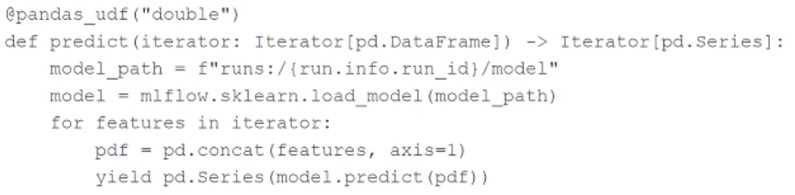
Assuming the default Spark configuration is in place, which of the following is a benefit of using an
Iterator?
- A. The data will be limited to a single executor preventing the model from being loaded multiple times
- B. The model will be limited to a single executor preventing the data from being distributed
- C. The model only needs to be loaded once per executor rather than once per batch during the inference process
- D. The data will be distributed across multiple executors during the inference process
Answer:
C
Explanation:
Using an iterator in the pandas_udf ensures that the model only needs to be loaded once per
executor rather than once per batch. This approach reduces the overhead associated with repeatedly
loading the model during the inference process, leading to more efficient and faster predictions. The
data will be distributed across multiple executors, but each executor will load the model only once,
optimizing the inference process.
Reference:
Databricks documentation on pandas UDFs: Pandas UDFs
Question 13
Which of the following tools can be used to distribute large-scale feature engineering without the
use of a UDF or pandas Function API for machine learning pipelines?
- A. Keras
- B. Scikit-learn
- C. PyTorch
- D. Spark ML
Answer:
D
Explanation:
Spark MLlib is a machine learning library within Apache Spark that provides scalable and distributed
machine learning algorithms. It is designed to work with Spark DataFrames and leverages Spark’s
distributed computing capabilities to perform large-scale feature engineering and model training
without the need for user-defined functions (UDFs) or the pandas Function API. Spark MLlib provides
built-in transformations and algorithms that can be applied directly to large datasets.
Reference:
Databricks documentation on Spark MLlib: Spark MLlib
Question 14
A data scientist has developed a linear regression model using Spark ML and computed the
predictions in a Spark DataFrame preds_df with the following schema:
prediction DOUBLE
actual DOUBLE
Which of the following code blocks can be used to compute the root mean-squared-error of the
model according to the data in preds_df and assign it to the rmse variable?
A)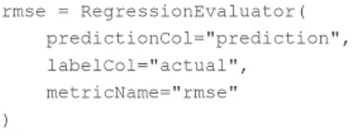
B)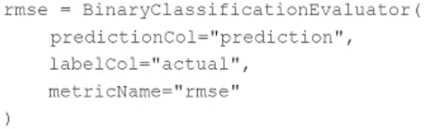
C)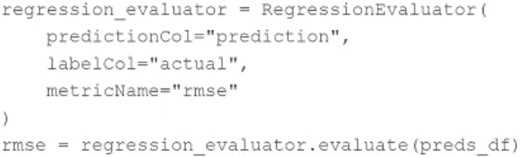
D)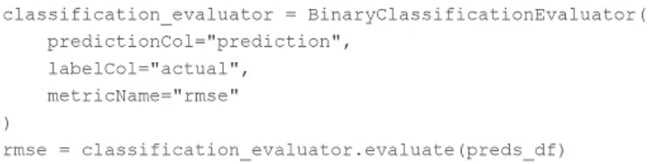
- A. Option A
- B. Option B
- C. Option C
- D. Option D
Answer:
C
Explanation:
To compute the root mean-squared-error (RMSE) of a linear regression model using Spark ML, the
RegressionEvaluator class is used. The RegressionEvaluator is specifically designed for regression
tasks and can calculate various metrics, including RMSE, based on the columns containing
predictions and actual values.
The correct code block to compute RMSE from the preds_df DataFrame is:
regression_evaluator = RegressionEvaluator( predictionCol="prediction", labelCol="actual",
metricName="rmse" ) rmse = regression_evaluator.evaluate(preds_df)
This code creates an instance of RegressionEvaluator, specifying the prediction and label columns, as
well as the metric to be computed ("rmse"). It then evaluates the predictions in preds_df and assigns
the resulting RMSE value to the rmse variable.
Options A and B incorrectly use BinaryClassificationEvaluator, which is not suitable for regression
tasks. Option D also incorrectly uses BinaryClassificationEvaluator.
Reference:
PySpark ML Documentation
Question 15
A data scientist has written a feature engineering notebook that utilizes the pandas library. As the
size of the data processed by the notebook increases, the notebook's runtime is drastically
increasing, but it is processing slowly as the size of the data included in the process increases.
Which of the following tools can the data scientist use to spend the least amount of time refactoring
their notebook to scale with big data?
- A. PySpark DataFrame API
- B. pandas API on Spark
- C. Spark SQL
- D. Feature Store
Answer:
B
Explanation:
The pandas API on Spark provides a way to scale pandas operations to big data while minimizing the
need for refactoring existing pandas code. It allows users to run pandas operations on Spark
DataFrames, leveraging Spark’s distributed computing capabilities to handle large datasets more
efficiently. This approach requires minimal changes to the existing code, making it a convenient
option for scaling pandas-based feature engineering notebooks.
Reference:
Databricks documentation on pandas API on Spark: pandas API on Spark