cisco 400-201 Exam Questions
Questions for the 400-201 were updated on : Mar 07 ,2026
Page 1 out of 14. Viewing questions 1-15 out of 197
Question 1
Which Cisco IOS XR configuration implementation meets this requirement?
- A. Option
- B. Option
- C. Option
- D. Option
Answer:
B
Question 2
Which statement about Policy-Based Tunnel Selection implementation on Cisco CRS Series is true?
- A. Classification criteria of the incoming packets can be based on IP precedence, EXP, or TOS field
- B. IGP and LDP are the default path for traffic that do not meet any of the classification criteria
- C. Load balancing across multiple MPLS TE tunnels is not supported
- D. Egress-side remarking affects PBTS tunnel selection
Answer:
A
Question 3
DRAG DROP
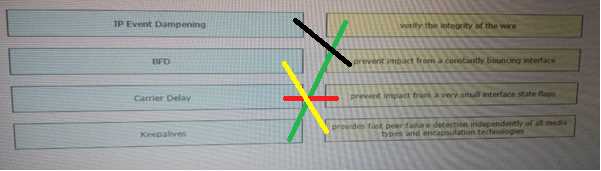
Drag and drop each fast detection mechanism on the left onto its definition on the right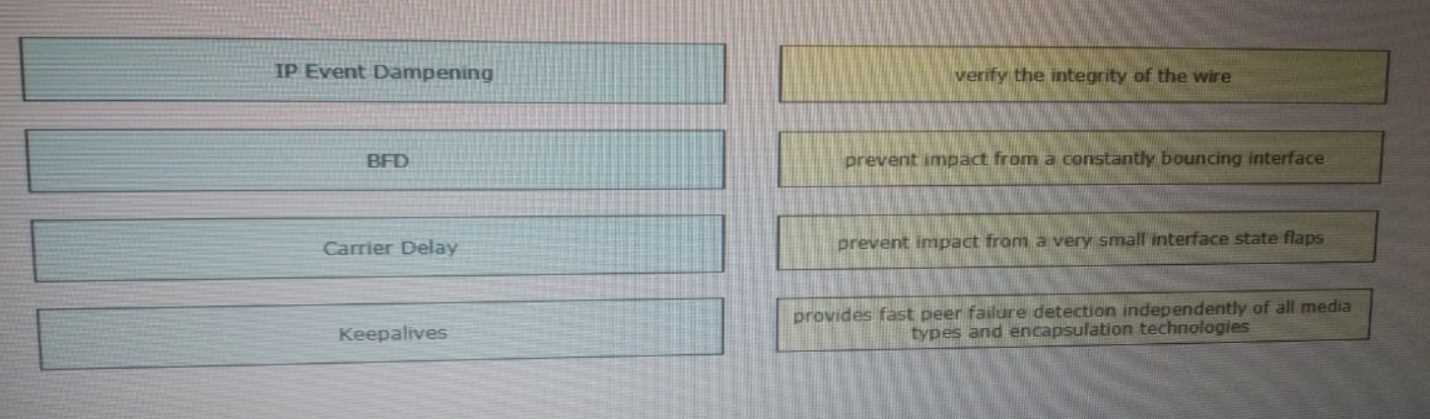
Answer:
Question 4
Which statement about Cisco CSR 1000v Series Cloud Services Router is true?
- A. It is a non-SDR owner created on a Cisco ASR 1000 router series.
- B. It is a cloud-based virtual router deployed on a virtual machine instance on x86 server hardware.
- C. It is a virtual router reflector function enabled in a Cisco ASR 1000 router series.
- D. It is a multichassis solution based on two or more Cisco ASR 1000 router working as one single virtual router.
Answer:
B
Question 5
Which main difference between lean core and hollow core architecture is true?
- A. The hollow core model defines two models of operation: peering and overlay. The lean core model adapts only the peering operation.
- B. Hollow core addresses challenges associated with isolated packet, optical TDM, and DWDM layer control planes. Lean core ignores these challenges.
- C. In the lean core model, switches create a dense mesh of circuits between each of the edge and peering nodes. The hollow core model uses less-sophisticated NPUs.
- D. Hollow core uses a transport switching function, whereas lean core adapts full IP architectures by using MPLS to forward subscriber traffic instead of IP.
Answer:
D
Question 6
Which three PIM RP models does IPv6 multicast support? (Choose three)
- A. BGP MDT
- B. static RP
- C. embedded RP
- D. anycast RP
- E. auto RP
- F. BSR
Answer:
BCF
Question 7
Which three Layer 2 VPN pseudowire components are true? (Choose three)
- A. attachment circuit
- B. bandwidth requirement
- C. route distinguisher
- D. virtual circuit label
- E. pseudowire identifier
- F. route target
Answer:
ADE
Question 8
In unified MPLS, which protocol does the forwarding label distribution?
- A. RSVP
- B. BGP
- C. IGP such as IS-IS or OSPF
- D. LDP
Answer:
B
Question 9
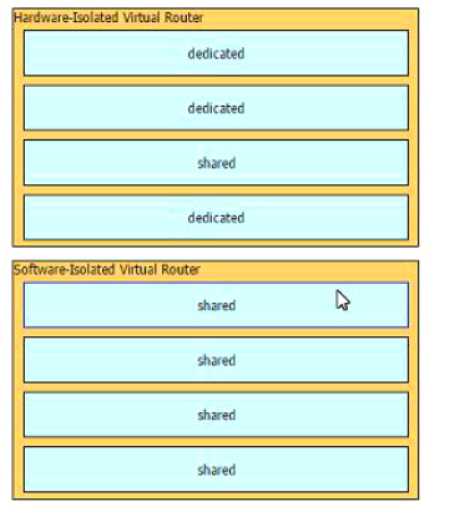
DRAG DROP
Drag and drop the virtualized Routing Architecture characteristics form the left onto the correct
categories for each isolated virtual router type on the right. Not all options are used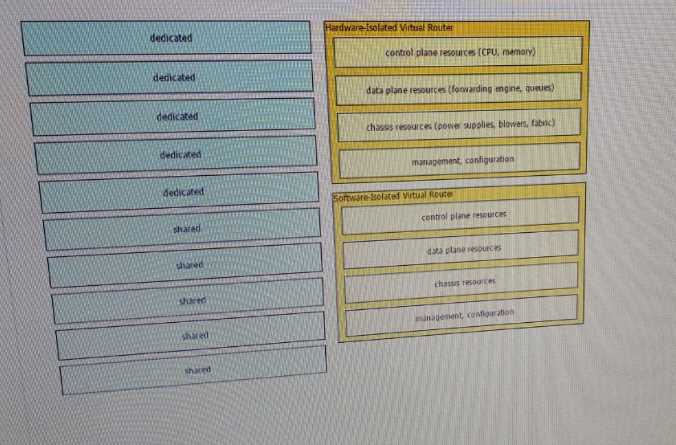
Answer:
Question 10
Refer to the exhibit,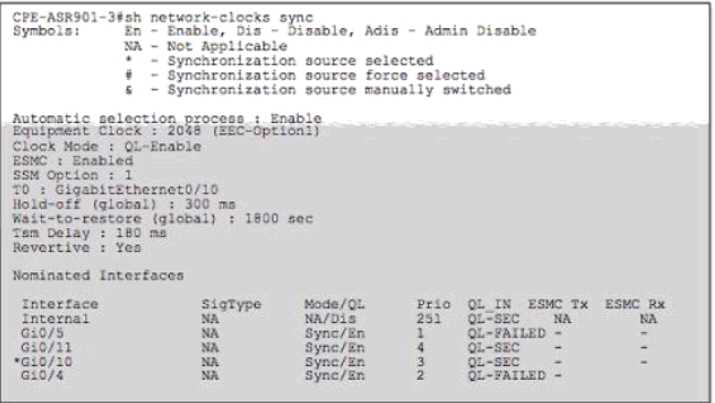
Refer to the exhibit, which physical interface provides the clock information?
- A. •Gi0/11
- B. •Gi0/10
- C. •Gi0/5
- D. •Gi0/4
Answer:
B
Question 11
Which two characteristics are benefits of MPLS LDP lossless MD5 session authentication? (Choose
two)
- A. It allows for asymmetric passwords.
- B. It uses the MPLS LDP targeted hello, which is authenticated, instead of the regular MPLS LDP hello, which cannot be authenticated.
- C. It allows you to achieve or change LDP MD5 session authentication without interrupting the LDP session.
- D. It uses the MD5 method, which is a more secure authentication method than traditional MPLS LDP authentication, which uses a cleartext method.
- E. It enables authentication for UDP MPLS LDP discovery packets as well as TCP MPLS LDP label exchange sessions.
Answer:
AC
Question 12
Refer to the exhibit.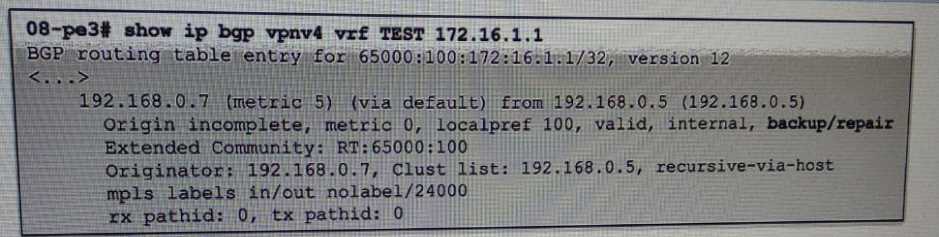
Refer to the exhibit. Which statement is true?
- A. BGP multipath is enabled.
- B. BGP has failed to load the entry into the RIB.
- C. BGP add-path is enabled.
- D. BGP next-hop tracking is enabled.
Answer:
C
Question 13
What is the main difference between the OSPF NSR and OSPF NSF mechanism?
- A. NSR does not use as much memory resource as NSF does.
- B. With NSR, OSPF on the newly active standby RP initially has no state information.
- C. On NSR, the neighbors must be NSR-aware.
- D. With NSR, the router that performs the switchover preserves the state internally.
Answer:
C
Question 14
Refer to the exhibit.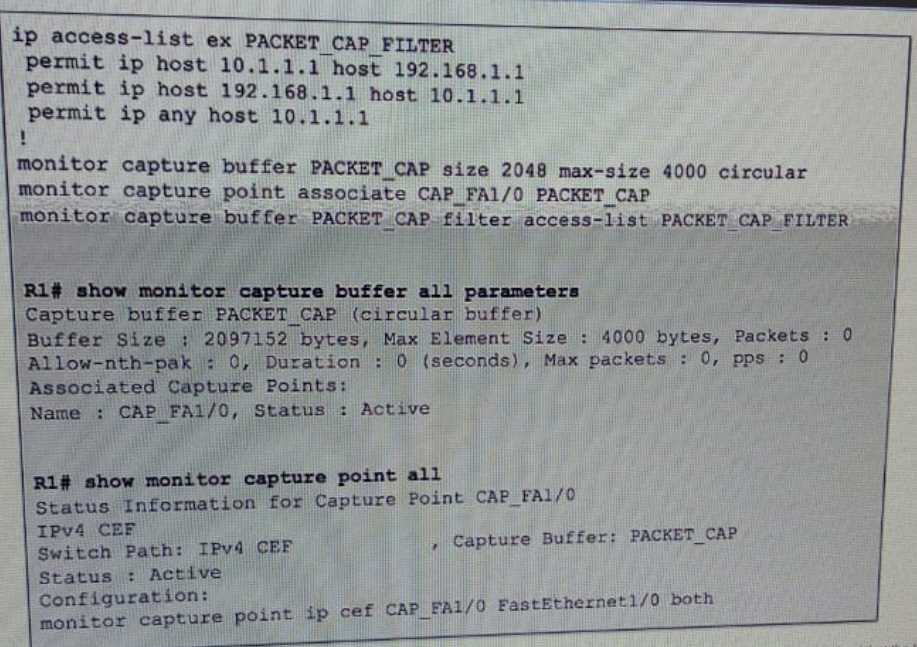
Refer to the exhibit. Ping is successful from R1 with source IP 10.1.1.1 to the destination 192.168.1.1.
it is routed via the FastEthernet 1/0 interface. It is noticed that the ICMP echo request packets are
not logged to the captured file. Which issue is possible?
- A. Capture from Fast 1/0 interface is only for inbound traffic.
- B. The access list PACKET_CAP_FILTER has no match.
- C. These ping packets are process switched.
- D. Capture point CAP_FA1/0 is inactive.
Answer:
B
Question 15
DRAG DROP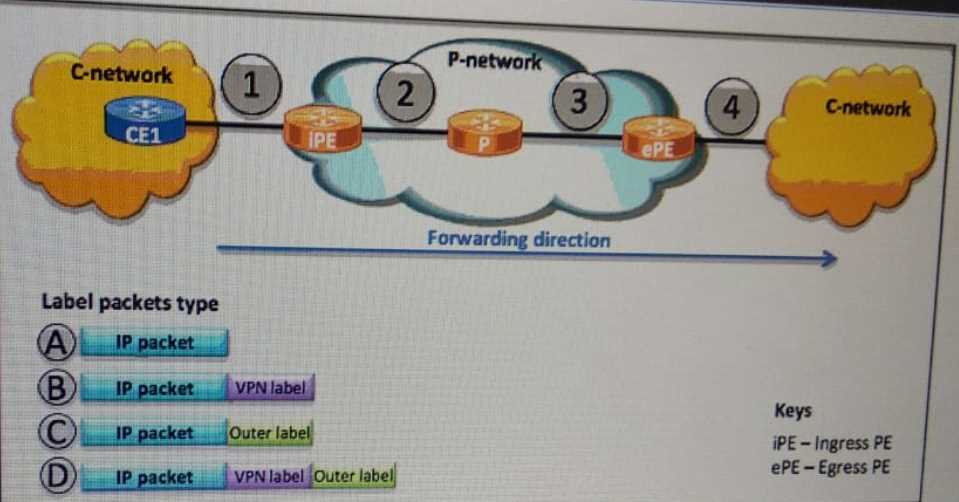
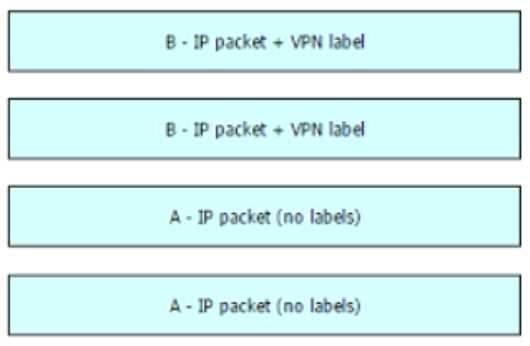
Refer to the exhibit. Drag and drop the label packets types from the left into the correct order
according to Layer 3 MPLS VPN packet forwarding. Not all options are used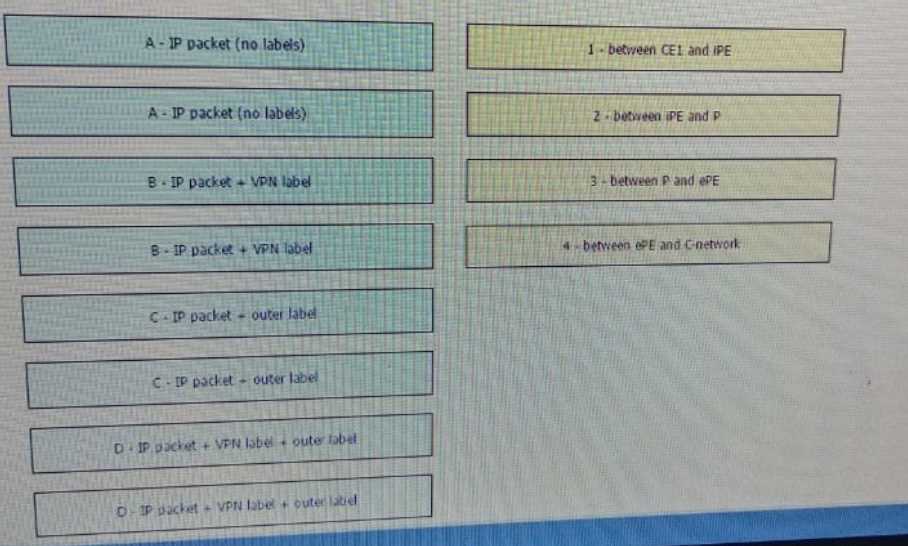
Answer: