cisco 300-610 Exam Questions
Questions for the 300-610 were updated on : Mar 11 ,2026
Page 1 out of 19. Viewing questions 1-15 out of 277
Question 1
A small company hosts several critical applications on bare-metal servers connected via iSCSI
protocol to shared JBOD storage. One of the critical applications is experiencing latency issues, which
the engineering team suspects is due to incorrect prioritization for iSCSI traffic. An engineer must
update the network QoS settings to prioritize iSCSI traffic with these requirements:
iSCSI traffic must be prioritized.
The solution must be able to differentiate between different types of iSCSI traffic.
The solution must be scalable because iSCSI traffic is expected to increase in the future.
The solution must not disrupt other traffic.
Which two configurations must the engineer apply to the devices on the network to meet the
requirements? (Choose two.)
- A. class-map match-all ISCSI match access-group name ISCSI policy-map QoS_Policy class ISCSI priority percent 50
- B. ip access-list extended ISCSI permit tcp any any eq 3260
- C. policy-map QoS_Policy class class-default priority percent 100 police rate 100 mbps burst 5000 packets conform-action transmit exceed-action drop
- D. ip access-list extended iSCSI permit tcp any any eq 865
Answer:
A, B
Question 2
In this data structure, what is the XML terminology for the currency="usd" code snippet?
<? xml version="1.0" encoding="UTF-8"?>
<ciscopress>
<book isbn="50581730795252386">
<title>Routing TCP/IP</title>
<author>Jeff Doyle</author>
<category></category>
<year>2005</year>
<edition>2</edition>
<price currency="usd">72</price>
</book>
</ciscopress>
- A. root element end tag
- B. attribute
- C. character
- D. root element start tag
Answer:
B
Question 3
An engineer must complete vNIC and vHBA allocations for 16 new servers. All servers currently have
the same requirements, but the company wants to be prepared for a future update to add additional
vNICs and vHBAs to servers 14, 15, and 16 only. The engineer decided to use service profile
templates to complete the task. Which approach must the engineer take?
- A. Create the 16 service profiles via an initial template, and manually update servers 14, 15, and 16 with additional vNIC and vHBA when required.
- B. Create the 16 service profiles via an updating template, and update the template with the additional vNIC and vHBA when required.
- C. Create the 16 service profiles via an initial template, and then update the initial template with additional vNICs and vHBAs for servers 14, 15, and 16.
- D. Create service profiles for servers 1 through 13 via an initial template, and create separate service profiles for servers 14, 15, and 16 via an updating template that includes the additional vNIC and vHBA.
Answer:
D
Question 4
Refer to the exhibit.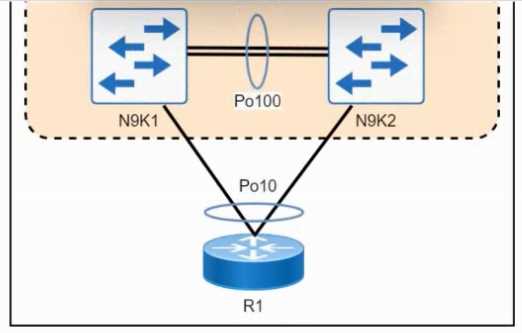
Refer to the exhibit. Two Cisco Nexus 9000 Series Switches exchange OSPF routing information with
R1. Which action accomplishes this goal?
- A. Add layer3 peer-router under vPC domain.
- B. Add layer3 peer-router under vPC interface link.
- C. Add peer-gateway under vPC domain.
- D. Add peer-gateway under vPC interface link.
Answer:
A
Question 5
Refer to the exhibit.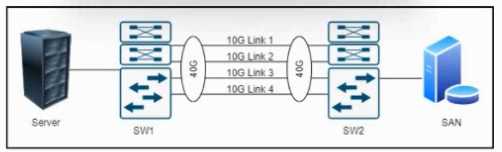
Refer to the exhibit. A 4x10G Fibre Channel has been configured between SW1 and SW2 to carry
backup traffic sourced to and from the SAN. An engineer noticed that 10G Link 1 is being used more
heavily than the other links within the port channel. Which action must the engineer take on the two
switches to ensure that the traffic uses all available links between SW1 and SW2?
- A. Configure exchange-based load-balancing.
- B. Configure flow-based load-balancing.
- C. Configure src-dst-ip-based load-balancing.
- D. Configure dst-mac-based load-balancing.
Answer:
A
Question 6
Which vNIC/vHBA Placement policy should be selected in Cisco UCS Manager to ensure that only
dynamic and static vNICs and vHBAs are explicitly assigned to the policy?
- A. Assigned Only
- B. Exclude usNIC
- C. All
- D. Exclude Unassigned
Answer:
A
Question 7
A network engineer needs to design Layer 2 connectivity for a subnet between two data centers
using VXLAN with Cisco Nexus switches. The engineer must ensure seamless host mobility and
optimal first-hop routing. Which gateway MAC attribute must be synchronized across both data
centers?
- A. HSRP
- B. anycast
- C. multicast
- D. VRRP
Answer:
B
Question 8
The network engineering team at a large corporation operates a critical data center with stringent
business requirements for network reliability and high availability. EIGRP is used as an interior
routing protocol. The team is planning to implement a robust new redundancy strategy that
minimizes downtime and maximizes network uptime. According to the requirements, business
services can tolerate 3 seconds for failover performance. The solution must be based on RFC 2281.
Which action must the team take as part of the implementation?
- A. Implement GLBP to distribute traffic across multiple gateways to provide load sharing.
- B. Implement VRRP to provide Layer 3 gateway redundancy.
- C. Implement EIGRP with equal-cost multipath routing to provide load balancing.
- D. Implement HSRP to provide gateway redundancy and failover.
Answer:
D
Question 9
A network engineer must design a high-performance, lossless Ethernet network to support AI
workloads in a data center. The network uses a spine-leaf topology with Cisco Nexus 9000 Series
Switches. The design must ensure that critical AI traffic can move seamlessly across the fabric
without being dropped due to congestion. The design requirements are:
Prevent packet drops for high-priority AI traffic flows.
Proactively manage and signal congestion to ensure continuous data flow even under heavy load.
Which design approach must be used to meet these requirements?
- A. Enable PFC across all QoS classes. Tune buffer at the spine layer for AI traffic congestion.
- B. Configure PFC on all traffic classes across the spine-leaf topology. Enable ECN only on the leaf switches.
- C. Implement PFC only on high-priority traffic. Configure ECN across both spine and leaf switches.
- D. Use ECN across the network to manage congestion. Adjust the TCP settings for AI workload resilience.
Answer:
C
Question 10
An enterprise recently provisioned multiple new servers in their data center using service profile
templates on Cisco UCS. Server 2 now requires two additional vNICs. How must the engineer
facilitate the change to server 2 without affecting the other servers?
- A. Create a new updating template with the additional vNICs and assign it to the server 2 service profile.
- B. Individually update the server 2 service profile with the additional vNICs.
- C. Update the vNIC configuration in an update template with the additional vNICs.
- D. Update the vNIC configuration in the initial template with the additional vNICs.
Answer:
B
Question 11
A company is planning to improve the segmentation of its data center network to isolate traffic of
different clients across various parts of the facility. The solution must be highly scalable and provide
flexible traffic isolation for a growing number of clients. Which action must be taken to best meet the
requirements?
- A. Implement VRF-Lite to segment traffic between different network environments.
- B. Configure VXLAN Multi-Tenant mode to segregate traffic by using different network identifiers.
- C. Implement VXLAN with IP-based VLAN segmentation to provide separation for each client while using standard Layer 3 routing.
- D. Enable VXLAN with Border Gateway Protocol EVPN to provide separation and granular routing control.
Answer:
D
Question 12
A network engineer must design a UCS SAN configuration for vNIC port eth0, which is currently
configured directly via the adaptor. The engineer set the Connection Policies option to VMQ and
selected a VMQ Connection Policy named Primary-Cluster. What happens to the eth0 running
configuration when the configuration is applied?
- A. The existing Adaptor Policy configuration remains active until it is disabled.
- B. The existing Adaptor Policy configuration remains active until it is removed.
- C. The new policy overrides the Adaptor Policy configuration.
- D. The new policy becomes active only when the same policy is applied to vNIC port eth1.
Answer:
C
Question 13
The Cisco UCS environment must be connected to an existing SAN network that consists of several
Cisco MDS 9000 Series Switches added to increase storage density. The solution must not exhaust the
SAN network from the list of available domain IDs after connecting. Most of the SAN traffic must be
mapped from the Cisco UCS blades to a specific group of the fabric interconnect ports. Which
configuration must be deployed to meet these requirements?
- A. Dynamic Pinning and UCS Fabric Interconnect in Fibre Channel Switching Mode
- B. Static Pinning and UCS Fabric Interconnect in Fibre Channel End Host Mode
- C. Static Pinning and UCS Fabric Interconnect in Fibre Channel Switching Mode
- D. Dynamic Pinning and UCS Fabric Interconnect in Fibre Channel End Host Mode
Answer:
B
Question 14
Which statement describes differences between training and inference in AI learning models?
- A. The inference process requires high throughput to enable rapid training on large datasets.
- B. The training process is more computationally demanding because it processes new data.
- C. The training process is more optimized for low latency, which enables faster analysis of large datasets.
- D. The inference process requires continuous model adjustments to maintain accuracy with new data.
Answer:
B
Question 15
What should be implemented on a Cisco Nexus 9300 Series Switch to reduce oversubscription
between switches within a Fibre Channel fabric?
- A. LACP port channel
- B. vPC+
- C. SAN port channel
- D. E-Trunk
Answer:
B