cisco 300-515 Exam Questions
Questions for the 300-515 were updated on : Mar 14 ,2026
Page 1 out of 5. Viewing questions 1-15 out of 71
Question 1
How do Ethernet virtual circuits provide a way for service providers to maximize the use of VLAN
tags'-1
- A. They add an additional tag to VLANs that allows up to two switch ports to use the same globally configured VLAN ID.
- B. They redefine the VLAN tag to include classification, forwarding, and QoS using MPLS labels and EXP bits
- C. They separate the classification and forwarding concepts for VLAN tagging which allows multiple switch ports to use the same VLAN ID without it being configured globally.
- D. They assign VLAN IDs to VTP domains so that the same VLAN ID are used more than once globally.
Answer:
C
Question 2
Refer to the exhibit.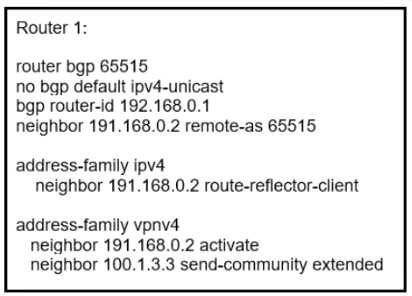
Router 1 is a route reflector client within a service provider core PE1 cannot see VPNv4 routes
received from the ASBR PE1 only has an iBGP relationship with Router 1. Which action resolves this
issue?
- A. Activate PE1 as a neighbor under the IPv4 address family.
- B. Configure Router 1 as a route reflector for PE1 under the VPNv4 address family.
- C. Configure PE1 to have an eBGP relationship with Router 1.
- D. Enable BGP default ipv4-unicast
Answer:
B
Question 3
An engineer noticed that PE3 is failing to accept IPv6 traffic information from PE1 The engineer
confirmed that both PE3 and PE1 routers are configured accurately with IPv6 protocol To eliminate
IPv6 traffic loss issue, which action must the engineer take to solve the problem?
- A. Disable 6PVE that provides local IPv6 reachability over MPLS.
- B. Configure 6PE that provides global IPv6 reachability over IPv4 MPLS
- C. Allow PE routers use the MP-iBGP extensions in the IPv6 network configuration to exchange IPv6 reachability information.
- D. Configure 6PE forwarding between 6PE routers based on the IPv6 header
Answer:
B
Question 4
What is a requirement to share VRF reachability information to all members of a VPN when using
IPv6?
- A. PE and CE routers must be running BGP as the PE-CE routing protocol
- B. PE routers must have MPLS disabled and be running MP-BGP between all P and PE routers.
- C. PE routers must be running MP-BGP and bgp default ipv4-unicast must be disabled
- D. All PEs must have the same VRFs configured.
Answer:
D
Question 5
Refer to the exhibit.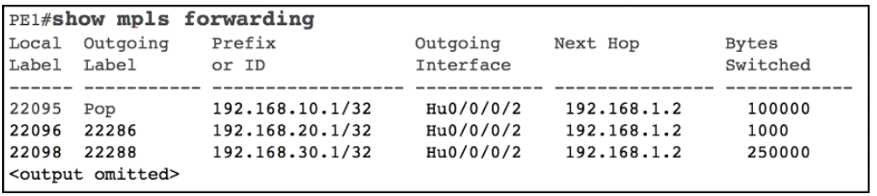
What is shown in this output?
- A. local and outgoing abels are updated in hardware
- B. BGP is used between neighbors that are exchanging MPLS labels
- C. LDP neighbor statuses
- D. the labels received and advertised on PE1
Answer:
D
Question 6
How does Layer 3 VPN traffic traverse an ISP network?
- A. Devices on the network use MPLS labels to share VPN routes between P routers in the network.
- B. Devices on the network use LSAs to share routes between P routers in the network.
- C. Devices on the network use MPLS labels to move VPN traffic through the network.
- D. Devices on the network use GRE tunnels to move traffic between VRFs.
Answer:
C
Question 7
Refer to the exhibit.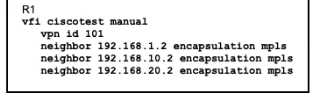
An organization is running H-VPLS on a network comprising four routers in a hub-and-spoke topology
with R1 as the hub An engineer added a new spoke with multiple VCs to the network, and now traffic
cannot flow properly How should the engineer update the configuration on R1 to correct the
problem?
- A. Disable spanning tree to allow loops to occur within the hub-and-spoke topology.
- B. Disable split horizon to allow multiple VCs per spoke
- C. Disable Cisco Discovery Protocol to allow MPLS to share labels between the designated spokes
- D. Disable Cisco Discovery Protocol to allow for neighbor discovery
Answer:
B
Question 8
Refer to the exhibit.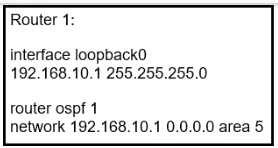
Refer to the exhibit Router 1 is a P router in the ISP MPLS core A connected P router cannot generate
an MPLS label for the router 1 loopback0 interface Which action resolves this issue?
- A. The loopback0 interface must be in OSPF area 0.
- B. The network statement under the routing process must have a wildcard mask of 0 0.0 255.
- C. The OSPF network type must be changed on loopback0 to point-to-point
- D. A static route to null 0 must be added for the loopback interface and then static routes must be redistributed into OSPF
Answer:
B
Question 9
Refer to the exhibit.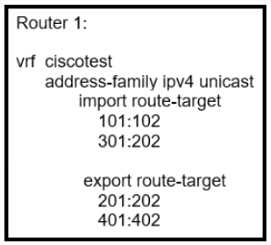
An engineer has configured router 1 to provide shared services to clients behind router 2. To
complete the implementation so that routes from router 1 are accepted, what must the engineer
configure on router 2?
- A. with import route targets 101:102 and 202:201
- B. with import route targets 201:202 and 401:402
- C. with export route targets 301:202 and 101:102
- D. with export route targets 201:202 and 401:402
Answer:
B
Question 10
How do PE routers exchange CE routes between remote sites?
- A. by converting CE routes into VPNv4 routes and exchanging them using MP-BGP
- B. by establishing BGP neighbor relationships between all connected CEs to exchange routing information
- C. by learning IPv4 routes from connected CEs and redistributing them into the global IGP
- D. by converting CE routes into VPNv4 routes and exchanging them using the global IGP
Answer:
A
Question 11
What do routers on the network use to avoid routing loops when OSPF is running as the PE-CE
routing protocol on a service provider network?
- A. the AS-Override feature
- B. the DN bit with type 3, 5, or 7 LSA
- C. the domain tag for type 2 LSA
- D. sham links to create a super backbone over the service provider network
Answer:
B
Question 12
Refer to the exhibit: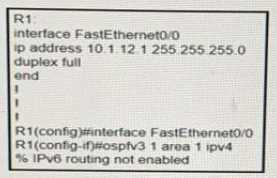
A network engineer is implementing an OSPF configuration Based on the output, which statement is
true?
- A. In the ospfv3 1 area 1 ipv4 command, area 0 must be configured instead of area 1.
- B. OSPFv3 does not run for IPv4 on FastEthemet0/0 until IPv6 routing is enabled on the router and IPv6 is enabled on interface Fastfc.thernet0/0
- C. OSPFv3 cannot be configured for IPv4; OSPFv3 works only for IPv6.
- D. IPv6 routing not enabled" is just an informational message and OSPFv3 runs for IPv4 on interface FastEthernet0/0 anyway
Answer:
B
Question 13
Which optional information can be included with an IPv6 ping to support the troubleshooting
process?
- A. IPv4 IP address
- B. source MAC address
- C. destination MAC address
- D. IPv6 hostname
Answer:
D
Explanation:
Reference:
https://www.cisco.com/c/en/us/td/docs/ios-xml/ios/ipv6/configuration/xe-3s/ipv6-xe-36s-book/ip6-mng-apps.html
Question 14
The network engineering group of a large ISP needs to harden the management plane of its Cisco
9000
Series ASRs. While addressing IPv6 ICMP issues, they realized they have to limit the rate at which
IPv6 ICMP error messages are sent out on the network. Which command do they need to apply?
- A. icmp ipv6 rate-limit unreachable 1000
- B. ipv6 rate-limit 1000
- C. icmp ipv4 rate-limit unreachable 1000
- D. ipv6 icmp error-interval 50 20
Answer:
D
Explanation:
Reference:
https://www.cisco.com/c/en/us/td/docs/ios-xml/ios/ipv6_basic/configuration/xe-3s/ip6b-xe-3s-book/ip6-icmp-rate-lmt-xe.html
Question 15
Refer to the exhibit.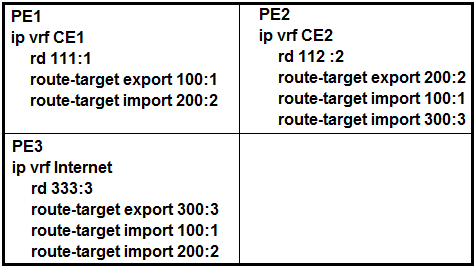
PE1 and PE2 are exchanging VPNv4 routes for CE1 and CE2, and PE3 contains the default route to the
internet. If the three devices are operating normally, which two conclusions describe this
configuration? (Choose two.)
- A. The CE1 and CE2 VRFs can exchange routes only between their respective VRFs on PE1 and PE2.
- B. All three routers must be running a distance-vector routing protocol.
- C. All three routers must be running MP-BGP.
- D. The CE1 and CE2 VRFs can access the default route provided by the Internet VRF.
- E. Only the CE2 VRF can access the default route provided by the Internet VRF.
Answer:
AC