cisco 300-510 Exam Questions
Questions for the 300-510 were updated on : Feb 18 ,2026
Page 1 out of 18. Viewing questions 1-15 out of 269
Question 1
Refer to the exhibit.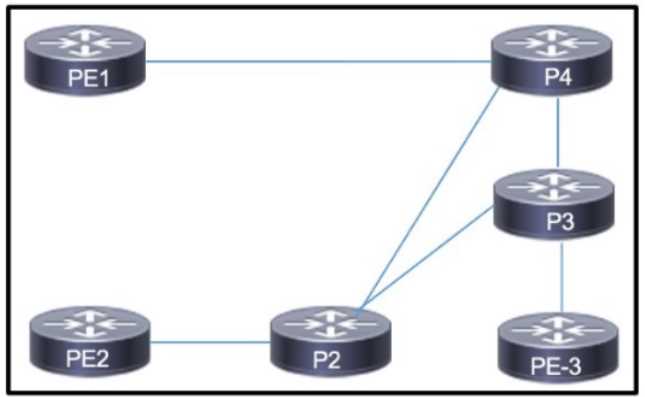
The service provider deployed segment routing in its core P2 is connected to P3 and P4 via a point-
to-multipoint link as shown The service provider provides connectivity for a large enterprise with
three main offices in different geographic regions Each office is connected via one of the three PEs
The enterprise wants to implement multicast traffic across the service provider to stream mission-
critical applications between sites The applications will be sourced from a server connected to the
network through PE2 Which action must the network-engineering team take so that multicast traffic
will flow between the enterprise sites over the point-to-multipoint link?
- A. Implement RSVP to reserve bandwidth on the link between PE2 and P2
- B. Implement PIM-DM to flood multicast traffic from the enterprise into the service provider core
- C. Implement MLDP to allow multicast traffic to flow within the single AS
- D. Implement SR Tree-SID to build a multicast replication tree over the point-to-multipoint link
Answer:
D
Question 2
The engineering team at ISP_1 must improve network stability time and minimize the impact of
routing instabilities from other domains to unicast transit services in the backbone R1 is part of an
OSPF- enabled network, and acts as an ASBR connected via interface GiO/1 to the external domain
The OSPF exponential backoff algorithm RFC 3623 with helper mode is already implemented on R1
Which additional configuration must the ISP_1 team apply to suppress routing instability for 3
minutes'?
- A. Configure ip ospf resync-timtout 180 under the Gi0'1 interface configuration
- B. Configure ip ospf timer nsf interval 3 under the global Gi0'1 interface configuration
- C. Configure nsf ittf restart-inttrval 180 under the global OSPF configuration
- D. Configure nsf ospf wait 3 under the global OSPF configuration
Answer:
A
Question 3
Refer to the exhibit.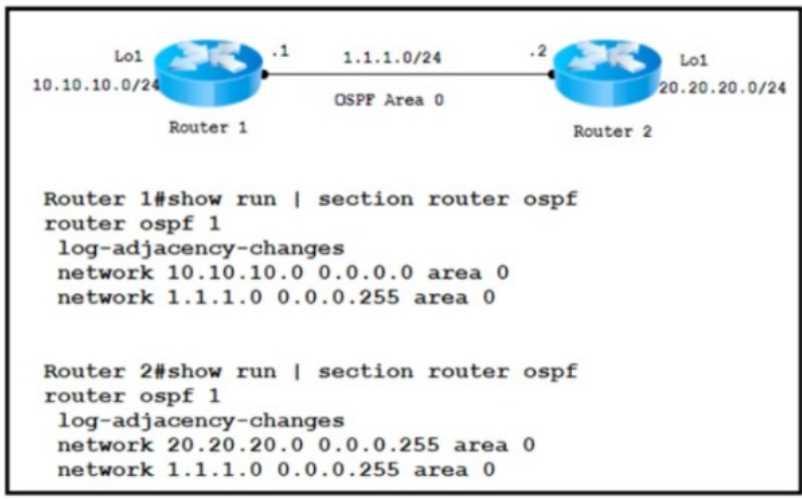
A network engineer at a large ISP with an employee ID 4876 94 052 started to configure OSPF on two
routers The engineer notices that router 1 learned about network 20 20 20 0/24 from router 2, but
router 2 did not learn about 10.10 10.0/24 from router 1 Layer 2 and Layer 3 connectivity are working
between the two routers and the physical connection between the devices is functioning. Which
action must the engineer take to resolve the issue?
- A. Replace the router 1 OSPF network configuration with network 10.10.10.0 0.0.0.255 area 0.
- B. On router 1 configure a route map with a distribution list for the 10 10.10 0/24 network.
- C. Replace the router 2 OSPF network configuration with network 10.10.10.0 0.0.0.255 area
- D. On router 2 configure a route map with a distribution list for the 101010 0/24 network
Answer:
A
Question 4
Which BGP well-known attributes are preserved between peers with a BGP confederation?
- A. origin and MED
- B. originator and origin
- C. next-hop and local-preference
- D. next-hop and weight
Answer:
C
Question 5
Which fact must a network architect consider when implementing IGMP in a multicast routing
environment?
- A. If SSM is in use IGMPv3 must be enabled
- B. If BISS support is required IGMPv2 must be enabled
- C. If leave latency is critical IGMPv3 must be enabled
- D. If PIM-DM is required, IGMPv2 must be enabled
Answer:
A
Question 6
RPL has several fundamental capabilities that differ from those present in configurations oriented to
traditional route maps Routing policy language introduces the notion of sets Which group of set
types is valid in RPL?
- A. acl-path-set community-set pre-community-set prefix-set and bgp-set
- B. as-path-set community-set. extcommunity-set prefix-set and rd-set
- C. access-control-set, community-set post-community-set pre-prefix-set and routed-set
- D. route-path-set, community-set in-community-set prefix-set and rd-set
Answer:
B
Question 7
What are two major differences between OSPF and IS-IS routing protocols? (Choose two.)
- A. OSPF uses IP protocol 89 foe encapsulation and IS-IS uses an IEEE 802 3 standard-based protocol foe encapsulation
- B. The OSPF default administrative distance is 115 and the default administrative distance for IS-IS is
- C. The OSPF DR role can be pre-empted only when the active DR goes down, but the IS-IS DR role can be taken by a router with higher priority at any time
- D. OSPF partially refreshes the LSA database every 30 minutes, and IS-IS refreshes the complete database table every 60 minutes
- E. An OSPF-enabled router is part of only one area but an IS-IS-enabled router is part of multiple areas
Answer:
A, C
Question 8
Refer to the exhibit.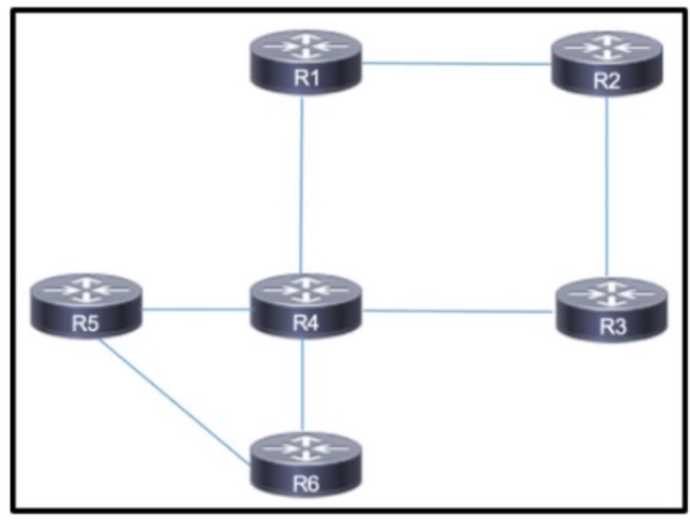
Early in the growth cycle of a small enterprise the network-engineering team implemented segment
routing to support automation of the IPv4 network As the network grew organically more devices
were added and the company migrated to SRv6 The company is now planning to significantly expand
the number of hosts connected to R2 and R6 which will require further path manipulation Which
action must the team take to customize the route that traffic takes between endpoints in the
network?
- A. Implement the flexible algorithm to customize the shortest path through the network
- B. Implement MLAG to reduce traffic load on heavily congested links
- C. Implement spanning-tree protocol to avoid loops between excess devices in the network
- D. Implement priority queuing to drop non-mission-critical traffic.
Answer:
A
Question 9
Refer to the exhibit.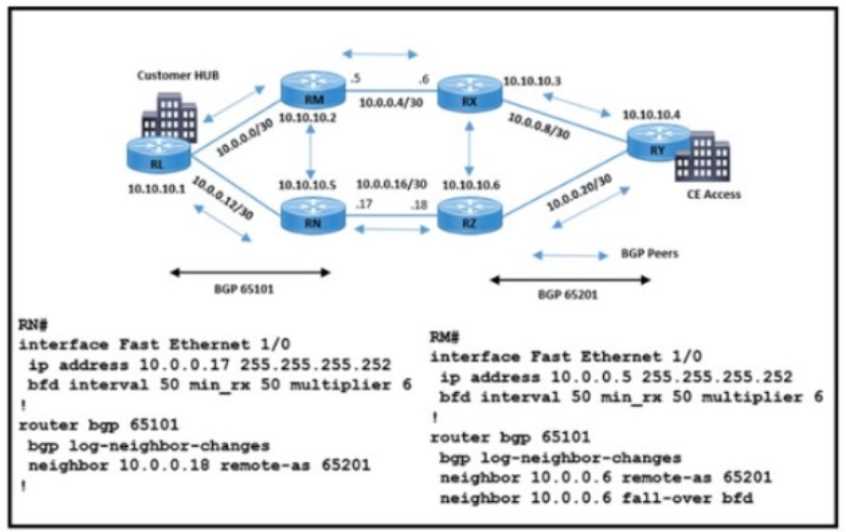
EBGP peering is up between BGP AS 65101 and BGP AS 65201 The service provider expects traffic
convergence within 300ms between the two autonomous systems but the network operations team
sees that route and traffic convergence is too slow Which two actions improve the convergence
time? (Choose two.)
- A. Change the bfd multiplier value to 3 on routers RN and RM
- B. Configure fall-over bfd under the BGP instance for BGP neighbors on RN
- C. Configure bfd interval 50 min_rx 100 multiplier 6 on the connected interfaces on RN and RM
- D. Configure bfd interval 50 min_rx 50 multiplier 6 on the connected interfaces on RL and RY
- E. Change the bfd interval value to 100ms on routers RN and RM
Answer:
A, E
Question 10
Refer to the exhibit.
AJI four routers on the network reside in the same data center The four routers are running IS-IS
between them in Level 1 mode within an IPv4 network After a network engineer installed several
new servers connected to R4, users connected via R1 reported they could not connect to applications
on the servers The engineer has determined that R4 is receiving routes from R3 but it is failing to
receive routes from R1 Which action must the engineer take to resolve the issue?
- A. Configure R3 only lo be a Level 1'Level 2 router.
- B. Configure R2 and R3 to be Level 1/Level 2 routers
- C. Configure R2 only to be a Level 2 router
- D. Configure R1 and R4 to be Level 2 routers
Answer:
B
Question 11
Refer to the exhibit.
The service provider provides IPv6 connectivity to large enterprise customers with offices spanning
several geographic regions SRv6 is running in the service provider core The service provider just
signed a contract with a new customer that is still running IPv4 The new customer needs connectivity
between its two sites connected via CE1 and CE2 and the internet Which action must the service
provider s network-engineering team take to provide connectivity across the SRv6 data plane?
- A. Encapsulate IPv4 traffic from the CEs on their respective PEs through a TE path between PE1 and PE2.
- B. Translate the IPv4 addresses to an IPv6 address on each CE
- C. Redistribute the IPv4 routes from CE2 and CE1 on their respective PEs
- D. Implement an NTP master and sync the timers on the P and PE routers
Answer:
A
Question 12
Refer to the exhibit.
A regional service provider provides connectivity for several midsize businesses that run mission-
critical applications between multiple offices connected via PE 1 and PE2 Links throughout the
service provider network are connected using shared resources and an SR-TE tunnel is in use to route
traffic over different paths depending on congestion policies The networking team must implement
SR updates to reduce downtime in the event of a link failure. Which action must the team take to
meet the requirements?
- A. Implement SRLG protection to identify a post-convergence backup path
- B. Implement BGP timers to support immediate reconvergence when the BGP neighbor relationship status changes.
- C. Implement targeted LDP neighbors to prevent unwanted LDP relationships from forming
- D. Implement VRFs to segment the network and avoid large-scale network outages when a link fails
Answer:
A
Question 13
Refer to the exhibit.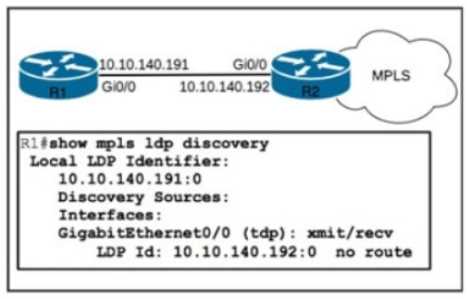
Routers R1 and R2 are RFC 5036-based MPLS-enabled core routers MPLS IP is enabled globally on
both routers OSPF with area 0 configuration is used as an interior routing protocol between the
routers After new services were enabled on the MPLS network, LDP connectivity failed on R1
TCP/UDP port 711 is confirmed to be open Which two actions must the engineer take to correct the
problem? (Choose two.)
- A. Configure network 10.10.140.192 0.0.0.0 arta 0 under the OSPF configuration on R2
- B. Configure mpls label protocol Idp under the Gi0/0 interface on R1
- C. Configure mpls ip under the Gi0'0 interface on R1
- D. Configure network 10.10.140.192 0.0.0.255 arta 0 under the OSPF configuration on R2
- E. Configure labtl mpls ip protocol tdp under the Gi0 0 interface on R1
Answer:
A, C
Question 14
Which type of policy does an IPv6 ISATAP tunnel support?
- A. policies that transmit Connectionless Network Service packets
- B. policies to transmit IPv6 traffic within a site
- C. policies to transmit IPv6 traffic over a point-to-point tunnel
- D. policies that require addresses to have a 2002 716 prefix
Answer:
B
Question 15
Refer to the exhibit.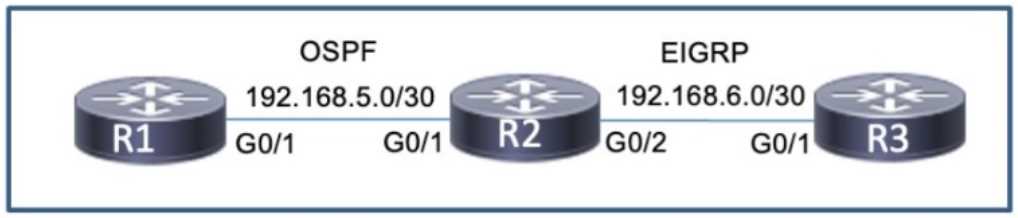
A company has been running OSPF and EIGRP on two separate portions of the network To allow
communication flow between these previously isolated parts of the business the networking team
just configured R2 to mutually redistribute routes between EIGRP and OSPF R3 has the OSPF routes
in its routing table but R1 is failing to receive EIGRP routes for the link between R2 and R3 Which
action must the team take to resolve the issue?
- A. Configure EIGRP on R1
- B. Configure the redistribution statement with the subnets keyword under the R2 OSPF configuration
- C. Configure a virtual link between R1 and R2 to handle traffic without an assigned area
- D. Configure R1 with a static route with the next hop set to R3 with the vrf keyword to avo»d the global routing table
Answer:
B