amazon AWS Certified AI Practitioner exam practice questions
Questions for the AIF-C01 were updated on : Mar 21 ,2026
Page 1 out of 15. Viewing questions 1-15 out of 224
Question 1
A company is deploying AI/ML models by using AWS services. The company wants to offer
transparency into the models' decision-making processes and provide explanations for the model
outputs.
- A. Amazon SageMaker Model Cards
- B. Amazon Rekognition
- C. Amazon Comprehend
- D. Amazon Lex
Answer:
A
Explanation:
Comprehensive and Detailed
Amazon SageMaker Model Cards document model details, performance, intended use cases, and
risk considerations. They support responsible AI by improving transparency and governance.
Rekognition is computer vision.
Comprehend is NLP for entity/sentiment.
Lex is conversational AI.
Reference:
AWS Documentation – SageMaker Model Cards
Question 2
A company wants to set up private access to Amazon Bedrock APIs from the company's AWS account.
The company also wants to protect its data from internet exposure.
- A. Use Amazon CloudFront to restrict access to the company's private content
- B. Use AWS Glue to set up data encryption across the company's data catalog
- C. Use AWS Lake Formation to manage centralized data governance and cross-account data sharing
- D. Use AWS PrivateLink to configure a private connection between the company's VPC and Amazon Bedrock
Answer:
D
Explanation:
Comprehensive and Detailed
AWS PrivateLink enables private connectivity between your VPC and supported AWS services (like
Amazon Bedrock) without sending traffic over the public internet.
CloudFront (A) is for CDN and content delivery, not private service connections.
AWS Glue (B) is for ETL/data catalog, not networking.
Lake Formation (C) provides governance for data lakes, not API network isolation.
Reference:
AWS Documentation – Access Amazon Bedrock with PrivateLink
Question 3
HOTSPOT
A company wants to improve multiple ML models.
Select the correct technique from the following list of use cases. Each technique should be selected
one time or not at all. (Select THREE.)
Few-shot learning
Fine-tuning
Retrieval Augmented Generation (RAG)
Zero-shot learning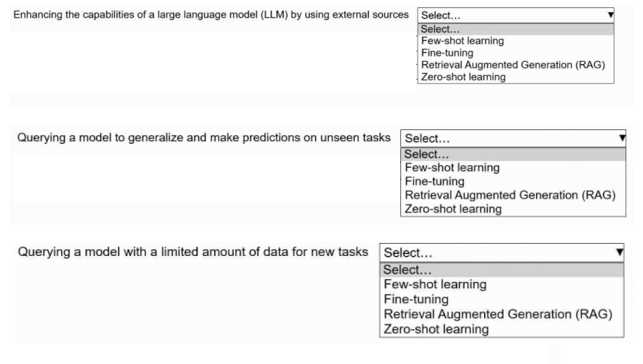
Answer:
None
Explanation:
AWS Reference:
Amazon Bedrock – Retrieval Augmented Generation (RAG)
AWS Generative AI Guide – Zero-shot & Few-shot learning
Question 4
A media streaming platform wants to provide movie recommendations to users based on the users'
account history.
- A. Amazon Polly
- B. Amazon Comprehend
- C. Amazon Transcribe
- D. Amazon Personalize
Answer:
D
Explanation:
Comprehensive and Detailed
Amazon Personalize is a fully managed ML service for personalized recommendations (movies,
products, music, etc.) based on user behavior and history.
Polly converts text to lifelike speech.
Comprehend performs NLP tasks like sentiment analysis.
Transcribe is speech-to-text.
Reference:
AWS Documentation – Amazon Personalize
Question 5
A company is creating a model to label credit card transactions. The company has a large volume of
sample transaction data to train the model. Most of the transaction data is unlabeled. The data does
not contain confidential information. The company needs to obtain labeled sample data to fine-tune
the model.
- A. Run batch inference jobs on the unlabeled data
- B. Run an Amazon SageMaker AI training job that uses the PyTorch Distributed library to label data
- C. Use an Amazon SageMaker Ground Truth labeling job with Amazon Mechanical Turk workers
- D. Use an optical character recognition model trained on labeled samples to label unlabeled samples
- E. Run an Amazon SageMaker AI labeling job
Answer:
C
Explanation:
Comprehensive and Detailed
Amazon SageMaker Ground Truth lets you create data labeling jobs and can integrate with Amazon
Mechanical Turk (a distributed human workforce) to label large unlabeled datasets.
A (batch inference) applies models to already-trained data, not labeling.
B (PyTorch Distributed) is for distributed training, not labeling.
D (OCR) applies only to text extraction from images, not transactions.
E is incorrect; Ground Truth is the service for labeling, not "AI labeling job."
Reference:
AWS Documentation – SageMaker Ground Truth
Question 6
Which statement presents an advantage of using Retrieval Augmented Generation (RAG) for natural
language processing (NLP) tasks?
- A. RAG can use external knowledge sources to generate more accurate and informative responses
- B. RAG is designed to improve the speed of language model training
- C. RAG is primarily used for speech recognition tasks
- D. RAG is a technique for data augmentation in computer vision tasks
Answer:
A
Explanation:
Comprehensive and Detailed
Retrieval-Augmented Generation (RAG) integrates external knowledge sources (databases, vector
stores, document repositories) with LLMs, enabling them to generate contextually accurate and up-
to-date responses without retraining.
B is incorrect: RAG does not speed up training; it improves inference results.
C is incorrect: speech recognition is not an RAG use case.
D is incorrect: computer vision augmentation is unrelated to RAG.
Reference:
AWS Documentation – Knowledge Bases for RAG in Amazon Bedrock
Question 7
HOTSPOT
An ecommerce company is developing a generative Al solution to create personalized product
recommendations for its application users. The company wants to track how effectively the Al
solution increases product sales and user engagement in the application.
Select the correct business metric from the following list for each business goal. Each business metric
should be selected one time. (Select THREE.)
Average order value (AOV)
Click-through rate (CTR)
Retention rate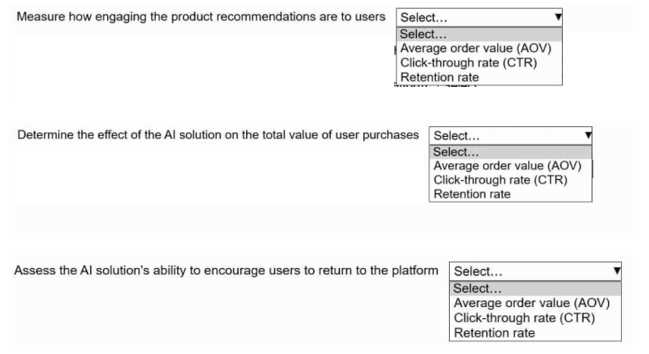
Answer:
None
Explanation:
Amazon Personalize – Evaluating recommendation effectiveness
AWS ML Business Metrics
Question 8
A company wants to use AI to protect its application from threats. The AI solution needs to check if
an IP address is from a suspicious source.
- A. Build a speech recognition system
- B. Create a natural language processing (NLP) named entity recognition system
- C. Develop an anomaly detection system
- D. Create a fraud forecasting system
Answer:
C
Explanation:
Comprehensive and Detailed
Anomaly detection identifies unusual behavior (such as suspicious IP traffic) compared to normal
baselines.
Speech recognition (A) is irrelevant.
NER in NLP (B) extracts entities from text, not detect malicious IPs.
Fraud forecasting (D) predicts fraudulent transactions but not directly suspicious IP activity.
Reference:
AWS Documentation – Anomaly Detection
Question 9
A financial company uses a generative AI model to assign credit limits to new customers. The
company wants to make the decision-making process of the model more transparent to its
customers.
- A. Use a rule-based system instead of an ML model
- B. Apply explainable AI techniques to show customers which factors influenced the model's decision
- C. Develop an interactive UI for customers and provide clear technical explanations about the system
- D. Increase the accuracy of the model to reduce the need for transparency
Answer:
B
Explanation:
Comprehensive and Detailed
Explainable AI (XAI) techniques such as SHAP (SHapley values) or feature attribution provide
transparency by showing which input factors influenced decisions.
A is not scalable for complex use cases.
C does not guarantee real interpretability.
D ignores the regulatory need for explainability.
Reference:
AWS SageMaker Clarify – Explainable AI
Question 10
A food service company wants to collect a dataset to predict customer food preferences. The
company wants to ensure that the food preferences of all demographics are included in the data.
- A. Accuracy
- B. Diversity
- C. Recency bias
- D. Reliability
Answer:
B
Explanation:
Comprehensive and Detailed
Diversity in datasets ensures representation of all demographics, reducing bias and improving
fairness.
Accuracy is model performance.
Recency bias skews towards recent data.
Reliability measures consistency of results, not representation.
Reference:
AWS Responsible AI Guidelines – Data Diversity
Question 11
What does inference refer to in the context of AI?
- A. The process of creating new AI algorithms
- B. The use of a trained model to make predictions or decisions on unseen data
- C. The process of combining multiple AI models into one model
- D. The method of collecting training data for AI systems
Answer:
B
Explanation:
Comprehensive and Detailed
Inference = applying a trained ML model to new, unseen data to make predictions, classifications, or
generate outputs.
A is algorithm research, C refers to ensemble learning, D is data collection.
Reference:
AWS ML Glossary – Inference
Question 12
A company wants to extract key insights from large policy documents to increase employee
efficiency.
- A. Regression
- B. Clustering
- C. Summarization
- D. Classification
Answer:
C
Explanation:
Comprehensive and Detailed
Summarization is a natural language processing (NLP) task that condenses long documents into
concise, meaningful summaries while retaining the key information.
Regression predicts numerical values.
Clustering groups similar items.
Classification assigns data into predefined categories.
Reference:
AWS NLP Use Cases – Summarization
Question 13
Which option is an example of unsupervised learning?
- A. Clustering data points into groups based on their similarity
- B. Training a model to recognize images of animals
- C. Predicting the price of a house based on the house's features
- D. Generating human-like text based on a given prompt
Answer:
A
Explanation:
Comprehensive and Detailed
Unsupervised learning involves discovering hidden patterns without labeled data. Example:
clustering.
Image recognition (B) is supervised learning.
House price prediction (C) is regression (supervised).
Question 14
A company wants to use Amazon Bedrock. The company needs to review which security aspects the
company is responsible for when using Amazon Bedrock.
- A. Patching and updating the versions of Amazon Bedrock
- B. Protecting the infrastructure that hosts Amazon Bedrock
- C. Securing the company's data in transit and at rest
- D. Provisioning Amazon Bedrock within the company network
Answer:
C
Explanation:
Comprehensive and Detailed
With Amazon Bedrock, AWS handles infrastructure security and patching (shared responsibility
model).
Customers are responsible for securing their data (encryption, IAM, policies) both in transit and at
rest.
Provisioning infrastructure (D) and platform patching (A, B) are AWS responsibilities.
Reference:
AWS Shared Responsibility Model
Question 15
A company is exploring Amazon Nova models in Amazon Bedrock. The company needs a multimodal
model that supports multiple languages.
- A. Nova Lite
- B. Nova Pro
- C. Nova Canvas
- D. Nova Reel
Answer:
B
Explanation:
Comprehensive and Detailed
Amazon Nova Pro is a multimodal foundation model in Amazon Bedrock that supports text, images,
and multiple languages.
Nova Lite is optimized for lightweight, faster inference at lower cost.
Nova Canvas is a creative tool for visual design.
Nova Reel is optimized for video-related use cases.
Reference:
AWS Documentation – Amazon Nova Models